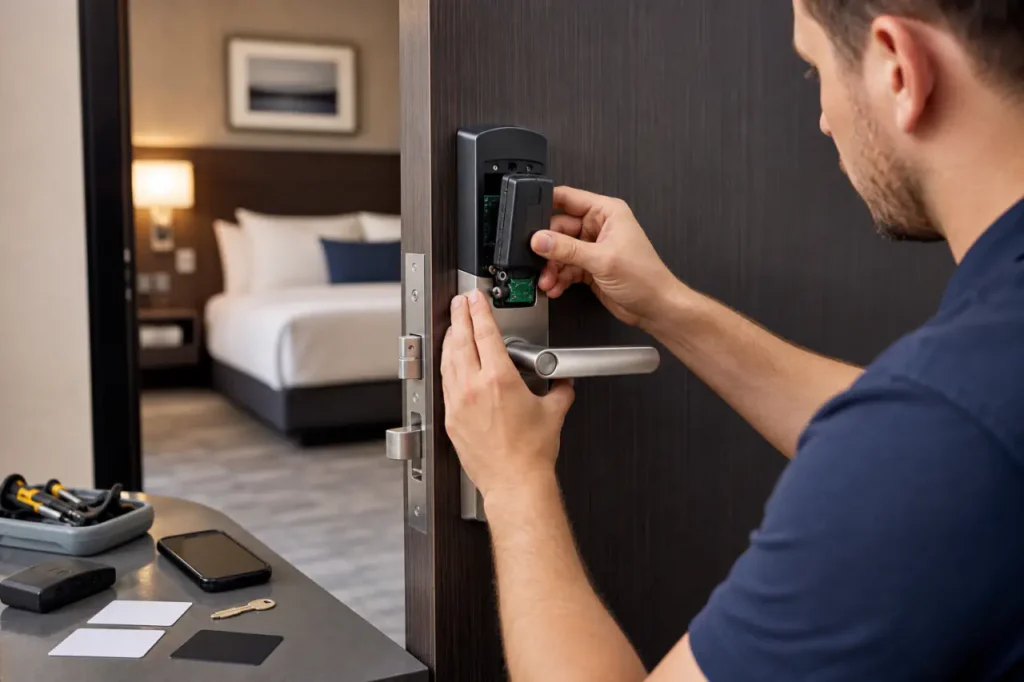
Comparing Hotel Lock Access Technologies
Three access credential formats now dominate commercial lodging: encrypted RFID key cards, Bluetooth Low Energy (BLE) mobile keys, and keypad PIN codes.
BLE mobile access is the fastest-growing standard for new luxury builds, but RFID still delivers the most predictable TCO for a 60-150 room midscale retrofit. The wrong choice locks a property into unnecessary licensing fees or forces a second upgrade 3-5 years later.
Avoid magnetic stripe technology entirely for new procurement. It lacks encryption, is trivially cloned, and is no longer supported by major PMS platforms.
Table 1: Access Technology Comparison
| Technology | Upfront Cost (per lock) | Ongoing Cost | Guest Convenience | Security Level | Ideal Property Type |
|---|---|---|---|---|---|
| RFID (MIFARE/Proximity) | $150-$350 | Low (cards ~$0.30-$1.50 each) | Moderate; card required | High (encrypted sector) | Midscale, extended-stay, retrofit |
| BLE Mobile Key | $300-$600 | Medium-High (app license, gateway nodes) | Very high; phone-based, web-link check-in | High (rotating token) | New-build luxury, boutique, select-service |
| Keypad PIN Code | $80-$200 | Very low | Low; guest must memorize code | Moderate (code sharing risk) | Budget motels, staff doors, back-of-house |
Which column changes the per-door quote most: ongoing cost. RFID hardware is cheaper, but switch to BLE and you’ll add gateway controllers every 10-15 rooms and a recurring cloud license. A 100-room property can see a $6,000-$12,000 annual difference between the two models.
RFID Key Card Systems (MIFARE/Proximity)
MIFARE Classic and MIFARE DESFire EV1/EV2 cards remain the workhorse of hospitality access control. The encrypted chip sector resists cloning, and the lock’s internal audit log captures every card presentation.
RFID hotel door lock systems from Gove support plug-in modular BLE upgrades, so a property can move to mobile keys later without replacing the lock body.
One verification point: ask the supplier whether the RFID reader uses an open format (ISO 14443) or a proprietary variant. Open format means you can source cards from multiple vendors, keeping consumable cost in check.
Bluetooth Low Energy (BLE) Mobile Keys
BLE mobile access lets guests receive a digital key via the hotel app, a web-link SMS, or a brand-agnostic wallet pass.
The lock communicates with the guest’s phone directly, eliminating the front desk for express check-in. BLE mobile access works well in properties where contactless flow and reduced front desk labor are business goals.
The procurement mistake is assuming a guest will always download a hotel app. Properties using web-link delivery (no app required) see 22-35% higher adoption, according to multiple PMS integration reports.
Ask the lock manufacturer whether credential delivery via browser-based guest portal is supported without native app dependency.
Keypad and PIN Code Configurations
For back-of-house areas, housekeeping pantries, and service corridors, a simple keypad lock can remove the cost of issuing cards to rotating shift staff. Temporary and one-time codes are managed through the same lock management software that handles guest keys.
Security drops when staff write codes on sticky notes or share them over group chat. Require a lock with a real-time audit trail that timestamps every code entry and links it to an individual user ID in the system.
Mechanical Standards and Security Certifications
Commercial lodging doors experience 15-30 cycles per day per room, over 10,000 cycles per year. The mechanical lock body must survive that without sagging or latch failure.
ANSI/BHMA Grade 1 security certification is the procurement floor, not a nice-to-have. Insurance carriers and fire marshals will ask for the lock’s UL fire rating and ANSI grade during building inspections.
A lock with a weak ANSI grade forces premature maintenance spend. Hardware that passes 800,000 open-close cycles only lasts about 4-5 years at a busy property, triggering an avoidable mid-cycle replacement.
Table 2: ANSI/BHMA Grades for Lodging
| ANSI Grade | Typical Use | Cycle Testing Minimum | Impact Resistance | Lock Body Strength | Suitable for Guest Rooms |
|---|---|---|---|---|---|
| Grade 1 | Heavy commercial, hotel, high-traffic | 800,000+ cycles | High (10 strikes) | Reinforced mortise or thick latch | Yes – procurement requirement |
| Grade 2 | Light commercial, interior office | 400,000 cycles | Moderate | Standard cylindrical or tubular | No – fails under guest room load |
| Grade 3 | Residential only | 200,000 cycles | Low | Cheap alloy body | Never – immediate liability |
Understanding ANSI/BHMA Grade 1 Requirements
Grade 1 is not a paper claim. Verify that the lock model carries a current certification certificate from an accredited lab (UL, Intertek, or similar).
The specification sheet should show the cycle count, latch throw length (minimum ½ inch), and the strike plate reinforcement.
A mortise lock body with a 1-inch deadbolt throw is the gold standard for guest room entry doors.
For retrofit projects, a mortise lock retrofit option that matches the existing door prep saves significant carpentry labor. Confirm the lock’s mortise dimensions (usually 86 mm x 32 mm x 3 mm) against your site survey before ordering.
Fire Safety and ADA Compliance
Any lock on a fire-rated door must have a UL 10C or UL 10B listing matched to the door assembly.
If the door carries a 3-hour fire rating, the lock must be tested with that specific door and frame combination. The supplier must provide a UL fire-rating compliance letter, not just product literature.
ADA compliance involves the operable part: a lever handle with 5 lb or less operating force, not a knob. The lock must allow one-hand operation without tight grasping or twisting.
Gove supplies lever options that return toward the door to prevent catching clothing, meeting the ADA operable part standard.
PMS Integration and Access Management Software
A lock that cannot receive check-in/check-out events from the PMS adds 5-7 seconds of manual encoding per guest at the front desk. That small lag turns into a 45-minute queue at peak check-in.
Certified API integration with your property management system is the real vetting question, not just whether the lock reads a card.
Verify that the lock manufacturer’s software has a prebuilt connector for your specific PMS (Oracle Opera, Cloudbeds, Mews, Maestro, etc.).
A generic middleware adds latency, and any PMS upgrade can break the integration if it’s not certified. Property management system integration should be a go/no-go line in the RFQ.
Cloud-Based vs. On-Premise Servers
Cloud-hosted access management means the front desk only needs a browser, no local server. Real-time alerts for door ajar, low battery, and forced entry appear on a central dashboard.
The downside: a network outage blocks remote audits and key issuance, so the lock must continue to function in standalone mode.
On-premise servers put you in control of data and latency, but you carry the IT maintenance burden. Many mid-sized properties now choose a cloud solution with offline caching at the lock level.
Ask the supplier: “During a cloud outage, how many hours can the lock issue new keys locally?” A good answer is 24-48 hours via encrypted front desk programmer.
API Compatibility with Leading PMS Platforms
Ask for a list of certified PMS integrations, not just “works with.” The integration should support automatic key creation, key revocation, and group check-in (tour bus mode), where a single credential opens multiple assigned rooms.
The software should also support hotel lock audit trails that tie each access event to a PMS reservation record.
Request a sample API documentation PDF before including a lock brand in your shortlist. If the documentation is thin, the integration likely depends on a brittle middleware layer that will break during a major PMS upgrade.
Hardware Durability and Ongoing Maintenance
Coastal resort locks fail 2-3 years earlier than inland properties if the finish isn’t salt-spray tested.
The lock’s escutcheon, screws, and internal spring cassette must survive ASTM B117 salt spray for at least 96 hours without corrosion.
Specify marine-grade 316 stainless steel or a multi-layer PVD finish for properties within 2 miles of salt water.
For interior corridor hotels, standard brushed nickel or satin chrome finishes hold up well. The bigger maintenance variable is the battery type.
A lock that uses 4 AA alkaline cells in a sealed compartment is far more field-serviceable than a proprietary lithium pack that only the manufacturer stocks.
Battery Life Management
Expect 12-18 months of battery life under 20-30 lock operations per day.
The lock must send a low-battery alert to the management dashboard at least 60 days before the battery dies, giving maintenance a window to swap.
Some systems also illuminate a low-battery LED on the reader face.
What kills battery life fast: a lock that maintains a constant BLE advertising signal instead of waking on tap.
Ask the supplier about the BLE sleep-wake algorithm and whether battery drain increases when the lock is in range of many guest phones (e.g., near a pool deck).
Environmental Resistance (Coastal vs. Inland)
Outdoor corridor properties in high-humidity regions need an IP55 rating on the outdoor face of the lock.
Check the warranty terms for corrosion damage; some manufacturers void the warranty if the lock is installed within 1,000 feet of salt water unless a specific coastal finish was ordered.
For mountain resorts, the lock’s operating temperature range should cover -20°F to 130°F to handle freeze-thaw cycles without condensation damaging the PCB. Ask for environmental test reports instead of datasheet claims.
Emergency Override Mechanisms
Every electronic hotel lock must carry a mechanical key override cylinder, typically a mortise cylinder with a restricted keyway that the manufacturer controls.
In a complete battery failure or circuit board fault, the mechanical key opens the door, and the lock’s internal event log records the mechanical override event with a timestamp.
Some systems also offer an external power jump via a programming device that temporarily powers the lock through the contact pads, bypassing the dead battery. This dual-failsafe approach keeps a lock operable without drilling the door.
Calculating Total Cost of Ownership (TCO)
Unit price per lock is a misleading benchmark. A cheaper lock that ships without the PMS integration module or forces you to buy the manufacturer’s proprietary cards can double the 5-year TCO. Calculate TCO over 7 years, the typical hotel renovation cycle.
At minimum, build your TCO model with five line items: lock hardware (including finish upgrades), labor for installation (mortise retrofit vs. fresh bore), annual software license per door, credential media (cards or mobile token fees), and an estimated battery replacement cadence plus staff time.
Upfront Hardware and Installation Costs
A new-build door preparation runs $80-$150 per door for the mortise pocket.
Retrofitting a legacy cylindrical door to a full mortise lock may cost $250-$400 per door because the carpenter must enlarge the edge bore and install a new strike plate with reinforcement.
Many midscale hotels reduce cost by choosing a tubular latch RFID lock that fits the existing door prep, but that limits future ANSI grade and BLE upgrade path.
When comparing quotes, separate the hardware line item from the labor line item so you can negotiate installation contracts independently. Request a door schedule template from the supplier and fill it out before asking for labor quotes.
Software Licensing and Credential Fees
Cloud-based access management typically charges a per-door, per-month fee ($2-$6 is common for small properties, scaling down for 200+ doors). This fee usually includes API upgrades, support, and feature updates.
On-premise licenses often have a higher upfront fee but lower ongoing cost, but you must factor in SQL server licensing and IT support hours.
RFID card cost adds $0.70-$1.20 per card in bulk, and a 100-room hotel issuing cards from a common pool can burn through 5,000-8,000 cards per year including lost and damaged.
BLE mobile reduces card spend but adds a per-user token cost in some cloud platforms. Ask the vendor for a 3-year credential cost projection based on your occupancy rate.
Procurement Preparation and Vendor Selection
You can shorten the quote-to-install timeline by 4-6 weeks if you collect the right door data before engaging suppliers.
What to look for in RFID hotel locks is mostly about matching the lock body to the existing door prep and confirming the software integration list.
Walk through this checklist before sending an RFQ to any manufacturer or distributor.
- Document total door count and categorize: guest room, suite, staff entry, back-of-house, public restroom.
- Measure door thickness (1-3/4″ is standard for commercial). Record if any doors are over 2-1/4″ thick.
- Photograph the existing lock and edge bore. Note if the current prep is mortise, cylindrical, or tubular.
- Identify the fire rating label on each door leaf and frame. List the UL rating required per door.
- Confirm the desired lock finish (satin chrome, polished brass, black PVD) and whether marine-grade protection is needed.
- List the PMS platforms used and the version number (e.g., Oracle Opera v5.5).
- Define network topology: hardwired PoE, Wi-Fi, or Z-Wave mesh? Provide building floor plans with network drop locations for BLE gateways if planning mobile keys.
- State the expected check-in volume (peak occupants per hour) to size the number of front desk encoders and portable programmers.
- Request hardware sample units, finish swatches, and API documentation as part of the RFQ response; many suppliers will ship 2-3 sample locks at no cost for a qualified project.
After shortlisting suppliers, ask for a reference hotel of similar size and climate that has used the system for at least 18 months.
Visit if possible, or request a video call with the chief engineer. The real-world battery life and maintenance feedback will outweigh any spec sheet promise.
When you’re ready to move to quotes, explore Gove commercial lock solutions built to ANSI Grade 1 and tested for continuous hospitality use; our engineering team can help you finalize the door schedule and provide sample units for your evaluation.
Frequently Asked Questions
How do hotel door locks work during a power outage?
Most electronic hotel locks are battery-operated and do not rely on building power. They continue to read and validate RFID cards or BLE tokens using an internal clock and local database.
Audit trails are stored in onboard memory and upload automatically when the network reconnects. The building’s main power failure does not affect door access.
Can legacy RFID hotel locks be upgraded to mobile BLE keys?
Yes, if the lock has a modular architecture. Major brands, including Gove, offer BLE antenna modules that install inside the existing RFID lock housing, replacing the card reader cover.
This avoids full lock body replacement and cuts retrofit cost by 60-70% compared to swapping the entire lock. Verify that the lock’s firmware can accept the BLE module without a board swap.
What happens if a hotel lock battery dies completely?
Every Grade 1 commercial lock has a dual-failsafe design. The mechanical override cylinder allows any authorized staff key to open the door regardless of battery state, and the lock logs the event.
Additionally, many systems include an external power jump point: a handheld programmer touches contact pads on the lock face to provide temporary power for motor operation.
This prevents guest lockouts even if the battery fails during a stay.