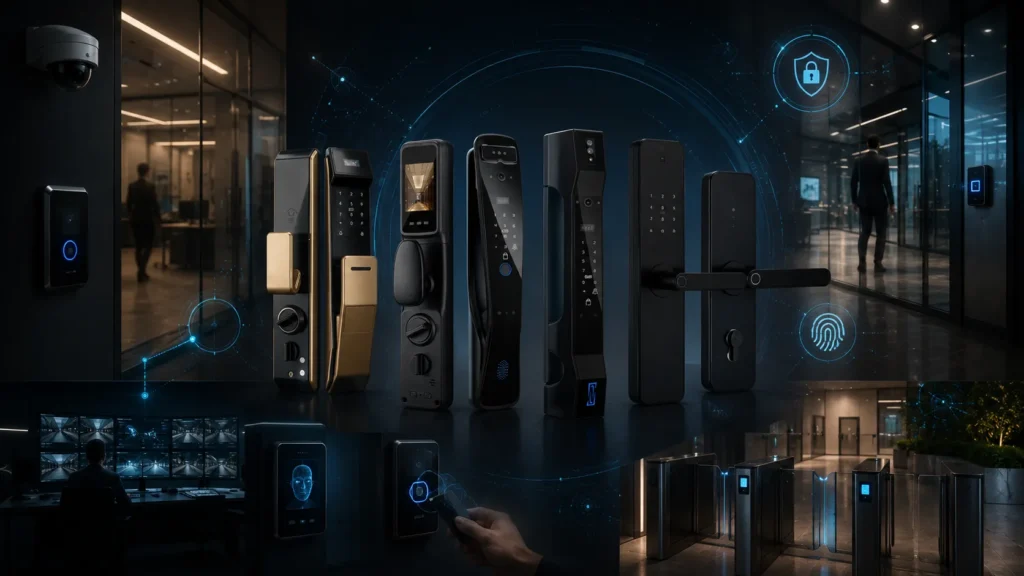
At 2:14 AM, an unauthorized entry triggers a silent alarm. Security reviews the camera feed, but because the access control system is siloed, it takes 12 minutes to correlate the badge event with the video—enough time for a data thief to walk out. This is the costly gap that access control integration closes. By converging access events with video, identity, and building systems, modern PoE access control systems and electronic access control systems create a single pane of glass that eliminates blind spots and delays.
The Value of a Unified Security Ecosystem
Moving from disjointed hardware to a converged ecosystem—where access events become a data source for the entire facility—delivers measurable operational and financial returns. A reliable door access control system provides the foundation.
- Improved Security Posture: Correlating access logs with video footage in a Video Management System (VMS) eliminates “shadow” entries and provides visual verification of every credential swipe. This integration, often managed by a Systems Integrator, ensures that security staff can retrieve a unified timeline instead of toggling between separate consoles.
- Operational Efficiency: Automated workflows replace manual data entry. For example, when an employee badge is deactivated in Active Directory (AD), the access control system instantly revokes physical access, cutting the offboarding process from hours to seconds.
- Cost-Efficiency: Through Building Management Systems (BMS) integration, occupancy data from badge readers can adjust HVAC and lighting schedules automatically. This reduces utility overhead while extending the lifespan of equipment.
Mapping Common Access Control Integration Types
Integrations are typically categorized by the system they connect to. For example, alarm panel integration often requires access control panels for integration that can interpret zone states and trigger door locks.
| Integration Type | Function | Key Security Benefit |
|---|---|---|
| Video (VMS) | Links access events with recorded video clips; enables visual verification and real-time alarm pop-ups. | Reduces investigation time from hours to minutes; provides evidence-quality footage tied to specific badge IDs. |
| IT/Identity (Active Directory, SSO, IAM) | Synchronizes employee status across HR and physical access databases; automates onboarding/offboarding. | Eliminates “ghost user” vulnerabilities when employees leave; simplifies Identity and Access Management (IAM) audits. |
| Alarm & Intrusion | Triggers lockdowns or door releases based on alarm panel states; arms/disarms zones via badge enrollment. | Accelerates emergency response by automating physical barriers during a breach. |
| Building Management (BMS) | Shares occupancy data with HVAC, lighting, and elevator systems for energy optimization and life safety. | Lowers operational costs and supports environmental compliance reporting. |
Integration capabilities depend on hardware and API versions; verify with your manufacturer and integrator that required protocol drivers (e.g., BACnet for BMS) are supported.
Technical Architecture: Hardware-Level vs. Software-Level Integration
The method of communication—software-level data exchange via APIs versus hardware-level signaling through physical connections—determines how scalable and secure the ecosystem will be.
| Aspect | Software-Level (API & Cloud) | Hardware-Level (Relays, OSDP, Wiegand) |
|---|---|---|
| Communication | HTTPS/REST APIs, Webhooks, or Cloud-to-Cloud sync | Dry contact relays, Wiegand data lines, OSDP via RS-485 |
| Scalability | Highly scalable; cloud-native updates enable rapid deployment | Limited by physical wiring; expanding requires additional cabling and controller ports |
| Security & Encryption | TLS 1.2+ encryption, OAuth 2.0 authentication; supports Single Sign-On (SSO) | Wiegand transmits unencrypted data; OSDP (Open Supervised Device Protocol) offers AES-128 encryption and bidirectional communication |
| Use Case Example | CRM-driven access for co-working spaces; HR system deactivation triggers | Failsafe door release during fire alarm; basic camera recording toggle on unlock |
Hardware-level integration with legacy Wiegand readers may require migration to OSDP for encrypted communication. Consult your integrator about cabling requirements before committing to a protocol.
Software-Level (API & Cloud-to-Cloud)
Modern REST APIs allow for custom triggers that turn access events into workflow actions. A co-working space, for instance, can provision a door credential automatically when a membership is purchased in a CRM. Cloud-to-cloud sync between the access platform and IAM providers like Okta or Azure AD eliminates duplicate user databases, while Webhooks enable real-time push notifications for incident reporting automation. Edge architectures, such as edge controller architecture for VMS integration, process these API calls locally, reducing cloud dependency and latency.
Hardware-Level (PoE & Physical Relays)
Hardware integration remains essential for life-safety functions and environments where network segmentation prohibits open API ports. PoE (Power over Ethernet) locksets simplify infrastructure by delivering both power and data over a single cable, making them ideal for integrated video/access door setups. The shift from Wiegand to OSDP (Open Supervised Device Protocol) is critical for modern installations because OSDP supports bidirectional encrypted communication, reader tamper detection, and remote firmware updates—something legacy Wiegand wiring can never provide.
Bridging Physical and Logical Security: HR and IT Identity Syncing
Automated identity management is the most impactful form of access control integration, directly linking human resources processes to physical access. When an employee is terminated in the HR system, their badge must be deactivated immediately—not after a manual ticket is processed hours later. Enterprise access control solutions provide native connectors for such workflows.
- Directory Syncing with Active Directory and Okta: By mapping user attributes from Active Directory (AD) or cloud identity providers to access groups, changes in employment status propagate to door controllers in real time. This eliminates the risk of an ex-employee still holding a valid badge.
- Visitor Management Automation: Integrating a Visitor Management System with access control allows temporary mobile credentials to be issued automatically upon check-in, and revoked when the visit ends. This removes the security gap of lost paper badges.
- Compliance and Auditing: Unified logs that merge physical access events with IT usage records streamline SOC2, HIPAA, and ISO 27001 audits. A single query can reveal precisely who accessed a sensitive area and when, with no data stitching required.
The Strategic Role of the Systems Integrator
Access control integration is not a plug-and-play feature. It demands a strategic design phase led by a certified Systems Integrator who understands both physical security and IT networking. Their role goes far beyond wiring panels; they must assess the entire ecosystem’s readiness.
- Perform site surveys to evaluate network bandwidth, cabling paths, and potential interference for IP-based devices.
- Design the integration architecture: choosing between cloud gateways, on-premise middleware, or edge controllers to bridge legacy systems with modern commercial access control locks for BMS integration.
- Develop and test custom API scripts or driver configurations to ensure that event triggers fire correctly between disparate systems.
Engage an integrator early to avoid costly retrofits when a new system won’t talk to an old one.
Technical Checklist for Integrated System Selection
Before investing in a new access control platform, verify that the manufacturer’s architecture supports true integration, not just basic relay outputs. Use this checklist as a vendor evaluation tool:
- Open API and SDK availability: Does the manufacturer provide a documented REST API with live sandbox environment and Webhooks? A closed system will require costly middleware.
- Mobile-first architecture: Are mobile credentials and remote management natively supported without third-party bridges? Smart lock suppliers for integrators should demonstrate mobile SDKs for tenant apps.
- Multi-cloud and on-premise support: Can the system operate in a hybrid environment? Verify AWS, Azure, and GCP hosting options meet your data residency requirements.
- Encryption standards: Confirm AES-256 encryption for data at rest and TLS 1.3 for data in transit. For hardware, insist on OSDP Secure Channel communication instead of legacy Wiegand.
- Backward compatibility with legacy cabling: Can the new controllers accept Wiegand reader wiring while providing an upgrade path to OSDP? This protects sunk infrastructure costs.
- Scalability and licensing model: Determine if the system can scale from 10 to 1,000 doors without a forklift upgrade, and whether the licensing model is per-door, per-user, or unlimited.
Future-Proofing Your Security Infrastructure
The future of access control integration lies in AI-driven anomaly detection and completely mobile-first environments. As access events become data-rich, machine learning algorithms will correlate unusual entry patterns—such as an employee badge swiping into two geographically distant offices within minutes—and automatically trigger lockdowns or alert security via Physical Security Information Management (PSIM). The convergence of cybersecurity and physical security departments is already happening, requiring access control to serve as a sensor network feeding risk analytics platforms. We are moving toward a state where a single credential on a smartphone can seamlessly operate across all building systems while being continuously vetted against threat intelligence feeds.
Request a System Architecture Audit
Transitioning from siloed, legacy hardware to a fully integrated ecosystem is not a rip-and-replace project. It begins with a rigorous assessment of your current IT back-end, network topology, and existing access control hardware. Our engineers work alongside your security team and designated Gove access control integration solutions partners to map out a phased migration that preserves viable infrastructure while introducing IP-based controllers and API-driven workflows. Whether you need to integrate with a specific VMS, HR directory, or BMS protocol, we help you define the technical requirements before a single lock is ordered.
Schedule a system architecture audit to receive a detailed integration roadmap tailored to your facility’s operational demands.
Frequently Asked Questions
What is the difference between an API integration and a physical relay integration?
An API integration is software-based, exchanging structured data (e.g., JSON payloads) over HTTPS to trigger actions like badge creation or event logging. A physical relay integration uses dry contacts or data lines to send simple on/off signals between hardware components, limited to binary states.
Can legacy access control systems be integrated with modern cloud VMS?
Yes, often through the use of IP-enabled controllers or cloud gateways that convert proprietary panel protocols to API calls. However, the legacy system must at minimum support event output via RS-232 or Wiegand, and some features like live video pop-up may be constrained by hardware limitations.
How does access control integration impact network bandwidth?
Standard credential events and access logs consume negligible bandwidth. When integrating with video management, however, the continuous streaming of high-definition camera feeds requires a dedicated QoS-enabled backbone, especially when deploying PoE++ powered devices at every door.