Edge controller architecture is the hardware and software blueprint for uniting real-time machine control with IT-grade edge computing. We’ve seen too many automation teams invest in controllers that promise cloud connectivity, only to find later that a runaway containerized app can halt a production line. If you’re evaluating controllers for an industrial facility, the architecture you choose determines not just data throughput but also process safety.
We’ll walk through the core design elements, the virtualization logic that isolates deterministic control from IT workloads, and the procurement checks that prevent costly mismatches.
Understanding the Core Elements of Edge Controller Architecture
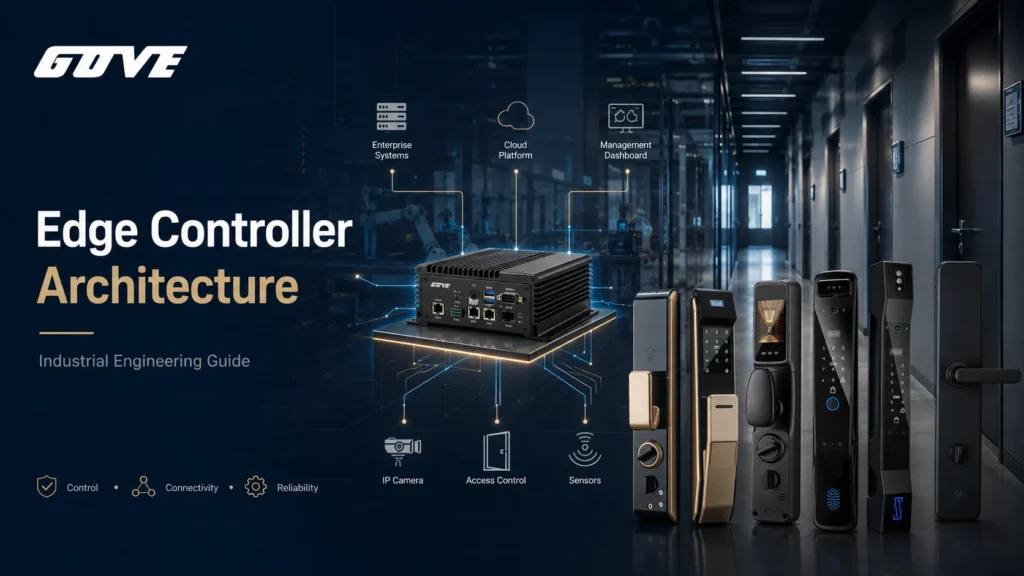
An edge controller architecture is a hybrid hardware-software system that runs a real-time operating system (RTOS) for deterministic control alongside a general-purpose operating system (like Linux) for IT edge computing on a single physical device. This fusion lets one unit behave as both a logic solver and an Industrial Internet of Things (IIoT) server, bridging IT/OT convergence without extra hardware.
The Core Definition of an Industrial Edge Controller
We define an industrial edge controller as a compute platform that executes millisecond-level deterministic control while simultaneously hosting containerized industrial applications for analytics, protocol translation, or local database services. Unlike a conventional PLC that offloads data to a separate gateway, the edge controller keeps control and data processing on one physical device. This reduces latency, removes the need for an external industrial PC, and simplifies network cabling.
- A multi-core CPU partitions resources into RTOS and general-purpose domains.
- Southbound fieldbus interfaces (Modbus TCP, EtherNet/IP, PROFINET) connect directly to sensors and drives.
- Northbound interfaces publish processed data to MQTT brokers, cloud platforms, or on-premises SCADA systems.
- Local storage captures time-series data during network outages and forwards it when the connection restores.
- The entire stack runs under a hypervisor that guarantees the RTOS cannot be starved by IT workloads.
This definition matters because it redefines what one device can do in brownfield upgrades. A facility can keep existing I/O and field wiring, replace a legacy PLC rack with an edge controller, and layer on cloud dashboards without touching validated safety logic.
How Edge Controllers Differ from PLCs and PACs
The distinction between a PLC and PAC systems and an edge controller often trips up procurement teams that treat them as interchangeable. All three can execute IEC 61131-3 control logic, but their architectural boundaries diverge after the control loop.
Here’s the engineering reality:
- PLC: Single‑task runtime, tight I/O coupling, no native IT stack. It excels at fast, repetitive logic but cannot run a database or a REST API natively.
- PAC: Multi‑domain control with better networking and more memory, often running a real‑time kernel alongside limited Ethernet services. It still lacks a general‑purpose OS for arbitrary container workloads.
- Edge Controller: Merges a PAC‑class real‑time engine with a full Linux OS, enabling containerized applications, cloud SDKs, and local analytics while guaranteeing control isolation through hardware‑enforced separation.
The leap from PAC to edge controller is not a simple performance bump; it’s an architectural shift that alters how a plant manages software updates, cybersecurity, and dataflow.
The Dual-OS Paradigm: Real-Time Control meets General-Purpose IT
The heart of this architecture is the dual‑OS paradigm. One side runs a hardened RTOS (such as a real‑time Linux kernel or VxWorks) to execute the machine’s safety interlocks and motion sequences. The other side runs a standard Linux distribution that hosts Docker containers, Node‑RED flows, or Python analytics scripts. The two never interfere because a hypervisor allocates dedicated CPU cores, memory regions, and I/O ports to each operating system.
We often describe the relationship as a “one‑box SCADA‑plus‑PLC.” The real‑time side guarantees cycle times, while the IT side handles data contextualization, protocol bridging, and cloud communication. Without this dual‑OS approach, facilities end up duct‑taping an IPC to a PLC—and then debugging latency spikes that appear only under heavy analytics loads.
Hypervisor Virtualization and Hardware Resource Allocation
To ensure safety and zero‑latency execution, modern edge controller architecture relies on Type-1 hypervisors to split multicore processor resources into isolated physical domains. No amount of software containerization alone can guarantee that a memory‑leaking Go application won’t eventually degrade the control loop.
Multi-Core Processors and Type-1 Hypervisors
We evaluate edge controllers by how they map physical hardware, not by marketing descriptions. A Type‑1 hypervisor sits directly on the silicon, assigning dedicated CPU cores to the RTOS virtual machine and separate cores to the Linux VM. PCIe lanes, Ethernet MACs, and UART ports are passed through to one VM or the other, not shared by software. This is fundamentally different from a Type‑2 hypervisor that runs on top of a host OS, which introduces scheduler jitter that can wreck deterministic timing.
| Isolation Method | Hardware Separation | Deterministic Safety | Typical Use in Edge Controllers | Buyer Should Verify |
|---|---|---|---|---|
| Type‑1 Hypervisor | Direct core/device assignment | Guaranteed; no jitter from IT workloads | Preferred for safety‑critical applications | Hardware‑enforced isolation, not soft partitioning |
| Type‑2 Hypervisor | Host OS arbitrates resources | Possible jitter; not suited for sub‑ms control | Rarely used in industrial edge | Ask for latency benchmarks under load |
| Software Containerization (Docker only) | No hardware split; shares kernel | No deterministic guarantee | Not acceptable for mixed‑criticality systems | Ensure the vendor does not rely on containers for safety isolation |
Note: The data above reflects field‑proven design patterns. Buyers should request the hypervisor specification and test reports from the vendor to confirm compliance with their application safety requirements.
Strict Resource Isolation: Preventing IT Application Crashes from Stopping the RTOS
Engineering takeaway: Without strict resource isolation, a Python script that consumes all available memory in the Linux partition can cause the hypervisor to balloon into the RTOS domain and halt machine safety functions.
We design for resource isolation by pinning physical RAM banks to each VM and disabling kernel‑level shared memory. The RTOS partition gets a fixed memory pool that cannot be reclaimed by the Linux host, even under extreme pressure. Likewise, network interfaces are mapped one‑to‑one: the fieldbus port connects exclusively to the RTOS, while the enterprise LAN port connects only to the Linux VM. This prevents a DDoS attack on the IT side from ever reaching the machine network.
When evaluating a controller, ask the vendor to demonstrate what happens when the Linux host runs a fork bomb or a memory‑intensive Docker container. The RTOS control loop must continue executing without a single microsecond of added jitter. If the vendor cannot show that guarantee, the architecture is not truly isolated.
Data Flow and Network Topology in Hierarchical Edge Systems
Industrial network architectures must treat the edge controller as a secure translation bridge that converts low‑latency southbound fieldbus protocols into lightweight northbound IoT payloads. This single‑point translation eliminates the protocol gateway appliances that clutter traditional control panels.
Hierarchical Processing: Embedded, Gateway, and Network Edge Layers
We typically decompose an IIoT architecture into three layers, with the edge controller operating most efficiently at the gateway and network‑edge layers:
- Embedded layer: Individual sensors, drives, and I/O blocks communicating over real‑time fieldbuses. Latency is sub‑millisecond, and data remains raw.
- Gateway layer: The edge controller aggregates data from multiple fieldbus segments, performs protocol conversion, and runs local analytics. This is where control loops close and where first‑stage alarm logic resides.
- Network edge layer: The same edge controller—or a coordinating supervisory unit—prepares data for cloud ingestion, applying store‑and‑forward buffering, payload compression, and semantic tagging before northbound transmission.
By collapsing the gateway and network‑edge layers into one device, facilities reduce the number of IP addresses on the plant floor and minimize the attack surface. It also simplifies the enterprise access control systems that govern who can reach the edge hardware.
Southbound OT Protocols vs. Northbound IT Interfaces
The edge controller’s true value emerges in its protocol translation capability. Southbound, it speaks deterministic control languages; northbound, it speaks cloud‑native IoT protocols.
| Direction | Protocol | Key Attribute | Typical Use Case |
|---|---|---|---|
| Southbound | Modbus TCP/RTU | Ultra‑simple, universal | Legacy device integration |
| Southbound | OPC UA | Information‑modeling, secure | Machine‑to‑machine data exchange |
| Southbound | EtherNet/IP, PROFINET | Deterministic cycle times | High‑speed motion, safety PLCs |
| Northbound | MQTT (Sparkplug B) | Lightweight, report‑by‑exception | Cloud and SCADA data push |
| Northbound | AMQP | Transactional, queued messaging | Enterprise message bus integration |
| Northbound | HTTPS/REST | Stateless, firewall‑friendly | Configuration APIs, dashboard pull |
Note: Protocol support varies by edge controller model. Buyers should confirm the specific driver versions and performance limitations during the engineering evaluation phase.
Local store‑and‑forward is the safety net in this design. When the WAN connection drops, the IT partition buffers data to a local SQLite or InfluxDB instance and automatically backfills cloud storage once connectivity returns. This prevents data gaps that undermine analytics and preserves asset health records for regulatory compliance.
Key Benefits of a Hybrid Edge Controller Architecture
By processing high‑frequency sensor data locally on the controller, industrial operations can cut cloud bandwidth consumption by up to 90% while achieving sub‑millisecond local response times. The financial impact shows up immediately in reduced cellular data plans and fewer cloud ingestion costs.
Local Analytics and Machine Learning Inference
Modern edge controllers can run ONNX or TensorFlow Lite inference models directly beside the machine interface, eliminating the round‑trip to a cloud GPU cluster. For example, a vibration monitoring algorithm analyzing 10‑kHz accelerometer data can detect bearing degradation within a single PLC scan cycle and trigger a graceful shutdown long before a cloud‑based alert would arrive. This capability is central to edge-based AI processing and predictive maintenance strategies that require deterministic reaction times.
We’ve seen plants deploy optical quality inspection using a single edge controller that simultaneously runs a vision model, a local SQL database, and the motion control logic for a reject conveyor. Without the edge architecture, this same function would require a separate IPC, a vision controller, and additional integration engineering.
Cloud Bandwidth Reduction and Low-Latency Edge Computing
Streaming raw 1‑kHz vibration data from a single machine consumes roughly 2.5 GB per day over a cellular backhaul. By preprocessing that data with an edge‑side FFT and only publishing the spectral peaks and fault severity scores, an edge controller can reduce the daily payload to a few kilobytes. For multi‑facility operators with hundreds of assets, the cumulative savings on cellular and cloud‑ingestion costs quickly justify the hardware investment.
Moreover, any control action that requires sub‑10‑ms latency—such as part‑reject gating or tension‑loop corrections—must stay local. No cloud‑based system, no matter how optimized, can close a hard real‑time loop over a WAN. The edge controller keeps those loops local while still feeding contextualized data northbound for OEE dashboards and ERP integration.
Securing the IT/OT Convergence Boundary
Securing an edge controller requires a strict zero‑trust posture where physical network ports are mapped directly to specific virtual machines, preventing any accidental bridging between the IT and OT networks. We approach this as an architectural mandate, not an optional feature.
Physical and Logical Network Port Isolation
Buyer warning: Single‑network‑interface edge controllers that rely on VLANs alone for OT‑IT separation are inherently riskier than designs with physically separate Ethernet ports. A misconfiguration or a switch‑level attack can collapse the security boundary.
We advocate for controllers that integrate at least two independent Ethernet interfaces: one dedicated to the RTOS for fieldbus traffic, another to the Linux host for enterprise LAN access. Firewall rules inside the hypervisor should block all bridging and routing between the two interfaces. The Linux VM should have no knowledge of the fieldbus subnet, and the RTOS should never be able to reach the internet. When electronic access control systems need to interact with edge locks, the communication should pass through a demilitarized zone, not through a shared IP stack on the controller.
Container Security and ISA/IEC 62443 Compliance
Because the Linux partition hosts containerized applications, its attack surface must be aggressively minimized. We recommend read‑only root file systems for containers, immutable image registries, and runtime vulnerability scanning integrated into the CI/CD pipeline. But these measures are only effective if the underlying hypervisor itself remains patchable.
What to verify: Before purchasing, confirm that the vendor provides a documented, long‑term update policy for both the hypervisor and the Linux distribution. The container runtime must receive security patches within the timeline demanded by your site’s ISA/IEC 62443 security program. Ask for evidence of compliance with ISA/IEC 62443‑4‑2 (component security) and 4‑1 (secure product development lifecycle). We also advise mapping any enterprise IoT compliance requirements to the specific controller model before issuing a purchase order.
Common Engineering Pitfalls in Edge Controller Deployment
The most expensive mistake in edge controller engineering is running unchecked Python, Node‑RED, or Go applications that leak memory and degrade the overall responsiveness of the processor. Facilities that treat the Linux side like a development sandbox often discover the resulting control instability only after production is affected.
Resource Starvation and Thermal/Environmental Stress
In one plant we visited, a developer deployed a Docker container that periodically scanned the entire file system for logs. The container’s CPU spikes didn’t touch the RTOS cores thanks to hardware isolation, but the shared L3 cache thrashing caused micro‑bursts of latency on the fieldbus interface—enough to trip a safety watchdog. The root cause was not a hypervisor flaw but a failure to pin the application’s CPU affinity and to monitor shared cache contention.
Equally dangerous is deploying lightweight edge hardware designed for carpeted server rooms onto a stamping‑press skid. High vibration loosens board‑level connectors; ambient temperatures above 60°C degrade electrolytic capacitors; and corrosive mists seep into unsealed connectors. We recommend specifying fanless, DIN‑rail‑mountable controllers with an operating range of at least -40°C to +70°C and an IP20 or higher ingress rating for shop‑floor environments. When the edge controller will directly actuate commercial access control locks or safety gates, ruggedized locking hardware and proper power isolation become non‑negotiable.
- Verify the controller’s thermal design power (TDP) and derating curves above 55°C.
- Check for conformal coating on PCBs if any corrosive atmosphere is present.
- Confirm that the vendor tests for vibration per IEC 60068‑2‑6.
Custom Scripting Pitfalls: The Dangers of Bypassing IEC 61131-3 Standards
Engineering takeaway: The flexibility of the Linux partition tempts engineers to rewrite control‑loop logic in Python or Node‑RED. We have seen this erode the traceability, version control, and safety validation that the IEC 61131-3 programming standard provides. A PID loop written in Python, for instance, cannot be reasoned about with the same formal guarantees as a Structured Text or Function Block Diagram authored in an IEC 61131‑3 runtime.
We draw a hard line: safety‑related and high‑consequence control logic must remain inside the RTOS partition and follow IEC 61131‑3. The Linux side is for ancillary functions—KPI calculations, cloud synchronization, local dashboards—that can fail without endangering the machine or personnel. When we design an edge controller architecture, we enforce this separation by using secure boot, signed firmware, and role‑based access that prevents unauthorised logic uploads to the RTOS domain.
Selection Matrix: PLC vs. PAC vs. Edge Controller Architecture
While simple machinery relies on cost‑effective PLCs and complex lines require high‑speed PACs, multi‑facility operations looking to execute cloud connectivity, local databases, and control loops in one footprint require an edge controller. The following matrix helps align device class with application demands.
The Application-Fit Comparison Framework
| Dimension | PLC | PAC | Edge Controller |
|---|---|---|---|
| Primary OS | Proprietary RTOS | RTOS + limited network stack | RTOS + full Linux OS |
| Deterministic Control | Excellent (sub‑ms scans) | Excellent | Excellent, with hardware isolation |
| Native IT Workloads | None | Minimal (e.g., FTP, web server) | Docker, databases, ML runtimes |
| Programming Languages | IEC 61131‑3 only | IEC 61131‑3 + limited C | IEC 61131-3 + Python, C++, Go, etc. |
| Cloud Protocol Support | Requires external gateway | Basic OPC UA, often no MQTT | Native MQTT, AMQP, HTTPS |
| Typical Application Fit | Standalone machines, small I/O counts | Complex motion, multi‑axis coordination | Brownfield IIoT upgrades, multi‑facility analytics |
Note: Performance capabilities vary by model and firmware version. Always request datasheets and benchmark results for your expected I/O count and container workload before committing.
Technical and Operational Procurement Checklist
When we guide procurement teams through an edge controller selection, they compile the following checklist to avoid gaps that surface only after commissioning:
- Confirm that the hypervisor virtualization layer is Type‑1 and hardware‑enforced, not software‑only.
- Validate the RTOS cycle time under full container load—request a test report.
- Verify southbound protocol drivers for all required fieldbuses (Modbus, EtherNet/IP, PROFINET, OPC UA).
- Check northbound support for MQTT Sparkplug B and at least one enterprise‑grade protocol (AMQP or HTTPS/REST).
- Ensure the controller supports local store‑and‑forward with configurable buffer sizes.
- Review the vendor’s security patch policy and alignment with ISA/IEC 62443.
- Evaluate environmental ratings: IP class, operating temperature range, vibration tolerance, and hazardous area certifications if needed (ATEX, Class I Div 2).
- Clarify software licensing: subscription vs. perpetual, and whether container runtime updates are included.
- Assess hardware architecture for edge devices if the controller will directly drive locking mechanisms or secure enclosures.
- Plan for smart lock interoperability if the edge controller will manage physical access points alongside industrial automation.
This checklist serves as a pre‑evaluation gate. Vendors that cannot answer every point usually have hidden constraints that will surface during the first plant‑wide rollout.
Designing Your Next-Generation Edge Infrastructure
Successful implementation of an edge controller architecture requires aligning control engineering safety goals with enterprise IT security standards before purchasing hardware. That alignment rarely happens naturally; it must be designed into the specification from day one.
Before engaging with suppliers, we advise operations teams to prepare a concise technical brief that includes:
- A current topology diagram showing fieldbus segments, existing PLC/PAC racks, and network gateways.
- A list of the 10 most critical control loops, including required scan times and safety integrity levels.
- Expected data destinations—Azure IoT Hub, AWS IoT Core, on‑premises SCADA, or a hybrid—and the associated authentication requirements.
- A catalog of existing plant‑floor protocols, including any legacy serial devices that will need protocol conversion.
- An inventory of physical space and environmental conditions at each deployment location.
With this information, a technical team can map out which edge controller models fit the brownfield landscape without disrupting validated control logic. The conversation shifts from “which box should we buy” to “how do we virtualize the control plane while layering on analytics.”
For teams exploring Matter over Thread smart locks as part of an integrated facility, we often layer edge controllers that speak Thread border‑router functions alongside traditional fieldbuses, consolidating physical access data and machine telemetry on the same platform. The same architectural principles—hardware isolation, deterministic control, and secure northbound messaging—apply regardless of whether the endpoint is a robot or a door.
If you’re ready to map your current OT topology to an edge architecture, we recommend starting with a structured walkthrough of your I/O counts and dataflow goals. Our engineering team regularly helps facilities choose between edge controller approaches that preserve existing PLC investments while opening a path to predictive maintenance and cloud‑based fleet management. Explore Gove access control solutions and edge-enabled lock products to see how hardware engineered for rugged, secure environments can anchor your converged infrastructure.
Frequently Asked Questions
Can an edge controller completely replace a traditional PLC?
An edge controller can physically execute PLC logic natively, but in practice it often serves as a supervisory controller or bridge alongside existing PLCs. This preserves certified control logic while adding edge computing functions, which is a far lower‑risk upgrade path for brownfield sites.
What is the role of a hypervisor in edge controller architecture?
The hypervisor acts as a hardware virtualization layer that creates an absolute wall between the deterministic real‑time operating system executing machine movements and the non‑deterministic IT container platform. This isolation prevents IT workloads from ever starving safety‑critical control loops of execution time.
How does an edge controller handle data storage during network outages?
The IT partition typically includes a local database—such as SQLite or InfluxDB—configured to store edge sensor data and forward it using store‑and‑forward logic once the network connection is restored, preventing any data loss.
What industrial standards should I verify before selecting an edge controller?
Verify support for IEC 61131‑3 for deterministic control logic, ISA/IEC 62443 for security, relevant UL/CE certifications, and any required environmental ratings such as ATEX or Class I Division 2 for hazardous locations.
Does running Linux applications on an edge controller compromise system safety?
When the system is designed with a proper edge controller architecture—using a Type‑1 hypervisor and separate processor cores—the Linux applications operate in a virtual container that cannot interfere with the RTOS safety control functions, so safety integrity is preserved.