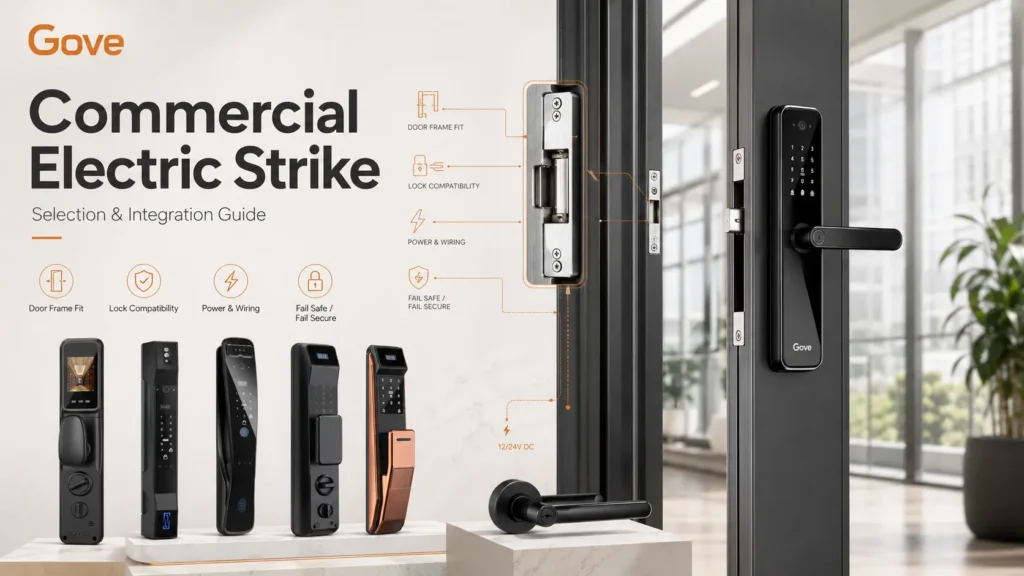
A facility manager told us recently that they only compared voltage and finish when replacing door strikes. We’ve seen that decision trigger expensive callbacks too many times. The real procurement risk in commercial access control isn’t the electronics — it’s matching an electric strike’s mechanical profile to the lock body and frame. Choose the wrong keeper depth or ignore the door’s existing preload, and even a premium solenoid will fail within weeks.
We’ve written this guide to give commercial buyers, integrators, and specifiers the engineering and selection framework we use every day. It connects the lock type, fire-life-safety code, and electrical design to the strike model so you can issue a specification that holds up in the field.
What is an Electric Strike and How Does It Work in Commercial Access Control?
An electric strike is an access control device installed in a door frame that replaces a standard fixed strike plate. It uses an internal solenoid to release a hinged keeper, allowing the door latch to pass through without manual key rotation — but only when powered or depowered, depending on the configuration.
The Core Mechanical Elements: Keeper, Solenoid, and Faceplate
The keeper is the pivoting metal gate that blocks or releases the latch bolt. In a resting state, the keeper holds the door secure. When triggered, a solenoid converts electrical energy into linear motion, pulling or pushing a linkage that frees the keeper. The faceplate secures the assembly inside the frame and must match the door jamb’s cutout geometry. Together, these three components determine whether the strike will survive daily traffic or fail under light pressure.
We pay close attention to the keeper’s lip profile. A deeper lip retains a larger latch throw, while a shallow lip works with narrow stile aluminum storefront frames. Faceplates can be flat, radiused, or extended lip, each suited to specific door and commercial door locks setups.
Engineering takeaway: The solenoid must be rated for the duty cycle the application demands. Intermittent-duty solenoids overheat when energized for more than a few seconds; continuous-duty models are mandatory for fail-safe arrangement.
Electric Strikes vs. Magnetic Locks (Maglocks): Key Operational Differences
Both devices control access, but their operational logic and fire-code implications are fundamentally different. An electric strike in an access control system works with the physical latch, meaning someone inside can always turn the lever and exit — a requirement in most commercial egress codes. Magnetic locks lock the door by adhesion and require additional PIR sensors, exit buttons, or pneumatic override to meet life-safety codes.
A practical distinction: electric strikes consume power only during the unlock cycle (fail-secure) or while locked (fail-safe), while maglocks consume power continuously to maintain the holding force. This affects heat buildup, power supply sizing, and emergency failover behavior.
Fail-Safe vs. Fail-Secure: Aligning Security Needs with Life Safety Codes
The choice between fail-safe and fail-secure is dictated by a balance of life-safety regulations and facility security goals. Fail-safe strikes require constant power to stay locked and release when power is cut; fail-secure strikes require power to unlock and remain locked during an outage, preserving perimeter integrity.
Fail-Safe (Power to Lock) and Egress Compliance
Fail-safe strikes are the default on egress paths defined by NFPA 101 and local building codes. In a fire or power loss, the door unlocks immediately, allowing occupants to exit without fumbling for keys or pushing crash bars. We see these most often on interior stairwell doors, fire-rated corridor doors, and cross-corridor doors that must remain latched for compartmentation but release instantly in an emergency.
Specifiers should check with the local AHJ, but the rule of thumb is: if the door is part of a means of egress, fail-safe is nearly always required. That means the power supply and backup battery must be reliable, because a long outage will leave the door unlocked, potentially creating a security gap.
Fail-Secure (Power to Unlock) and Perimeter Security
Fail-secure strikes keep the door locked when power is lost, so they are used on building perimeter doors, IT server rooms, cash-handling areas, and high-security storage. The door remains physically secure even if the access control panel loses power. This configuration demands that the lock’s solenoid and keeper can withstand attack during an extended blackout.
What to verify: In a fail-secure installation, the door must still allow free mechanical egress from the inside via lever handle or panic bar. The strike cannot impede the ability to exit; it only prevents entry from outside when unpowered.
Classifying Electric Strike Locksets by Physical Door Hardware
The first procurement filter is the lock body type already installed on the door. A strike designed for a cylindrical latch will not work with a heavy mortise lock or a surface-mounted rim exit device. Matching the strike profile to the lockset prevents field returns and keeps your door listing intact.
Cylindrical Lockset Strikes
Cylindrical locks are the most common commercial interior lock, and their strikes fit a standard ANSI 4-7/8″ faceplate cutout. The latch is a spring-loaded beveled bolt that enters a single keeper opening. When we select a cylindrical electric strike, we check the latch projection and whether the lock has an auxiliary deadlatch that must be depressed. Many strikes now accept both 1/2″ and 5/8″ latch throw without adjustment, simplifying retrofits on storefront door security projects.
Mortise Lockset Strikes
Mortise lock bodies are heavier and contain both a latch bolt and a deadbolt in a single rectangular chassis. A mortise electric strike must accommodate the latch — and often recapture the deadbolt — within the frame. We look for extended lip strikes that extend beyond the frame face, because mortise lock plates are larger and the keeper must engage both locking points. Some mortise strikes also support a monitor switch to confirm deadbolt status, useful in hotel and healthcare applications.
Rim Exit and Panic Bar Strikes (Surface-Mounted)
Rim exit devices have a surface-mounted latch that projects into a strike on the frame’s face or header. The electric strike here is often a surface-mounted housing that bolts directly to the frame without cutting deep into the jamb. This preserves frame structural integrity, especially in hollow metal frames where a deep cutout could weaken the wall anchoring. Rim exit devices are standard on business door security systems that must meet panic bar requirements. We recommend verifying the manufacturer’s cut-sheet for minimum frame depth before ordering.
Key Engineering Specifications: BHMA Grades, Preload, and Fire Ratings
Commercial specifiers must match the strike’s mechanical ratings to the door’s traffic volume and environmental exposure. Choosing a strike without considering physical door preload or fire-rated compliance can lead to mechanical failure or code violations.
BHMA Grade 1 vs. Grade 2 Holding Strength
BHMA/ANSI A156.31 defines three grades for electric strikes. Grade 1 is tested to 1,500 lbs of static holding strength and over 1,000,000 cycles, while Grade 2 is tested to 750 lbs and 500,000 cycles. We specify Grade 1 for high-traffic main entries, institutional doors, and any opening subject to abusive use. Grade 2 is acceptable for interior office doors where traffic is predictable and controlled.
Buyer warning: A Grade 1 rating on paper doesn’t guarantee real-world performance if the frame installation creates misalignment. Buyers should verify the BHMA certification on the manufacturer’s data sheet and confirm the testing lab.
| Parameter | Grade 1 | Grade 2 |
|---|---|---|
| Static holding force (lbs) | 1,500 | 750 |
| Cycle life (operations) | 1,000,000+ | 500,000 |
| Best use | High-traffic entries, institutional | Light commercial interior |
Data reflect BHMA A156.31 minimums. Verify actual test reports from the supplier.
The Engineering Challenge of Door Preload
Door preload is the pressure exerted on the keeper by the latch bolt when the door is closed — caused by warped doors, strong closers, stack pressure from HVAC, or misaligned frames. If the preload is high, the solenoid must overcome that friction to pivot the keeper. A standard strike may simply buzz and refuse to release, even though the solenoid is working.
Specialized preload-release electric strikes solve this via a compound mechanical linkage that converts solenoid pull into a cam action, releasing the keeper under up to 15–30 lbs of preload. We always recommend measuring preload with a pull scale during commissioning. If the reading exceeds the strike’s spec, adjusting the closer or upgrading to a preload-rated model is the only long-term fix.
Fire Ratings (UL 10C) and Weatherability (IP Ratings)
For fire-rated doors, the electric strike must be UL 10C fire rated for the specific door assembly. That listing ensures the strike will not compromise the door’s positive pressure fire resistance. We look for strikes that are listed for use with the door core (hollow metal, wood) and fire rating duration (20, 45, 60, or 90 minutes). A strike not listed can void the door’s fire label.
When specifying outdoor electric strikes, verify the IP (Ingress Protection) rating: IP54 at a minimum for covered entries, IP65 or higher for exposed locations. A stainless steel faceplate and potted solenoid coil prevent moisture ingress and corrosion. We also check the operating temperature range if the door faces direct sun or freezing conditions; some solenoids stall below -30°F.
Electrical Design: Operating Voltages, Current Draw, and Power Supplies
Reliable electric strike operation depends on matching the device’s voltage and current draw with an adequately sized, filtered power supply. Insufficient current or voltage drop across long wiring runs causes solenoid failure and intermittent locking.
12V vs. 24V DC and AC Systems
Today most access controllers output 12V DC or 24V DC. 24V DC is preferred for long cable runs because it halves the current draw for the same solenoid wattage, reducing voltage drop. Some legacy installations still use AC strikes (12VAC or 24VAC) that produce an audible buzz when energized. The buzz is normal for AC operation, but DC models are silent and more common in new projects.
We see integrators standardize on 24V DC for entire buildings to simplify power supply purchasing. If the panel provides only 12V, a step-up converter or separate power supply is needed. Always confirm the strike’s nominal voltage and its tolerance; a strike rated 12V DC ±10% will not operate reliably at 10.5V.
Solenoid Duty Cycles: Continuous vs. Intermittent Duty
The solenoid duty cycle is the single most overlooked spec in procurement. An intermittent-duty solenoid is designed to energize for 2–5 seconds per activation. If used in a fail-safe application where the solenoid must hold for hours, the coil will overheat, insulation will degrade, and the strike will fail permanently — sometimes within days.
We require solenoid continuous duty ratings for any fail-safe installation. Continuous-duty solenoids use higher-temperature insulation and often include a mechanical latch that holds the keeper without sustained current. When evaluating a spec sheet, look for “continuous duty” or “100% duty cycle” explicitly.
Calculating Voltage Drop and Sizing Power Supplies
To determine the effective voltage at the strike, use the formula: V_drop = (2 * L * R_per_ft * I) where L is one-way cable length in feet, R_per_ft is the wire resistance (e.g., 18 AWG: 0.00638 ohms/ft at 20°C), and I is the strike’s current draw in amps. If the resulting terminal voltage drops below the strike’s minimum operating voltage, the solenoid will not pull in.
Here’s a quick reference for 24V DC, 0.3 A strike:
- 18 AWG up to 150 ft: drop ≈ 0.57V — acceptable
- 18 AWG up to 300 ft: drop ≈ 1.15V — marginal, check tolerance
- 22 AWG up to 150 ft: drop ≈ 1.45V — likely below threshold
We also recommend sizing the power supply to 150% of the total continuous load, including all strikes that may energize simultaneously, to prevent voltage sag during peak demand. For PoE access control systems, a dedicated PoE midspan with enough per-port budget is critical.
Common Installation, Alignment, and Integration Mistakes to Avoid
Most operational issues with electric strikes stem from poor alignment between the latch bolt and the strike’s keeper, rather than electrical failure. Proper mechanical installation is vital to prevent ongoing maintenance calls.
Horizontal Misalignment of Latch Bolt and Keeper
If the latch bolt enters the keeper too deeply, it preloads the keeper upward; too shallowly, and the door remains unlocked because the latch never fully seats. The result is either a jammed strike or a door that pops open with light pressure. We align the keeper so the latch engages by 1/8″ to 3/16″ past the lip, with no vertical binding. Shimming the hinge side often corrects horizontal offset more effectively than repositioning the strike.
Incorrect Cutting and Frame Structural Integrity Degradation
Cutting the frame to accept a strike body is a one-way process. Remove too much metal near the face or the jamb anchor points, and the frame can deform under load — potentially cracking the hollow metal or weakening the fire rating. We always recommend low-profile electric strike products that require minimal frame material removal, especially for fire-rated frames. When a deep cutout is unavoidable, we reinforce the jamb with a welded box tube or backplate to restore stiffness.
The B2B Electric Strike Procurement Matrix and Checklist
Use this decision matrix to cross-reference your physical door hardware, frame construction, and security mandates before selecting an electric strike model.
Hardware and Lockset Compatibility Comparison
| Lock Type | Strike Profile | Typical Cutout | Avg. Holding Strength |
|---|---|---|---|
| Cylindrical | ANSI 4-7/8″ faceplate | Standard duty, shallow | 750–1,500 lbs |
| Mortise | Extended lip, deadbolt recapture | Deep frame pocket | 1,200–1,500 lbs |
| Rim exit | Surface-mounted housing | Minimal cut or no-cut | 1,500 lbs typical |
Holding strengths listed are typical for BHMA Grade 1 models. Always verify with the manufacturer.
Regulatory and Environmental Compliance Checklist
We use this checklist during procurement reviews to avoid late-stage substitution:
- Confirm the strike carries UL 10C listing for the door assembly’s fire rating.
- Verify egress mode (fail-safe/fail-secure) with the local AHJ approval letter.
- Check BHMA Grade certification against traffic analysis.
- Review IP rating and temperature range for exterior openings.
- Ensure faceplate finish and cutout dimensions match the existing frame or architectural spec.
- Validate that the power supply can deliver continuous rated current to all simultaneously energised devices.
- Confirm that emergency overrides (fire alarm interface) will release the strike as required.
For commercial access control locks, these verification steps reduce change orders and keep the project schedule on track.
Ready to Specify Your Access Control Hardware?
Selecting the right electric strike requires precise alignment with architectural drawings, electrical load calculations, and local fire codes. We find that a 15-minute technical consultation prevents most field installation errors and helps the procurement team lock in the correct part numbers early.
If you’re working on a multi-door commercial project, contact our team with your door schedule, frame material, lock model, and duty-cycle requirements. We’ll help you cross-reference compatibility and can support bulk pricing or factory-direct custom finishes from our electronic lock manufacturing line. Having the fire inspector’s egress requirements and a simple wiring diagram on hand will make the call more productive.
Frequently Asked Questions
What is the main difference between an electric strike and a maglock?
An electric strike integrates with the mechanical latch and allows free egress by turning the inside lever, while a magnetic lock holds the door closed with an electromagnet and requires additional egress sensors and release buttons to meet fire code. The strike installs in the frame; the maglock mounts on the frame face and door.
Can you use an electric strike on a fire-rated commercial door?
Yes, but the strike must be UL 10C listed and fire-rated for that specific door assembly. It must also be configured as fail-secure to keep the latch engaged during a fire if power is lost, maintaining smoke and flame containment.
Why is my electric strike buzzing but not unlocking?
Buzzing usually indicates an AC power supply (normal for older strikes), but failure to unlock is typically caused by excessive preload pressure on the keeper, a burned solenoid coil, or low voltage at the strike terminal due to voltage drop over long wiring.
How do I resolve door preload problems?
Adjust the door closer to reduce closing force, shim the hinge side to align the latch, or upgrade to an electric strike model designed with a preload-release mechanism. In severe cases, reinforce the frame to eliminate warping that causes binding.
Can electric strikes be installed outdoors?
Yes, but you must specify an outdoor-rated electric strike with an IP65 or higher rating, stainless steel faceplate, and potted electronics. Verify the operating temperature range to prevent solenoid failure in freezing or high-heat conditions.