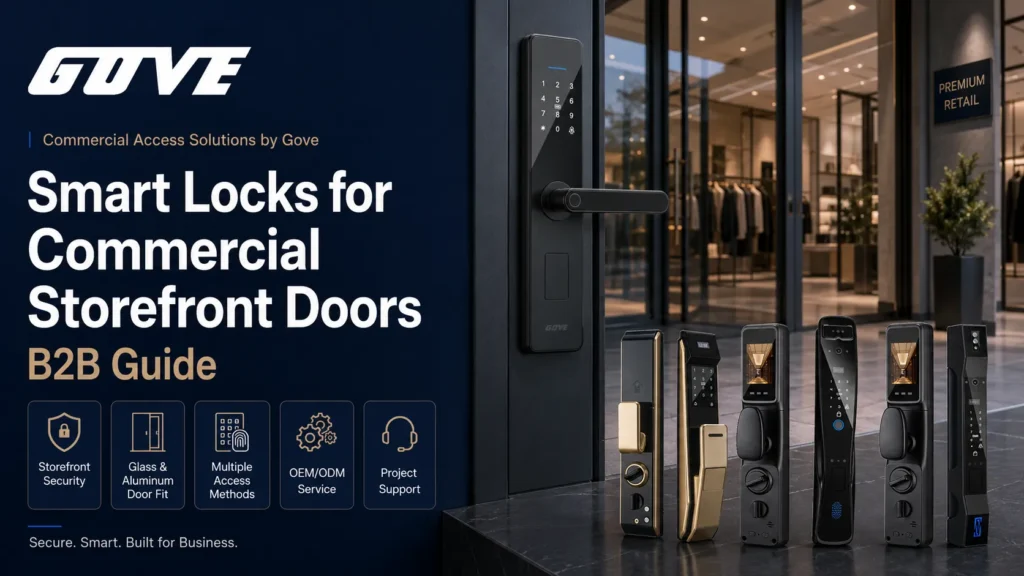
Most smart lock marketing ignores a simple fact: commercial aluminum and glass storefront doors are not built like residential wooden doors. You can’t just slap a 2-1/8″ bore deadbolt onto a 1-inch-wide aluminum stile. When we evaluate replacements for mixed-use retail centers, the real bottleneck isn’t smart features—it’s the mortise cylinder pocket. Getting the right commercial storefront door smart lock means respecting that pocket and the narrow stile’s unforgiving backset limits first.
Procurement teams often purchase a lock before measuring the door. That’s a costly mistake. In every storefront retrofit we’ve advised, identifying the existing Adams Rite latch—deadlatch, deadbolt, or hookbolt—dictates 80% of the hardware selection process. Skip this step and you’ll be returning locks, or worse, drilling into a perfectly good door.
The Engineering Challenges of Narrow Stile Storefront Doors
Stile Width and Backset Limitations
Unlike residential wood doors that happily accept a 2-3/8″ or 2-3/4″ backset, narrow stile door lock hardware must contend with backset dimensions as shallow as 31/32″, 1-1/8″, or 1-1/2″. The stile itself—the vertical aluminum extrusion—is often only 1-3/4″ to 2″ wide. This leaves very little metal between the lock’s mounting holes and the glass edge, which is why standard off-the-shelf smart deadbolts simply won’t fit. We’ve seen too many facilities try to force a 1-1/2″ deadbolt into a frame that demands a 31/32″ mortise cylinder, and the result is never code-compliant.
Before you order any electronic lock, you must physically open the door and measure the distance from the edge of the latch faceplate to the center of the cylinder cutout. If your storefront uses an aluminum stile with a 1-1/8″ backset, you’ll need a lock designed specifically for that dimension. Anything bulkier will protrude past the stile or bind against the door’s internal reinforcement. We also recommend checking for any concealed vertical rods that might obstruct the cylinder pocket.
Standard Adams Rite Mortise Prep Compatibility
Most North American aluminum-and-glass storefronts ship with Adams Rite 1850 or 1950 series mortise locks, or their generically patterned equivalents. These uses a distinctive rectangular faceplate—typically 1″×6-7/8″ or 1-1/4″×8″—with a standard mortise lock cylinder prep that accepts a 1-1/8″ or 1-1/4″ rim or mortise cylinder. That prep is your entry point for a great many Adams Rite replacement options without drilling new holes.
Before shopping for a smart lock for glass door applications, confirm three things: the faceplate dimensions and its mounting screw locations; the cylinder type (usually a rim cylinder or a mortise cylinder with a 1-1/8″ or 1-1/4″ length); and the latch function—deadlatch, deadbolt, or hookbolt—because the required tailpiece and can vary. A mismatch in any of these will make the “drop-in replacement” claim fail. In our experience, the safest path is taking a photo of the existing cylinder and faceplate and sharing it with your supplier before ordering.
Smart Retrofit Strategies for Existing Storefront Hardware
Property managers typically face a choice of three retrofit depths, ranked from least invasive to full infrastructure replacement. We always advise starting with the simplest solution that meets your access control and durability requirements. The table below outlines the main approaches.
| Strategy | What It Replaces | Best For | Install Complexity | Key Maintenance Factor |
|---|---|---|---|---|
| Cylinder replacement (drill‑free) | Only the mortise cylinder; keeps existing latch & handle | Multi‑site portfolios needing fast rollout with existing hardware | Low (15‑minute swap) | Battery changes per cylinder |
| Standalone keypad lock | Entire lock body, including cylinder and push‑bar trim | Single heavy‑traffic entry doors; schools, offices | Moderate (re‑mounting on narrow stile) | Battery life under high cycle count |
| Integrated access control (electric strike/mag‑lock) | Strike or keeps, plus system wiring and controller | Multi‑door buildings requiring centralized IT‑managed access | High (low‑voltage wiring, fire alarm tie‑in) | Power supply and IT uptime |
Note: Installation complexity and code compliance requirements vary by jurisdiction. Buyers should verify the exact hardware dimensions and wiring requirements with the lock manufacturer.
Standalone Cylinder Replacement and Drill-Free Smart Locks
If the existing door has a healthy Adams Rite–style mortise latch and you only want to eliminate metal keys, a drill‑free commercial glass door smart lock that threads directly into the mortise cylinder hole is the least disruptive option. These units look like an oversized thumbturn on the interior and frequently rely on Bluetooth or Z‑Wave radios. We’ve specified these for retail chains that need to re‑key 30 doors in a weekend without a locksmith. One caveat: the interior mounting plate must clear any panic bar push pad, so verify clearance depth before purchase. For an overview of reliable drop‑in models, see our guide to commercial door smart lock selections.
Heavy-Duty Standalone Keypad Locks
When door traffic hits 200+ cycles a day, a standalone battery‑powered electronic lock built for narrow stiles—like the top-rated commercial smart lock models with a Grade 1 chassis—delivers the proper durability. These units replace the entire external escutcheon and latch mechanism and typically offer backlit keypads, multi‑user PINs, and optional HID prox card readers. They mount using existing Adams Rite faceplate holes, but the interior chassis is bulkier; always check that the interior thumbturn or lever won’t interfere with the push bar. We also recommend selecting a lock that supports electronic storefront hardware protocols like remote one‑time PIN generation so you’re not running to the door every time a vendor needs entry.
Fully Integrated Commercial Access Control Systems
For multi‑door retail or office lobbies, integrating the storefront into a broader access control for storefront doors system makes sense. That means installing an electric strike in the frame (or a magnetic lock at the top) and wiring it to a local IP controller with Power over Ethernet. The cloud dashboard allows centralized management, real‑time audit trail software, and automatic lockdown scheduling. Two critical integration points: you must coordinate the egress—typically using a push bar with a request‑to‑exit (REX) motion sensor—and you must decide between fail‑safe and fail‑secure behavior, which we’ll cover in the next section. A fully integrated solution also lets you expand later to business smart lock for storefronts with biometric or mobile credentials.
Enterprise Access Management and Software Integration
Centralized Cloud Administration and Audit Trails
Modern access control system platforms connect locks to a SaaS dashboard over WiFi, Bluetooth gateways, or Z‑Wave hubs. From that single pane, a facility manager can see which door was accessed, by whom, and exactly when—a crucial record for HIPAA, PCI, or corporate security audits. The best platforms log each event with a date‑time stamp and the credential ID, and they push alerts for tailgating or forced‑open conditions. When we spec a system for multi‑tenant properties, we prioritize audit trails that can’t be edited or deleted locally. This level of oversight turns a door lock into a compliance tool.
Temporary Credentialing for Staff, Vendors, and Tenants
High‑turnover retail and co‑warehousing spaces need the ability to issue and revoke credentials in seconds. Cloud‑connected smart locks let you send one‑time PINs via SMS or email for delivery windows, grant tenant‑specific mobile keys with time‑based expiry, and instantly deactivate a departing employee’s credential. We’ve seen operations teams cut re‑keying costs by 90% once they stop cutting mechanical keys and move to digital credentialing. For bulk purchasing, consider bulk commercial smart lock purchase programs that include multi‑site license management.
Life Safety Codes, Egress, and Security Compliance
Emergency Egress and Panic Bar Compatibility
Commercial storefront doors in the U.S. must meet NFPA 101 Life Safety Code, which generally requires single‑motion egress: one push on the bar must release all latches and allow the door to swing freely. Any smart lock retrofitted onto a door with a panic bar must not interfere with that mechanism. We always test that the interior electronic trim—whether it’s a thumbturn, keypad, or lever—does not obstruct the push pad’s travel. If the door uses vertical rod hardware, the smart lock must accommodate the upper and lower rod actuators; otherwise, you risk locking a door that won’t release under pressure.
Fail-Safe vs. Fail-Secure Configurations
The fail-safe vs fail-secure decision determines what happens when power is cut. A fail-safe electric strike or magnetic lock automatically unlocks, allowing free egress—required for most public building exits to meet fire codes. A fail-secure setup stays locked from the outside but always allows egress from the inside via the panic bar, maintaining perimeter security during a blackout. We frequently see confusion here: specifying a fail-safe lock on a server room door that must remain secure during a power outage creates a security gap. Always map the fire evacuation route before choosing the lock state.
Physical Key Overrides and SFIC Integration
Even the best wireless system can go down. That’s why we require a physical key override on every commercial smart lock installation. Small Format Interchangeable Core (SFIC key override) cylinders let you re‑key a lock in under 60 seconds using a control key, without replacing the lock body. This is invaluable when a tenant moves out or a master key is lost. Look for smart locks that accept standard SFIC housings (usually 6‑ or 7‑pin) so your locksmith can key all doors to the facility’s existing master system. It’s a detail that saves thousands over the life of a property.
Evaluating Total Cost of Ownership and Maintenance
Battery Lifecycle and Power Source Management
Battery‑powered standalone locks on a busy retail entrance can drain a set of AA lithium batteries in 6–8 months. We’ve seen operators budget for quarterly battery swaps on high‑traffic doors. Hardwired (PoE or 12‑24V) electric strike systems eliminate battery anxiety but add cabling costs and require a life‑safety tie‑in; if the fire alarm cuts power, the strike must fail to the correct state. When comparing options, factor in the labor cost of dispatching a technician to change batteries across dozens of locks—hidden OpEx that often favors hardwired solutions in new construction. Some affordable commercial smart lock models now offer lithium rechargeable packs with a 12‑month advertised life, but we always derate that by 30% for real‑world winter cold.
Mechanical Durability and Traffic Volume Grades
ANSI/BHMA standards rate lock durability in cycles, with Grade 1 being the highest. For storefronts that see 500+ cycles a day, only a Grade 1 lock will survive years without flogging out the latch or wearing the motor. The table below translates grades into practical procurement terms.
| ANSI/BHMA Grade | Minimum Cycles Tested | Recommended Traffic | Typical Warranty | Procurement Note |
|---|---|---|---|---|
| Grade 1 | 800,000 | Heavy commercial (500+ cycles/day) | 3‑5 years | Look for all‑metal internals; zinc or steel reinforced |
| Grade 2 | 400,000 | Light commercial / back office | 2‑3 years | Often fails early in storefront use |
| Grade 3 | 200,000 | Residential / interior only | 1‑year | Not designed for commercial doors |
Note: Durability figures are based on ANSI/BHMA testing standards. Buyers should request the specific standard and test report from the manufacturer.
Weather is another durability factor. Storefront locks are exposed to rain, dust, and sub‑zero windchill. We always verify IP ratings—IP66 is the minimum for outdoor aluminum doors—and check that the lock’s internal electronics have conformal coating against condensation. For doors facing direct sun, look for UV‑stabilized keypad overlays that won’t yellow and crack within two summers. If your door faces a loading dock with weather extremes, a durable lock for outdoor storefront conditions is essential.
Frequently Asked Questions
Can I install a standard smart lock on a glass storefront door?
No. Standard smart deadbolts require a 2‑1/8″ bore and a 2‑3/8″ or longer backset that glass storefront aluminum stiles cannot accommodate. You need hardware engineered specifically for narrow stile door lock applications, typically using a mortise cylinder prep.
What is the difference between a smart mortise cylinder and an electric strike?
A smart mortise cylinder replaces the physical keyway inside the existing lock body and retains the original latch; an electric strike replaces the keep in the door frame and releases the latch electrically, requiring wiring and a power supply.
What happens to a commercial smart lock if the power or internet goes down?
Most battery‑powered locks store credentials locally and continue to operate. Electric‑powered strikes without backup will default to their pre‑configured fail‑safe or fail‑secure state, and physical key overrides (like an SFIC cylinder) still function mechanically.
Do I need a professional locksmith to install an Adams Rite smart lock replacement?
Drop‑in Adams Rite replacement cylinders can often be swapped without a locksmith, but heavy‑duty keypad locks or integrated electric strike systems typically require professional installation to maintain warranty and meet fire‑alarm tie‑in codes.
Are magnetic locks legal for commercial storefront exits?
Magnetic locks are legal only if they are integrated with the building’s fire alarm system and include an egress button that cuts power on activation. Always confirm local building and fire code requirements before installation.