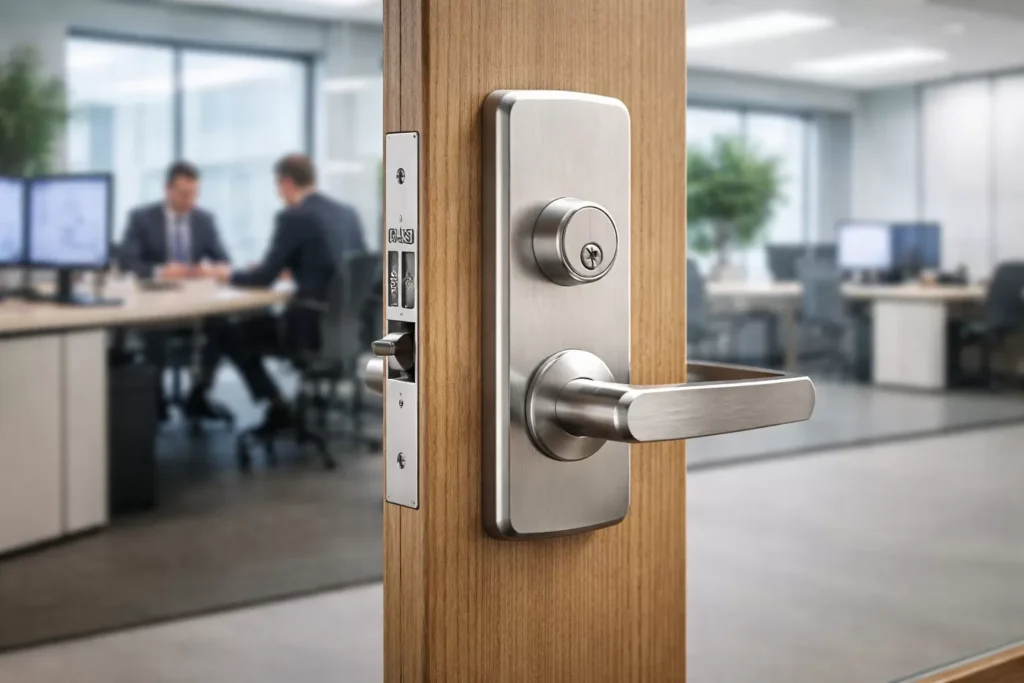
Demystifying ANSI/BHMA Standards: What Makes a Lock \”Grade 1\”?
When outfitting a commercial facility, facility managers and procurement teams constantly face a critical question: Will this hardware actually withstand the daily grind of our operations? As a dedicated lock manufacturer and supplier, we know that vague promises of durability are never enough. This is where ANSI Grade 1 door locks come into play. Earning this designation requires passing the most punishing tests in the industry.
The Role of BHMA Certification
The Builders Hardware Manufacturers Association (BHMA) sets the objective benchmark for hardware performance. BHMA certified commercial locks undergo rigorous, independent testing protocols to ensure they meet the strict requirements of the American National Standards Institute (ANSI). Grade 1 is the absolute highest standard achievable, engineered specifically for heavy-duty commercial applications where mechanical failure is simply not an option.
Unmatched Lock Cycle Testing Standards
In a bustling B2B environment, doors open and close hundreds of times a day. Grade 1 hardware is built specifically to endure this relentless high-volume traffic.
- 1 Million Cycles: To achieve Grade 1 status, a lock must successfully operate for at least one million full cycles without failure.
- Operational Integrity: This massive testing threshold guarantees that the internal springs, levers, and cylinders will not degrade prematurely, eliminating constant maintenance calls and facility downtime.
Superior Physical Intrusion Resistance
Security threats in enterprise facilities go beyond standard wear and tear. Our Grade 1 locks are engineered to deliver exceptional physical intrusion resistance against aggressive, brute-force attacks.
- Impact Resistance: Designed to withstand extreme blunt-force impacts and heavy prying without yielding.
- Anti-Drill & Anti-Pick: Integrated with specialized hardened steel pins and cylinder guards to thwart sophisticated bypass attempts and drilling.
- Reinforced Chassis: Heavy-duty internal construction prevents the lock body from collapsing under severe pressure.
Commercial Deadbolt Durability & Mechanics
The secret to commercial deadbolt durability lies in the uncompromising internal engineering. We manufacture our Grade 1 deadbolts with exact engineering tolerances to guarantee maximum structural security.
- Extended Bolt Throws: A solid 1-inch minimum deadbolt throw ensures deeper, more secure penetration into the door frame.
- Heavy-Duty Strikes: Ovesized, reinforced strike plates are anchored with heavy screws to distribute impact energy deeply into the wall studs, effectively preventing kick-ins.
- Solid Construction: Critical internal components are machined from solid steel or brass, eliminating the structural weak points found in lower-grade, hollow-cast hardware.
The Unique Security Demands of B2B Facilities
B2B environments face completely different operational pressures than residential spaces. As a commercial lock manufacturer, we design heavy-duty commercial door hardware specifically to tackle the extreme demands of enterprise operations.
- High-Volume Foot Traffic: Hundreds of employees, visitors, and vendors push, pull, and slam commercial doors daily. Standard hardware breaks down fast under this relentless wear and tear. Reliable high-traffic door locks require the massive cycle-tested endurance that only ANSI Grade 1 door locks can consistently deliver.
- Asset and Data Protection: A typical commercial facility houses server rooms, inventory warehouses, and sensitive document storage. Exceptional physical intrusion resistance is mandatory. Pairing Grade 1 mechanical deadbolt durability with an advanced commercial door smart lock creates a formidable barrier against unauthorized access while maintaining a detailed audit trail.
- Compliance and Liability: Commercial spaces are heavily regulated. Building security compliance, strict insurance requirements, and life-safety codes leave no room for hardware failures. Installing BHMA certified commercial locks ensures your B2B facility security solutions meet all legal and safety mandates, protecting your business from costly liabilities and potential breaches.
The Tangible Business Benefits of Upgrading to Grade 1 Hardware
When we evaluate B2B security, the bottom line matters. Upgrading to ANSI Grade 1 Locks is not just about meeting a standard; it is a direct investment in the operational efficiency of your facility.
Maximizing Long-Term ROI
Paying a premium upfront for heavy-duty commercial door hardware makes financial sense. Cheaper alternatives wear out quickly under high-volume use. By installing Grade 1 hardware, we eliminate the endless cycle of frequent replacements, broken parts, and costly maintenance call-outs.
Minimizing Operational Downtime
A broken door mechanism disrupts the entire workday. When employees are locked out or supply rooms become inaccessible, productivity stops. Grade 1 locks are explicitly engineered to prevent these unexpected mechanical failures, ensuring your daily operations run without a hitch.
Seamless Enterprise Security Integration
Modern facilities require physical hardware that works flawlessly with advanced technology. Grade 1 mechanical locks integrate easily with modern commercial access control systems. Whether you are upgrading an entire office wing or adding a reliable smart door lock for business to secure sensitive server rooms, Grade 1 hardware provides the robust mechanical foundation required for hybrid enterprise security hardware.
Quick Benefit Breakdown
| Business Benefit | Grade 1 Lock Advantage | Impact on Operations |
|---|---|---|
| Cost Efficiency | Eliminates frequent replacements | Delivers high long-term ROI |
| Reliability | Withstands constant heavy use | Prevents lock-out downtime |
| Scalability | Pairs with electronic access | Future-proofs facility security |
Grade 1 vs Grade 2 Locks: The Risk of Settling
As a commercial Lock Manufacturer and Supplier, we frequently see businesses try to cut initial costs by installing Grade 2 or Grade 3 hardware. In a demanding B2B environment, this approach creates immediate vulnerabilities. Grade 2 and Grade 3 locks are engineered for residential or light commercial use. When exposed to the relentless traffic of a modern enterprise, their operational failure points become obvious very quickly.
Operational Failure Points of Lower Grade Locks
Deploying subpar hardware in strict B2B environments leads to specific, predictable failures:
- Insufficient Cycle Testing: Grade 3 locks are tested to just 200,000 cycles, and Grade 2 reaches 400,000. In contrast, ANSI Grade 1 door locks must survive over 1 million cycles, ensuring they handle high-volume foot traffic without internal mechanism failure.
- Weak Physical Intrusion Resistance: Lower-tier locks lack the hardened steel pins, anti-drill plates, and heavy-duty strike plates necessary to withstand blunt-force attacks or picking attempts.
- Compromised Deadbolt Durability: Grade 2 and 3 deadbolts often feature shorter bolt throws and weaker internal metals, making them highly susceptible to kick-ins and forced entry.
The Hidden Costs of \”Good Enough\” Hardware
Accepting \”good enough\” hardware ultimately costs your business more. When a Grade 2 lock fails prematurely, you face emergency locksmith fees, immediate operational downtime, and the cost of replacement hardware. Worse, a mechanical failure or successful breach can result in stolen assets and compromised data.
Whether you are securing high-traffic exterior doors or consulting a smart locker lock guide to protect employee assets indoors, your foundation must rely on strict BHMA certification standards. Relying on true Grade 1 hardware eliminates the constant cycle of maintenance and replacement, delivering true long-term security.
Key Industries That Mandate Grade 1 Security
Certain sectors simply cannot afford to cut corners when it comes to access control. As a dedicated lock manufacturer and supplier, we consistently see specific B2B environments where ANSI Grade 1 door locks are not just recommended, but strictly required.
Here are the primary industries that rely heavily on top-tier enterprise security hardware:
- Healthcare Facilities and Hospitals: Protecting restricted pharmaceuticals and sensitive patient data demands heavy-duty commercial door hardware that resists tampering and won\’t fail under constant daily use.
- Educational Institutions and Campuses: Schools and universities require reliable locks for rapid lockdown capabilities. Securing classrooms quickly and effectively is crucial for ensuring student and staff safety during emergencies.
- Industrial Manufacturing and Warehouses: Securing heavy machinery, equipment, and high-value supply chains requires exceptional physical intrusion resistance. In these rigorous environments, combining Grade 1 perimeter security with robust lock-out stations ensures comprehensive facility safety and strict compliance.
- Government and Financial Institutions: High-target facilities depend entirely on BHMA certified commercial locks. These environments demand the absolute highest level of deadbolt durability to protect critical assets, cash flow, and classified information from sophisticated physical attacks.
In these high-stakes environments, B2B facility security solutions must perform flawlessly to prevent unauthorized access and protect critical infrastructure.
Choosing the Right Lock Manufacturer and Supplier
When sourcing ANSI Grade 1 door locks, partnering with a supplier that understands enterprise-level procurement is non-negotiable. B2B facilities demand exact engineering tolerances to guarantee heavy-duty commercial door hardware performs flawlessly under daily pressure. As a trusted smart lock manufacturer in China, we know that delivering consistent physical intrusion resistance and exceptional deadbolt durability requires strict adherence to BHMA certification standards across every production run.
Selecting a commercial door lock supplier goes beyond just checking off a spec sheet. You need a partner capable of supporting global enterprise security hardware rollouts.
Here are the critical factors to evaluate when choosing your lock manufacturer and supplier:
- Supply Chain Reliability: Consistent, on-time delivery is vital to keep your facility upgrades or construction schedules moving without costly delays.
- Bulk Order Capabilities: True B2B partners can scale wholesale commercial locksets rapidly while maintaining rigorous lock cycle testing standards on every unit.
- Comprehensive Warranties: A manufacturer must stand behind their hardware. Strong warranties protect your investment and validate the hardware\’s long-term endurance.
- Expert Technical Support: Direct access to engineering teams ensures your mechanical hardware integrates seamlessly with modern commercial access control systems.
Frequently Asked Questions (FAQs)
What is the exact difference between ANSI Grade 1 and BHMA certification?
ANSI (American National Standards Institute) establishes the strict performance criteria for commercial hardware. BHMA (Builders Hardware Manufacturers Association) is the accredited body that actually executes the testing and issues the certification. When we manufacture heavy-duty commercial door hardware, earning that BHMA certification proves the lock has met or exceeded ANSI\’s Grade 1 standards for physical intrusion resistance and deadbolt durability.
How often do ANSI Grade 1 locks need to be replaced in a high-traffic B2B setting?
Because they must pass demanding lock cycle testing standards of at least one million cycles, ANSI Grade 1 door locks are built to last for decades. In a high-traffic B2B environment—such as a hospital or a bustling warehouse—you rarely need to replace them. This extreme durability eliminates the constant maintenance and replacement costs associated with lower-grade hardware.
Can Grade 1 mechanical locks easily integrate with existing electronic enterprise security systems?
Absolutely. High-grade mechanical hardware is specifically engineered to work seamlessly alongside modern commercial access control systems. When sourcing B2B facility security solutions from a reliable electronic door lock factory, you will find that heavy-duty mechanical chassis provide the necessary foundation for electric strikes, electronic readers, and smart access integrations.
Are ANSI Grade 1 locks legally required for specific commercial building codes?
In many jurisdictions and specific industries, yes. Local building codes, fire safety regulations, and ADA accessibility laws frequently mandate the use of Grade 1 hardware on fire-rated and high-occupancy commercial doors. Using uncertified locks in these scenarios fails building security compliance and opens your business to significant liability.