
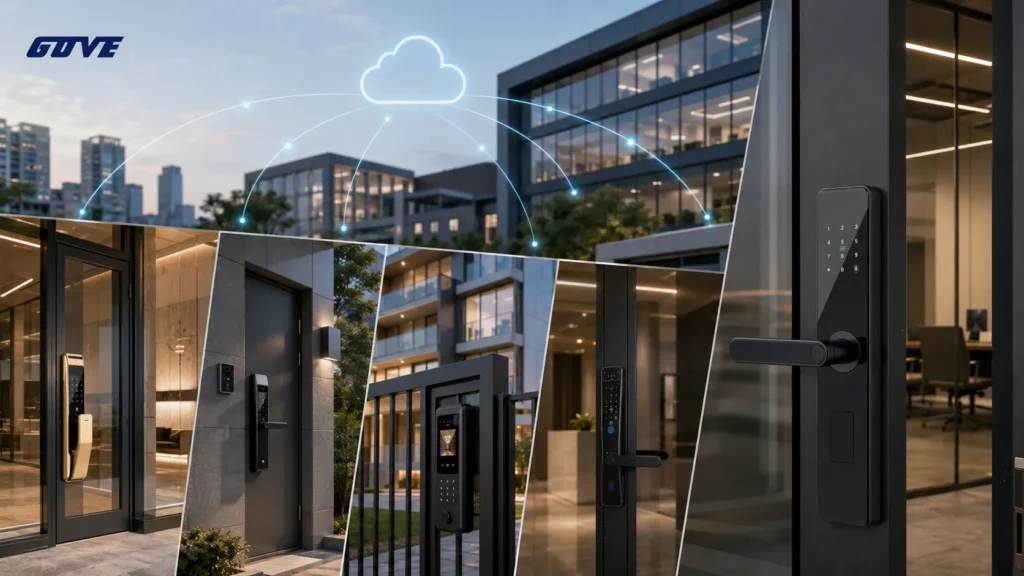
If your expansion plan treats security as a list of cameras and locks to add, you’re buying a future rip-and-replace project. The real difference between systems that stifle growth and those that enable it is architecture, not device count.
Organizations that invest in scalable security solutions early avoid forced hardware cycles and gain a framework that bends with the business. Here’s what happens when architecture is an afterthought:
- Capital cycles lock you into hardware refresh every 3–5 years.
- Management overhead multiplies faster than new doors.
- Regulatory drift creates audit exposure with each new site.
The Core Logic of Scalable Security: Beyond “Adding More Cameras”
A scalable security solution maintains consistent protection, detection, and response quality as the number of endpoints grows. It’s not about adding more cameras; it’s about the system’s ability to handle a 10x increase in devices without a 10x increase in management complexity or cost.
The architecture separates two layers that traditional systems keep locked together: the physical hardware (locks, readers, cameras) and the intelligence layer (management software, policy engines).
When you remove that dependency, adding a new site or 500 new doors no longer forces a software upgrade or hardware overhaul.
Linear vs. Exponential Growth in Security Systems
Two scaling patterns usually show up on the facility floor:
- Linear scaling – you add more of the same device but also add proportional management overhead. Each site gets its own server, its own access control panel, its own local admin. The total cost of ownership rises in lockstep with growth.
- Exponential scaling – the system leverages centralized management and intelligent edge processing so that 50 sites don’t require 50 separate control rooms. Each new endpoint carries a smaller marginal management cost because policies, updates, and monitoring are automated from a single plane of glass.
The mistake is treating scalability as a capacity question. It’s a design question. If your current system requires a forklift upgrade to add a new building, the architecture is already failing the growth test.
This is why modular security architecture matters more than the initial price tag.
Legacy vs. Scalable Architecture: A Technical Comparison
The table below isolates the five areas where architectural decisions make the biggest difference to long-term cost and operational agility. When procurement teams compare quotes, these are the rows that often get overlooked.
| Feature | Legacy / Fixed Systems | Scalable Modular Systems |
|---|---|---|
| Hardware replacement | Proprietary, single-vendor lock-in; replacing a controller often means replacing all downstream readers and wiring. | Standards-based components; new edge devices or door controllers can be mixed from validated vendors without a full refresh. |
| Centralized visibility | Site-by-site management; each location runs a local server with isolated databases. Global view requires manual data aggregation. | Unified dashboard across all sites; real-time event correlation and reporting from a cloud or hybrid VMS. |
| Integration (APIs) | Closed protocols; integration with HR systems, visitor management, or alarm monitoring requires expensive middleware or custom development. | Open RESTful APIs and webhooks that allow API-driven integration with third-party applications without per-connection fees. |
| Compliance updates | Manual firmware pushes per device; inconsistent patch levels create audit findings, especially in regulated industries. | Over-the-air (OTA) bulk updates with rollback capability; audit logs are automatically centralized and cryptographically signed. |
| Storage expansion | Fixed DVR/NVR with limited drive bays; adding storage means replacing the appliance or buying an expensive expansion unit. | Hybrid-cloud storage; local edge storage handles retention policy locally while the cloud scales elastically for long-term archive without hardware swaps. |
When a system fails on two or more of these rows, the hidden cost usually surfaces around year three. The team starts writing business cases for a “refresh” that looks suspiciously like the original deployment they just paid off.
Three Pillars of a Growth-Ready Security Framework
Every architecture that survives multiple business cycles without a redesign rests on three technical pillars. Miss one, and you’ll be back in procurement sooner than you expect.
1. Modular Hardware and Edge Processing
Scalable design starts at the door, not in the server room. Hardware must be modular: field-replaceable controllers, interchangeable readers, and locks that operate on open standards. This is where modular security hardware pays for itself.
- Field-replaceable controllers prevent single-vendor lock-in and reduce per-door cost over time.
- Edge decision-making keeps WAN traffic flat even as endpoints double, avoiding bandwidth bottlenecks.
- Standardized modular surveillance systems allow cameras from any ONVIF-compliant vendor, future-proofing the investment.
Edge processing is the missing piece that prevents bandwidth collapse. Instead of streaming raw video or raw card-swipe data to a central server for every event, edge devices make access decisions locally and only send metadata or exceptions.
That design keeps the wide-area network load nearly flat even when you double the endpoint count. It’s a key enabler for distributed infrastructure protection across campuses and remote facilities.
2. Cloud-Native Centralized Management (VMS)
A cloud-native VMS doesn’t mean dumping all video to the public cloud. It means the management plane—user directories, access policies, firmware policies, audit trails—lives in a centralized, multi-tenant environment while video and card data stay local until needed.
This is the edge-to-cloud security model: local resilience, global intelligence.
- Centralized security management ensures policy consistency globally—a single directory push disables access across all sites in minutes.
- Multi-tenant architecture separates business units or client sites without duplicating infrastructure.
- Real-time audit trails eliminate per-site server maintenance and manual log aggregation.
When a terminated employee’s badge must be disabled across 80 doors in 12 countries within minutes, centralized management turns a logistical nightmare into a single operation.
3. Protocol Standardization (ONVIF and SIA)
Proprietary communication protocols are the main reason companies get locked into multi-year hardware refresh cycles.
If your video encoder only talks to one brand of VMS, or your access controller only accepts a single reader type, growth becomes a negotiation with a vendor, not an engineering decision.
- ONVIF compliance ensures video devices from different manufacturers interoperate without custom drivers or middleware.
- SIA OSDP provides encrypted, bidirectional communication between readers and controllers, improving both security and flexibility.
- Standardized protocols turn a closed “system” into an open platform, lowering the per-door acquisition cost and future migration effort.
The enterprise access control systems that scale most cleanly enforce these protocols from the first door, not retrofit them later.
The Strategic Role of Compliance in Scalable Design
Compliance Doesn’t Scale Without Automation
Scalable systems must automate compliance logging across every node.
If you’re still pulling manual audit reports from individual door controllers to satisfy a SOC 2 or NIST 800-53 control, you’re carrying a risk that compounds with each new site.
- Inconsistent firmware versions – one lagging site can fall below the encryption baseline required by NIST 800 Series compliance, breaking the entire chain of trust.
- Fragmented access logs – separate databases at each location make it nearly impossible to produce a unified audit trail in the time regulators expect.
- Policy drift – local admins start making exceptions that violate corporate policy because the central configuration can’t reach their gear.
In regulated industries, a scalable architecture is also your compliance scalability plan. The two cannot be designed separately.
The TCO of Scalability: Why “Fixed” Systems Cost 3x More
The total cost of ownership for scalable security systems is significantly lower over a seven-year horizon because they eliminate recurring rip-and-replace capital costs and shrink per-door operational expenses as the system grows.
The first budget sheet never tells the whole story: a fixed-capacity system looks cheaper on Day 1 because you’re buying only what you need now. By year four, the situation reverses.
The Hidden Cost of Rip-and-Replace
Rip-and-replace cycles are the largest hidden cost. A campus that outgrows its door controller density in year three must often replace the panels, the power supplies, the wiring infrastructure, and sometimes the readers themselves.
That capital outlay, repeated every 48-60 months, can easily push total costs to three times the original deployment budget over a seven-year span. A scalable design absorbs the same growth with incremental hardware adds and zero rework.
Day-2 Operational Expenses Multiply
Day-2 operational costs widen the gap further. Non-standardized systems require manual audits, per-site firmware pushes, and more truck rolls for simple changes.
With a centralized, standardized architecture, the per-door operational cost drops as the system grows because the management workload no longer scales with the number of doors.
Scalability Audit: A Checklist for Vendor Selection
Use this table when evaluating hardware and software vendors. If a supplier can’t answer the verification questions clearly, treat it as a red flag for future scaling costs.
| Technical Requirement | Why it Matters for Growth | Verification Question for Vendor |
|---|---|---|
| Open API availability | Prevents integration dead-ends when you add HR, visitor management, or alarm systems later. | “Can you show me the public REST API documentation and a live integration example with a third-party identity provider?” |
| Multi-tenant support | Allows different business units or client sites to be managed separately under one platform without duplicating infrastructure. | “Does your system support hierarchical multi-tenancy with delegated administration and role-based access at the site level?” |
| Hybrid-cloud compatibility | Lets you keep video and access decisions local to survive WAN outages while still managing globally. | “Prove that all door access decisions continue to work if the cloud connection drops for 24 hours.” |
| OTA firmware updates | Bulk firmware management is the only way to keep 100+ door controllers at the same security baseline without sending technicians to every site. | “Can you push a firmware update to all controllers globally from a single console, and what is the rollback process?” |
| Protocol certification | ONVIF Profile S/G and SIA OSDP certification guarantee device interchangeability, which lowers per-door acquisition cost and future-proofs the hardware. | “Show me certificates for the ONVIF profiles and OSDP versions your controllers and readers currently support.” |
Case Study: Scaling Security Across 50+ Global Locations
The Fragmented Starting Point
Consider a logistics firm that spent four years stitching together local security systems at each distribution center—different access control brands, different DVRs, different local installers.
When the global security director needed to lock down a site during an incident, the response time depended entirely on whether the site manager picked up the phone. Mean time to respond often stretched to 20 minutes or more.
Migration to a Unified Platform
The company migrated to a single-pane-of-glass architecture using standardized edge controllers and a cloud-based VMS.
They kept their existing IP cameras where ONVIF compliance was already present and replaced controllers with commercial access control locks that spoke OSDP natively. Centralized policy now allowed one operator to disable badge access globally in under 30 seconds.
- Centralized lock-down time dropped from 20+ minutes to under 30 seconds.
- Annual per-site security administration costs fell roughly 40%.
- New 10,000-square-foot facilities now come online within a week, using the same standardized hardware stack.
The shift reduced the annual cost per site for security administration by roughly 40%, mostly by eliminating duplicate on-site servers and manual audit labor.
More importantly, the architecture now absorbed a new facility in the same week it came online, with no procurement delay beyond ordering the standardized door hardware.
Ready to Modernize Your Security Infrastructure?
Most enterprise teams benefit from a structured scalability assessment that maps their current site portfolio against a modular growth framework. It identifies where rip-and-replace risk is highest and what sequence of upgrades makes financial sense.
A focused scalability assessment audits your door density, protocol compliance, and management tooling across locations. The output is a technical roadmap—not a product pitch—that highlights the most urgent gaps.
A 15-minute conversation with our engineering team can clarify whether your architecture is ready for the next expansion phase.
Frequently Asked Questions
Can I scale my existing legacy analog system without a full replacement?
Hybrid encoders can bridge analog cameras into an IP-based VMS, extending useful life by a few years. However, the analytics, remote firmware management, and license-plate recognition capabilities will remain limited. Plan the bridge as a temporary phase, not a permanent solution.
What is the difference between “elastic” and “scalable” security?
Elastic security scales both up and down, matching resources to demand in real time—useful for pop-up clinics or construction sites that close after six months. Scalable security typically focuses on steady, sustained growth. Both rely on the same modular, software-defined architecture but have different capacity-planning patterns.
How does cloud-based security affect bandwidth as we add sites?
With edge processing and local storage, only metadata, thumbnails, and policy updates travel across WAN links. Full video streams stay on-site unless explicitly pulled for an investigation. SD‑WAN steering and local edge playback further reduce the impact, so adding a new site rarely forces a costly bandwidth upgrade.