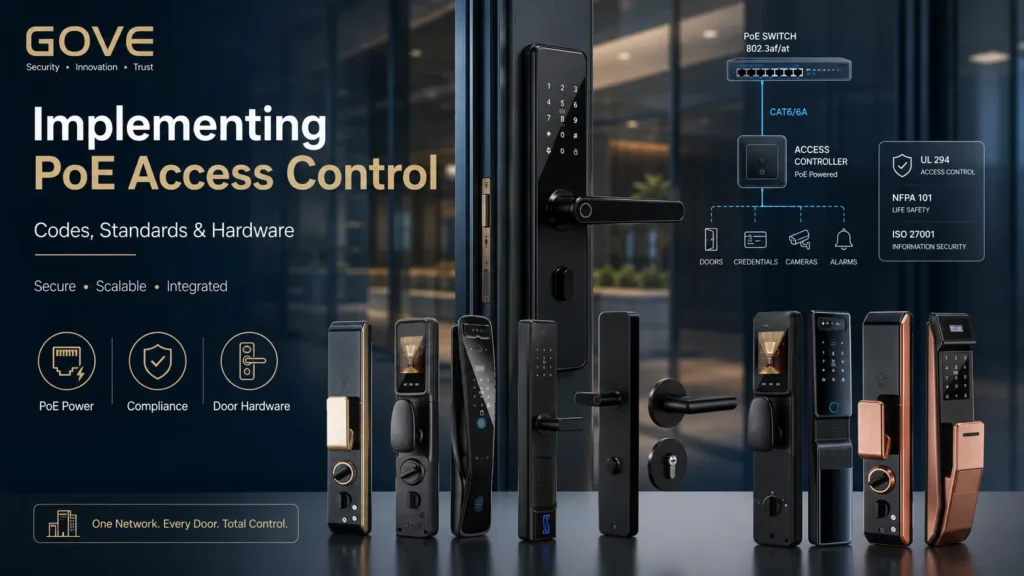
The biggest hidden cost in traditional access control isn’t the hardware — it’s the electrical wiring. We’ve seen deployments where running AC power to each door added 40% to the total project budget. PoE access control changes that equation by merging power and data into a single network cable.
For enterprise buyers, that means far fewer licensed electrician hours, simpler infrastructure planning, and centralized power backup through the IT closet. The real procurement question isn’t whether PoE works, but which standard you need and how to design around its constraints before your locks fail a fire inspection.
Understanding PoE Access Control: How It Bridges IT and Security
Decision rule: PoE access control uses a single Category (Cat5e/Cat6) cable to deliver both low-voltage DC power and network data directly to an edge door controller, eliminating the need for dedicated high-voltage AC outlets at every opening. This shifts physical security from a standalone electrical burden into a managed IT service.
Centralized Panels vs. Edge PoE Access Control Topology
In a conventional centralized architecture, multiple doors home-run heavy-gauge wiring back to a single access control panel. That panel needs a dedicated power supply, battery backup, and often a separate enclosure. In contrast, edge-based PoE topologies place an edge door controller at each door, powered and networked by one Cat6 drop from a PoE network switch. The difference in cable density alone can halve the wire-pulling labor for a mid-sized facility. It also reduces single-point-of-failure risk: if the centralized panel fails, all connected doors go offline; an edge controller failure affects only one door.
From an IT perspective, edge PoE controllers sit on the corporate network as managed endpoints. The security integrator only needs to run low-voltage Ethernet, not conduit, to each door. For facilities spread across multiple floors or buildings, this topology drastically simplifies expansion — you install a new edge controller for every additional opening and patch it into the nearest PoE switch.
The Mechanics of Power and Data Over Ethernet
At the hardware level, a PoE-enabled network switch or midspan injector sends DC power over unused wire pairs in the Ethernet cable while data travels simultaneously. The edge controller at the door separates power and data, then distributes conditioned voltage to the card reader, request-to-exit sensor, and the locking device. This is where our edge controller architecture evaluation becomes critical: the controller must manage power shedding, offline caching, and local I/O logic. In a PoE deployment, the edge controller is the intelligence center for that door; a well-designed unit can continue operating for hours using cached access permissions even if the upstream network link drops.
Technical Standards: Evaluating IEEE 802.3af, 802.3at, and 802.3bt
Procurement takeaway: Selecting the right PoE standard depends entirely on the combined power draw of the door controller, card reader, and electrified locking hardware, with 802.3at (PoE+) serving as the enterprise baseline for most doors with electric strikes or maglocks.
IEEE 802.3af (PoE) vs. IEEE 802.3at (PoE+)
802.3af delivers up to 15.4 watts at the switch port, but after cable losses, the device typically sees no more than 12.95 watts. This may suffice for a low-power reader and a light-duty electric strike, but it’s rarely enough for a magnetic lock (maglock) that can draw 6–12 watts continuously. We recommend 802.3at (PoE+) as the minimum enterprise standard. It provides up to 30 watts at the port (25.5 watts available), giving headroom for an edge controller (3–5W), a multi-technology reader (1.5–3W), and an electric strike pulling 7–9W during activation. Our internal power audits consistently show that 802.3af leaves zero margin for peak loads, especially when a PIR sensor or door position switch is added.
IEEE 802.3bt (PoE++ / High-Power PoE)
For doors that demand a heavy-duty magnetic lock, a touchscreen reader, and auxiliary sensors, 802.3bt Type 3 (60W) or Type 4 (90W) becomes necessary. This standard supports a much wider range of locking hardware without requiring a local power injector. We most often see 802.3bt used in high-security vestibules, perimeter doors with continuous-duty maglocks, and doors where a separate power supply would be difficult to maintain. However, enterprise switches that support 802.3bt can be significantly more expensive, so we advise procurement teams to audit only the doors that truly need the higher power budget and design the rest around PoE+.
Understanding Voltage Drop and Distance Limitations
Resistance in copper cabling causes voltage to drop over distance, reducing the usable wattage at the door. Over a full 100-meter run, a 30W PoE+ port may deliver only 22–25W at the endpoint. That’s why we emphasize calculating the power budget at the door, not at the switch. The table below provides typical draw values to help system designers size their PoE standard and switch port allocation.
| Component | Typical Power Draw (Watts) | Notes |
|---|---|---|
| Edge controller | 3–5 | Includes processor, memory, and onboard I/O |
| Multi-technology IP reader | 1.5–3 | Higher for large touchscreen readers |
| Electric strike | 3–9 | Peak during actuation; varies by model and tolerance |
| Magnetic lock (maglock) | 6–12 | Continuous draw while engaged; select low-power models when possible |
| PIR / door position sensor | 0.5–1.5 | Small, but adds up across multiple sensors |
Note: Actual draw varies by manufacturer and environmental conditions. Always verify specifications with the hardware vendor and test under full load before deployment.
The Core Benefits of Power over Ethernet Access Control
Buyer justification: PoE access control lowers total cost of ownership by reducing electrical labor costs, enabling centralized power backup through the network closet’s Uninterruptible Power Supply (UPS), and giving IT teams remote power-cycle control over every door.
Significant Reduction in Infrastructure and Cabling Costs
In a conventional electrified door, a licensed electrician must pull high-voltage line voltage to a local power supply, mount a separate backbox, and often coordinate with fire alarm wiring. With PoE, a low-voltage technician runs a single Category cable from the nearest IT closet to the edge controller. That one cable carries both data and power, eliminating the need for per-door AC circuits. For a 100-door campus retrofit, the electrical labor savings can reach tens of thousands of dollars. Additionally, using commercial access control locks designed for low-voltage operation eliminates the need for step-down transformers at each door frame.
Simplified Centralized Backup and Power Redundancy
When a building loses power, every door in a PoE-based system that’s connected to a switch with a Uninterruptible Power Supply (UPS) remains operational. That’s a stark contrast to traditional systems where each door relies on a local battery backup that may or may not have been tested recently. IT departments already maintain UPS capacity for servers and network switches; extending that protection to door hardware is a natural advantage. We recommend specifying managed PoE switches that allow remote power-cycling of individual ports, enabling an IT administrator to reboot a malfunctioning edge controller without dispatching a technician.
Scalability and Remote Management Capabilities
Because each door becomes an independent IP node, adding new doors is a matter of provisioning a new PoE edge controller and connecting it to a switch. There’s no need to assess whether the centralized panel has spare reader ports or relay outputs. This modularity simplifies both enterprise access control expansions and multi-building rollouts. Remote firmware updates, real-time diagnostics, and instantaneous door status visibility all become part of the IT network management dashboard, reducing the time security teams spend on troubleshooting.
Crucial Limitations and Challenges of PoE Access Control
Engineering takeaway: The primary engineering limitations of PoE access control are its strict 100-meter (328-foot) distance ceiling and its constrained power budgets, which can prevent the use of high-draw magnetic locks or multiple ancillary devices without careful planning.
Critical Limitations of the 100-Meter Distance Limit
The Ethernet standard imposes a 100-meter limit on copper cable runs from the switch to the device. For large warehouses, sprawling campuses, or historical buildings where IT closets are far from entry points, this can be a showstopper. We’ve solved this on retrofits using PoE extenders over 2-wire or coax, media converters over fiber, or by placing compact hardened switches nearer to door clusters. However, each of those workarounds introduces additional hardware and potential points of failure. Before committing to PoE, facilities teams must map every door location and verify that a compliant cable path exists within the distance limit.
Power Budget Shortages for Electrified Locking Hardware
An ordinary magnetic lock rated for continuous duty can easily consume 10–12 watts, pushing a PoE+ link beyond its reliable limit when combined with the controller and reader. The result can be intermittent lock failure or controller reboots under load. Our field reports show that many integrators underestimate the total inrush current during lock actuation. The safest approach is to add up all components’ maximum draw, add a 20% buffer, and then confirm that the switch’s per-port power budget can sustain that level across all connected doors simultaneously. This is where a smart door lock for business designed specifically for PoE efficiency becomes a procurement priority.
Single-Point-of-Failure Vulnerabilities at the Switch Level
If a PoE switch fails or is taken offline for maintenance, every door connected to that switch loses both network communication and power. In a centralized panel system, a failed panel similarly impacts all homerun doors, but in an edge topology the failure domain is limited to the switch’s port group. Mitigation strategies include redundant power supplies for the switch, stacking multiple switches with link aggregation, and configuring PoE access control panels or controllers with local supercapacitor backup that keeps the lock powered briefly during switch transitions. We also recommend maintaining a local emergency key override at every door, regardless of the access control architecture.
Life Safety, Fire Code Integration, and Regulatory Compliance
Compliance priority: Compliance with NFPA 101 (Life Safety Code) and local fire regulations requires a reliable mechanism to automatically cut power to fail-safe locks during a fire event, regardless of network or software status. This is non-negotiable for occupancy permits.
Fail-Safe vs. Fail-Secure Lock Configurations
A fail-safe lock (e.g., a magnetic lock) unlocks when power is removed. This is the default code-required configuration for egress doors along fire exit routes. A fail-secure lock (e.g., an electric strike) remains locked when power is lost, requiring a mechanical key or thumbturn for egress. In a PoE environment, the power to a maglock can be cut by de-energizing the PoE port itself or by cutting power at an inline relay. Choosing the wrong lock type for a fire-rated door will cause inspectors to deny the certificate of occupancy, so facility managers must confirm the fire marshal’s requirements before hardware specification.
Fire Alarm Control Panel (FACP) Integration
In a traditional hardwired system, a dry contact relay from the fire alarm control panel physically interrupts the power supply to the lock. For PoE, you can achieve the same outcome in three ways:
- Switch-level integration: Use network switches that have dedicated FACP input terminals capable of de-energizing designated PoE ports upon an alarm trigger.
- Local IP relay controller: Install a small IP-controlled relay near the door that cuts power to the lock when a fire alarm signal is received from the panel, independent of the switch.
- Edge controller with auxiliary input: Specify PoE edge controllers that include a supervised fire alarm input; upon activation, the controller drops power to the fail-safe lock output.
Each method has different cost and reliability implications. We advise buyers to engage the local fire marshal early in the design phase and confirm which integration method is acceptable, rather than assuming the network switch alone will satisfy code.
Navigating UL 294 and NFPA 101 Standards
What to verify: Enterprise buyers must confirm that both the edge controller and the overall deployment design carry a valid UL 294 (Standard for Access Control System Units) certification. UL 294 evaluates the system’s attack resistance, endurance, and line security. As for NFPA 101, the key requirement is that all occupied spaces have one unlocking operation for egress without prior knowledge or use of a special tool, even during a power failure. In a PoE system, this typically translates to ensuring that fail-safe doors receive power from the switch only when the fire alarm relay is in its normal (non-alarm) state. We recommend referencing industry knowledge on access control and local amendments before finalizing the bill of materials.
Hardware Selection: Aligning Locks, Readers, and Edge Controllers
Engineering priority: A successful PoE access control deployment relies on choosing high-efficiency, low-power locking hardware that operates safely within standard PoE/PoE+ power budgets, paired with edge controllers that support offline cached access.
Low-Power Electrified Locks and Strikes
Not all electric strikes are created equal. Models with high in-rush currents can momentarily spike beyond the PoE port’s capacity, causing a brownout or lock chatter. We look for strikes and locks that the manufacturer specifically rates for low-voltage, low-current operation, ideally under 300mA at 12V or 150mA at 24V. This often means selecting pre-load or buzzer-release strikes that actuate with minimal power. For magnetic locks, we prioritize units with integrated door position switches and standby current draw below 350mA. Many of the commercial access control locks we evaluate now include PoE-optimized models with built-in efficiency circuits that significantly reduce heat buildup and continuous draw.
Touchscreen and Multi-Technology IP Readers
A large touchscreen reader supporting HID, mobile credentials, and NFC can draw 3–4 watts by itself, leaving less margin for the lock. In a PoE+ configuration, that’s still manageable if the lock is a low-power electric strike. But for a maglock door, the combination may exceed 25.5 watts. In those cases, we either step up to 802.3bt or consider a reader that offloads heavy processing to the edge controller. The reader should also support OSDP for secure communication over RS-485 if the edge controller cannot pass TCP/IP all the way to the reader.
Evaluating High-Efficiency PoE Controllers
An edge controller that consumes 5 watts rather than 3 watts may seem trivial — until you multiply by 100 doors and factor in switch power budget limits. We recommend controllers with power management features like:
- Dynamic power shedding to temporarily reduce reader backlight or lock duty cycle during insufficient power
- Local supercapacitor or battery that sustains the controller for a few minutes if the switch reboots
- Firmware-configurable power profiles that let you cap the total draw per door
The controller must also support offline mode with local access decisions, as a temporary network outage shouldn’t lock employees out. For companies upgrading to smart door locks for business, compatibility with the existing IP reader infrastructure and PoE standard is essential.
B2B Procurement Blueprint: PoE Access Control Decision Matrix
Sourcing framework: Before procuring a PoE access control system, engineering teams must map out a comprehensive deployment matrix comparing edge-based PoE controllers against traditional centralized panel architectures to make an informed total cost and reliability decision.
Deployment Architecture Comparison Matrix
The table below provides a structured comparison across the key operational metrics that matter most to IT directors and facility managers.
| Metric | Centralized Panel System | PoE Edge Access Control |
|---|---|---|
| Electrical labor cost per door | High (licensed electrician for AC, multiple wire runs) | Low (low-voltage Ethernet; single cable run) |
| Cable density per door | Multiple heavy-gauge homeruns | One Cat5e/Cat6 cable |
| Single point of failure | Panel failure affects all doors on that panel | Switch failure affects doors on that switch; controller failure affects one door |
| Ease of expansion | Requires available panel I/O ports; limited scalability | Add a new edge controller and switch port; highly modular |
| Compliance integration | Physical fire relay interrupt at panel power supply | Relies on switch-level FACP interface or local IP relay |
| Remote management | Often requires separate network module | Native IP; remote power-cycle, diagnostics, firmware updates |
Note: Costs and capabilities vary by manufacturer. Always confirm the specific switch, controller, and lock specifications before final procurement.
Pre-Purchase Verification Checklist for B2B Sourcing
We recommend that procurement teams complete the following steps before issuing a purchase order:
- Audit existing network switches: Identify available PoE ports and their maximum power budget per port and total. Check for 802.3at/bt support.
- Calculate per-door power budgets: Sum the max draw of the controller, reader, lock, and any sensors. Add 20% headroom.
- Map door locations: Measure cable distances from the nearest PoE switch to each door. Flag any >90 meters (to allow for patch cords and service loops).
- Verify life safety integration plan: Confirm with the local fire marshal that the chosen FACP integration method (switch-level or relay) meets code.
- Confirm UL 294 certification: Request the UL 294 listing for every controller model and validate that it applies to the full door assembly as configured.
- Check cybersecurity posture: Ensure the controllers support 802.1X, encrypted protocols, and can be logically separated onto a dedicated security VLAN.
- Pilot test one door: Deploy a single door with the exact components planned and stress-test under all network failure, fire alarm, and power-loss scenarios.
Selecting a Partner for Your PoE Access Control Deployment
Transitioning to IP access control over PoE requires close coordination between your physical security team and your corporate IT department. We see too many projects stall because the BOM was written without IT’s input on switch port capacity or cybersecurity requirements. Before engaging a vendor, have the following information ready:
- Number of doors and types of frame materials (wood, hollow metal, storefront glass) — this affects lock selection and physical mounting.
- Current network switch inventory: models, available PoE ports, existing power budget, and support for IEEE 802.3at or IEEE 802.3bt.
- Existing security software integrations (LDAP, Active Directory, mobile credential platform) and API requirements.
- Local fire code amendments and any prior fire marshal feedback on access-controlled egress doors.
This preparation lets the integrator or manufacturer provide an accurate power budget, a realistic device list, and a deployment timeline that accounts for network segmentation and life safety compliance. For organizations exploring a full portfolio of compatible locking hardware, reviewing PoE access control solutions and top PoE access control locks can streamline the specification process. If your facility uses glass storefront entries, also evaluate storefront door smart locks that work with edge PoE controllers and low-power strikes.
Ultimately, the right supplier will help you validate the power budget per door, confirm the network switch configuration, and support the FACP integration testing. We recommend placing a sample door on a trial before committing to a full fleet rollout — it’s the fastest way to surface any integration or code compliance gaps.
Frequently Asked Questions
Can PoE power a heavy-duty magnetic lock?
Yes, but only with careful power budget design. A standard maglock can pull up to 500mA at 12V or 24V (around 6–12W continuous). Using standard PoE (802.3af) leaves very little overhead for the controller and readers. Implementing PoE+ (802.3at) or a specialized low-power lock is highly recommended.
What happens to PoE access control doors during a network outage?
Enterprise-grade PoE edge controllers feature local memory and processing power. If the network goes offline, the controller continues to function using cached user permissions, logging events locally until the network connection is restored.
How does fire alarm integration work with PoE-powered locks?
For fail-safe doors, power must be cut instantly upon a fire alarm trigger. This is achieved by feeding the fire alarm relay directly into the PoE power controller or by utilizing smart network switches with physical FACP interfaces that cut port power during alarms.
Is PoE access control safe from cybersecurity vulnerabilities?
Because edge controllers reside on the company network, they must be treated as IT endpoints. Security teams should implement 802.1X network authentication, place door hardware on dedicated secure VLANs, ensure encrypted communication (such as TLS 1.3), and change all default passwords during installation. For detailed guidance, review security standards for PoE locks.
What is the maximum distance a PoE cable can run to a door?
The maximum distance for standard copper Ethernet cabling (Cat5e or Cat6) is 100 meters (328 feet). For distances exceeding this limit, engineers must deploy network switches, PoE extenders, or media converters over fiber optic lines. Always account for patch panel and service loop lengths when measuring cable paths for a PoE access control installation.