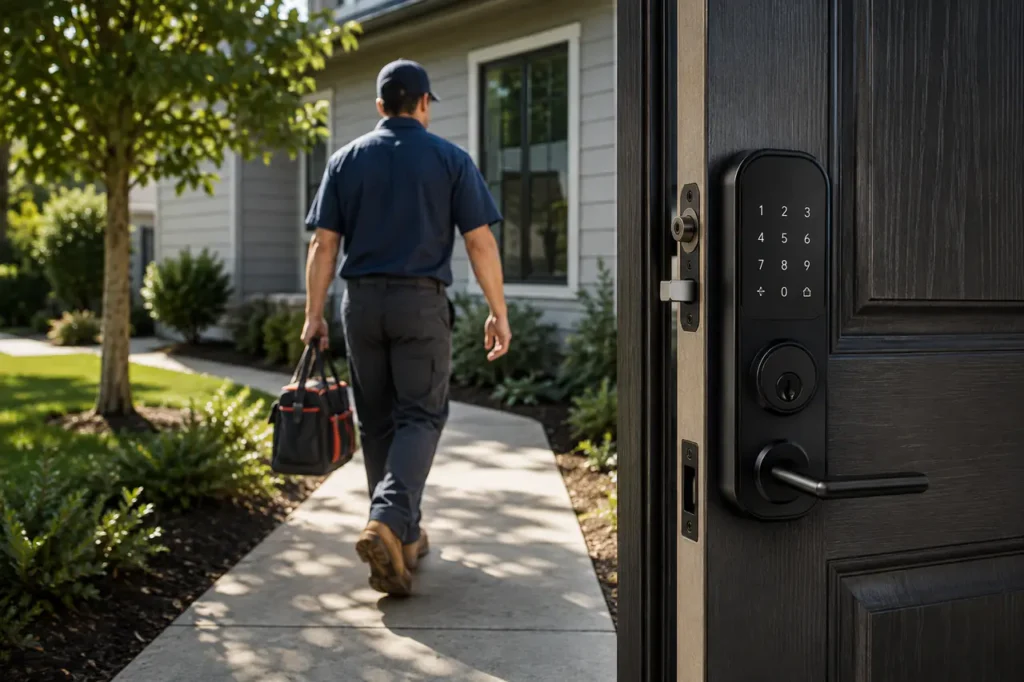
When a contractor arrives, the first question is physical access: who has the key, who can arrive first, or whether to leave a spare under a mat. A smart lock for maintenance access replaces those decisions with temporary codes, activity logs, and remote unlocking.
Core Features Required for Contractor and Maintenance Entry
A smart lock intended for service entry must do more than simply unlock with a smartphone app. To manage painters, cleaners, plumbers, and HVAC technicians without compromising property security, your lock must support specific scheduling, remote connectivity, and mechanical backup features.
Scheduling and Remote Control
- Temporary access codes and scheduled PINs: The lock should allow you to generate unique, time-restricted codes. You can configure these PINs to work only during set hours (such as Tuesdays between 9:00 AM and 1:00 PM) or expire immediately after a single use.
- Real-time audit trail logs: Activity tracking records the exact date and timestamp when a specific user code or digital key unlocked the door. This verification confirms when a contractor arrived and when they completed the job.
- Remote unlock capabilities: Built-in Wi-Fi or a dedicated bridge lets you unlock the door remotely if a technician arrives earlier than scheduled, eliminating the need to provide a persistent code.
Backup Entry and Security
- Physical key override: A traditional keyed exterior cylinder or external 9V battery terminal ensures that an unexpected battery failure will not lock out emergency service technicians during a burst pipe or electrical outage.
- Encrypted communication protocols: Locks adhering to recognized global smart lock security standards safeguard your local network against unauthorized credential interception.
Residential vs. Commercial Access: Which Fits Your Property?
The right hardware tier depends on your daily door cycle volume and whether you manage access for an individual home, a rental property, or a multi-unit facility.
Residential models emphasize simple installation and single-user app control, while commercial systems prioritize heavy-duty cycle durability and multi-door software dashboards.
| Property Scope | Hardware Grade | Software Management | Installation Type | Best For |
|---|---|---|---|---|
| Single-Family / Renter | Standard Residential (ANSI Grade 3) | Single-account smartphone app | Interior deadbolt retrofit | Homeowners, tenants, individual home contractors |
| Small Rental / AirBnB | Mid-Tier Residential (ANSI Grade 2) | App with guest code permissions | Full deadbolt replacement with keypad | Independent landlords, turnover cleaners, recurring trades |
| Multi-Tenant Residential | Commercial (ANSI Grade 1 or 2) | Centralized cloud dashboard | Commercial mortise or interconnected lock | Property managers, dedicated maintenance crews |
| Commercial Facilities | Heavy-Duty Commercial (ANSI Grade 1) | Enterprise access control system | Integrated access reader or commercial leverset | Offices, warehouses, third-party vendor access |
For standalone residences, paying for commercial enterprise software creates unnecessary complexity and recurring subscription costs.
However, deploying a lightweight consumer lock on a high-traffic entryway often leads to premature mechanical wear. Facilities handling steady vendor traffic benefit substantially from an ANSI-rated smart lock for business built to endure thousands of annual openings.
Best Smart Lock Scenarios for Single-Family Homes and Renters
Individual homeowners and apartment tenants require solutions that provide contractor access without altering existing key arrangements or violating lease agreements.
Renter-Friendly Retrofit Options
A retrofit smart lock installs directly over the interior thumbturn of your existing deadbolt while leaving the exterior lock hardware and key cylinder intact.
This approach offers two distinct advantages: you do not need to distribute new physical keys to your landlord or property manager, and you can remove the lock without damaging the door when moving out.
Maintenance teams can still use the property’s original master key from the outside, while you retain the ability to generate temporary app-based access codes or buzz contractors in remotely.
Managing One-Off Contractor Visits
For infrequent repairs-such as an appliance delivery or an emergency plumbing repair-a lock equipped with an exterior numeric keypad is the most practical choice.
Forcing a service worker to download a proprietary smartphone app and register an account often leads to delays.
Pairing a keypad with a reliable model from proven smart lock manufacturers allows you to text a temporary four-digit PIN directly to the technician.
Once the repair is complete, you can deactivate the code instantly from your phone.
Best Smart Lock Scenarios for Multi-Tenant and Commercial Buildings
Managing service access across apartment complexes or commercial buildings requires central oversight, high mechanical durability, and unified software platforms.
Unified Access Control Dashboards
Property supervisors cannot rely on individual phone apps to manage scores of doors. Multi-unit facilities require web-based access dashboards that connect all perimeter and unit locks.
Using a centralized smart lock for apartment buildings, an administrator can assign a maintenance technician digital access to three specific units undergoing routine inspections.
Once the shift ends or a contract terminates, the manager can revoke access across the entire property instantly without re-keying physical lock cylinders.
Adopting unified software platforms also streamlines operations and reduces turnover delays, illustrating why smart lock technology is vital for multifamily tech ecosystems where staff efficiency and detailed access tracking directly impact overhead costs.
Upgrading to Commercial-Grade Hardware
Maintenance staff, painters, and external contractors frequently carry bulky equipment, prop doors open, and subject entry hardware to rough handling.
Multi-family common areas and commercial maintenance corridors require ANSI/BHMA Grade 1 or Grade 2 certified locking mechanisms.
These commercial-grade locks feature reinforced internal steel clutches, weather-resistant keypads, and heavy-duty latch bolts designed to withstand continuous daily cycling without jamming or failing.
How to Manage Temporary Codes and e-Keys Securely
A smart lock is only as secure as the access rules you set. To maintain strict control over who enters your property, follow these configuration practices:
- Assign individual codes to each vendor: Never give contractors a generic shared code. Assigning a dedicated PIN to the painter and a separate PIN to the electrician ensures your audit log clearly identifies who accessed the property.
- Apply strict time windows: Restrict vendor codes to standard operating hours (such as Monday through Friday, 8:00 AM to 5:00 PM). If a contractor attempts to enter outside their scheduled hours, the lock automatically denies access.
- Use single-entry PINs for emergency service: For after-hours emergency calls, issue a one-time PIN that self-destructs the moment the deadbolt turns back into the locked position.
- Turn on immediate entry alerts: Enable push notifications on your phone so you receive an instant alert whenever a maintenance code unlocks your door.
- Regularly audit active credentials: Periodically review your lock’s user list and delete inactive codes from completed projects to prevent dormant PINs from accumulating.
Pre-Installation Hardware and Compatibility Checks
Before purchasing a smart lock for maintenance access, inspect your physical door preparation and network environment to avoid mechanical binding and connectivity drops:
- Deadbolt latch type: Confirm whether your door uses a standard tubular deadbolt or a heavy-duty mortise cassette. Standard consumer smart deadbolts do not fit mortise preparations; these setups require a dedicated smart lock for mortise lock mechanism.
- Door material and frame profile: Standard residential locks fit standard wood and composite doors with a 2-3/8 inch or 2-3/4 inch backset. Narrow-stile aluminum doors or commercial entryways require specialized hardware, such as a smart lock for commercial glass door assembly.
- Door alignment and latch clearance: Ensure your deadbolt throws smoothly into the strike plate without requiring you to push, pull, or lift the door. Motorized smart deadbolts will bind and drain batteries rapidly if the door is misaligned.
- Wi-Fi signal strength at the threshold: Test your 2.4 GHz wireless signal with your smartphone directly outside the closed door. Reliable remote unlocking and immediate activity logging require a stable network connection at the entryway.
If your property features custom door thicknesses, narrow framing, or integrated panic bars, verify the manufacturer’s physical clearance templates or consult an access hardware specialist before placing your final order.
Frequently Asked Questions
What happens if the smart lock battery dies while a contractor is there?
Most quality smart locks provide low-battery notifications weeks in advance. If the batteries drain completely, the door can still be opened manually from the outside using a standard physical key override.
Many keypad models also feature external contact pins on the bottom of the lock housing, allowing you to hold a 9V battery against the terminals to temporarily power the keypad and enter a valid PIN.
Do smart locks work with any existing door?
Most retrofit and replacement smart deadbolts work with standard residential wood, fiberglass, or metal doors with a standard thickness of 1-3/8 to 1-3/4 inches.
However, doors with non-standard thicknesses, multi-point locking systems, integrated mortise cassettes, or narrow glass stiles require specialized commercial smart hardware designed for those specific configurations.
Can maintenance staff still use a physical master key?
Yes. If you choose an interior retrofit lock, the exterior key cylinder remains unchanged, meaning existing master keys continue to function normally.
If you install a full-replacement smart lock, select a model that uses a compatible, re-keyable mechanical keyway so you can match the new lock to your building’s existing master key system.