
Securing a commercial facility requires balancing life safety, high daily throughput, and verifiable physical authentication. A commercial RFID access control door lock system must match frequency, locking hardware, and controller architecture to the facility.
Active vs. Passive RFID Door Lock Systems
The fundamental difference between active and passive RFID door lock systems is the power source and resulting read range.
Passive credentials are unpowered and read at close proximity; active credentials carry internal batteries and can transmit from 20 to 100+ meters. This distinction also drives infrastructure cost and ongoing maintenance.
| Feature | Active RFID | Passive RFID |
|---|---|---|
| Operational Read Range | 20 m to 100+ m | Contact to 10 cm (LF/HF); up to 12 m (UHF passive tags) |
| Credential Power Source | Internal battery (typically lithium coin cell) | Unpowered (harvests energy from reader field) |
| Credential Lifespan | 3 to 7 years (dependent on beacon interval) | Virtually unlimited (no battery degradation) |
| Hardware & Credential Cost | High credential and receiver cost; specialized power supplies | Low unit cost per card or fob; standard reader infrastructure |
| Ideal Commercial Application | Perimeter vehicle gates, logistics yards, asset tracking | Interior doors, perimeter turnstiles, server rooms, elevators |
Passive RFID Systems (Proximity & Smart Cards)
Passive systems are the industry standard for interior and perimeter commercial doors. Because passive credentials lack an internal power supply, they rely on magnetic induction or electromagnetic wave capture from the reader’s interrogation field.
When a user presents a card to the reader, the credential’s internal antenna coils capture the radio frequency energy, powering the microchip to transmit its encrypted identifier. This architectural simplicity keeps passive credentials cost-effective to deploy at scale across high-turnover workforces.
Active RFID Systems (Long-Range/Powered)
Active RFID systems deploy powered transponders that continuously broadcast or periodically beacon their identification payload. These systems require specialized receivers and substantial power budgeting.
While rarely deployed on standard pedestrian interior doors due to credential size, battery replacement overhead, and cross-read risks in dense hallways, active RFID provides practical value in industrial vehicle checkpoints, gated distribution yards, and automated transit lanes where stopping to present a credential impedes traffic velocity.
Selecting the Right RFID Frequency
The operational frequency of an RFID access control system directly dictates the data transfer speed, transmission security, read distance, and resistance to environmental attenuation (such as nearby metal frames or moisture).
| Frequency Band | Operational Frequency | Typical Range | Read Speed | Security Level | Typical Commercial Use Cases |
|---|---|---|---|---|---|
| Low Frequency (LF) | 125-134 kHz | 2-8 cm | Low (< 2 kbps) | Low (unencrypted fixed CSN; high clone vulnerability) | Legacy commercial installations, basic staff lockers, parking booms |
| High Frequency (HF) & NFC | 13.56 MHz | 2-10 cm | Moderate to High (up to 848 kbps) | High (supports AES-128/256, MIFARE DESFire, mutual auth) | Enterprise offices, healthcare facilities, datacenters, educational campuses |
| Ultra-High Frequency (UHF) | 860-960 MHz | 1-12 m | Very High (up to 640 kbps) | Medium to High (EPC Gen 2, standard password/crypto overlays) | Parking garages, automated loading bays, industrial tool cribs |
Low Frequency (125 kHz)
Low-frequency credentials communicate via unencrypted magnetic field induction. LF systems transmit a fixed Card Serial Number (CSN) or facility code in cleartext.
Because handheld cloning tools can easily capture and replicate standard 125 kHz signals from several inches away, specifying LF hardware is now discouraged for perimeter building envelopes and restricted data environments.
Its use is largely confined to maintaining backward compatibility in legacy facilities or low-risk secondary access zones.
High Frequency & NFC (13.56 MHz)
High-frequency systems, particularly those built on ISO/IEC 14443 standards, represent the modern baseline for commercial physical security. By operating at 13.56 MHz, these systems accommodate complex cryptographic handshakes before granting access.
Advanced standards like a MIFARE smart card (such as MIFARE DESFire EV2 or EV3) utilize hardware-level AES encryption and diversified keys to prevent credential skimming and replay attacks.
Furthermore, 13.56 MHz infrastructure supports Near Field Communication (NFC), enabling credentials to be issued directly to mobile wallets alongside physical plastic badges on a modern key card door access system.
Ultra-High Frequency (860-960 MHz)
Ultra-high frequency access relies on electromagnetic wave propagation, allowing directional antennas to read passive UHF tags at distances exceeding 10 meters. UHF access excels in hands-free vehicle gating and distribution logistics.
However, UHF signals suffer from signal reflection and absorption when interacting with metal cladding, liquid storage tanks, and human bodies. Commercial UHF deployments require careful antenna positioning, specialized shielding, and tuneable attenuation controls to avoid triggering adjacent doors or opening gates prematurely.
Core Components of Commercial RFID Access
Specifying a commercial entry setup requires evaluating the entire hardware ecosystem installed at the opening, including readers, processing hardware, electrified locking mechanisms, and secure credentials.
RFID Readers and Controllers (Standalone vs. Networked)
The reader interfaces with the physical credential, captures its identification data, and transmits it downstream. Readers commonly output signals over legacy Wiegand protocol wiring or modern Open Supervised Device Protocol (OSDP v2), which adds bidirectional AES-128 encryption.
For single exterior gates or outbuildings without data cabling, a vandal resist standalone controller provides an all-in-one keypad and reader with onboard relay outputs, housed in an IP66/IK10 zinc-alloy chassis to withstand weather and physical impact.
- Standalone controllers: one-door all-in-one units with onboard relay outputs and no network dependency.
- Networked controllers: central user database, audit trail, and remote credential management across multiple doors.
Electronic Locks (Maglocks vs. Electric Strikes)
Lock selection depends on traffic volume, door frame construction, and emergency exit requirements.
- Fail-safe magnetic lock: uses electromagnetic attraction (holding force typically rated at 600 lbs or 1,200 lbs) to secure the door; when power is lost, the circuit breaks and the door releases instantly for egress.
- Electronic strike: allows the mechanical latch of a standard lockset to release electrically while maintaining mechanical key override capabilities.
- Electrified mortise or motorized latch: provides tamper resistance and low standby current consumption for high-security interior entries.
Access Credentials (Fobs, Smart Cards, and Mobile)
Commercial organizations select physical credentials based on durability, budget, and risk profile.
- Clamshell cards: durable option for harsh industrial settings.
- ISO thin cards: support high-resolution photo ID printing.
- Epoxy-encapsulated key fobs: resist crushing and water damage.
- Mobile credentials: NFC-enabled smartphones can store encrypted virtual badges alongside physical cards.
- Hybrid credentials: combine HF smart chips with UHF transponders, allowing employees to access parking gates and interior office suites with a single token.
System Architecture and Security Ecosystem Integration
Modern access control cannot function effectively as an isolated system. Building operators require centralized visibility across the entire door access control system, linking door events with external surveillance, alarms, and identity management platforms.
Centralized platforms connect edge door readers to a multi-door networked controller installed inside a secure IT closet or electrical room. These controllers maintain local access databases to authenticate users even if upstream network connectivity drops.
When connected to the broader enterprise network via PoE (Power over Ethernet) or RS-485 serial loops, the system transmits event telemetry to administrative dashboards in real time.
Integrating with Video Surveillance Systems
Direct integration between access control software and Video Management Systems (VMS) allows visual verification of door events. When an unauthorized badge attempt or forced door alarm occurs, the system signals the VMS via an open API or digital input trigger.
This prompts pan-tilt-zoom (PTZ) surveillance cameras to orient toward the target entryway, bookmarking the video footage for forensic audit trails and alerting the security operations center.
Cloud-Based Access Management
Migrating access management to the cloud eliminates the need to host local management servers and manually apply firmware patches. A cloud access control lock architecture enables remote credential provisioning, cross-site door scheduling, and automated user synchronization.
SCIM connectors can synchronize user records with corporate directories like Microsoft Entra ID or Okta. Administrators can instantly revoke a lost badge across worldwide satellite offices without logging into local hardware panels.
Anti-Tamper and Automated Alert Configuration
Commercial hardware must resist physical bypass attempts and provide immediate alarm context when a door is forced or held open.
- Tamper switches: professional readers incorporate optical or mechanical tamper switches that trip an alarm loop if the reader housing is detached from the wall mounting bracket.
- Door Position Switches (DPS): monitor the physical state of the leaf and detect propped or forced openings.
- Door Forced Open condition: if the door opens without a preceding valid card read or Request-to-Exit (REX) sensor trigger, the system sounds local sirens and sends automated push notifications.
B2B Selection Criteria for Multi-Door Facilities
Specifying access hardware across multi-door facilities requires balancing operational throughput, physical resilience, and local building code compliance.
Scalability and User Client Capacity
Every access controller carries fixed hardware limits regarding local user record capacity and offline event memory storage. Entry-level standalone units often cap storage at 1,000 to 2,000 user credentials.
In contrast, multi-door enterprise controllers accommodate over 100,000 active card records and 50,000 local event buffers. Facilities planning future workforce expansion or experiencing high contractor turnover must specify controllers with memory headroom to avoid database sync bottlenecks.
- Can the controller support current cardholder count with at least 30% additional headroom?
- Will offline event memory cover the maximum expected network outage window?
- Can user records be expanded without replacing the controller hardware?
Hardware Durability and Vandal Resistance
Exterior entryways, logistics docks, and perimeter gates require ruggedized enclosures. Readers and standalone keypads deployed outdoors should carry an IP65 or IP66 rating against dust and water ingress, alongside an IK09 or IK10 mechanical impact rating.
For environments where low-profile wireless deployment is preferred, facility designers can specify wireless access control lock solutions to reduce coring and trenching costs across historic architectural elements or glass storefronts.
- Confirm the enclosure’s IP and IK ratings for exterior or high-abuse locations.
- Verify anti-tamper and door position monitoring are included.
- Check the operating temperature range for unconditioned vestibules or loading docks.
Fail-Safe vs. Fail-Secure Power Planning
Life safety and fire codes (such as NFPA 101 and IBC regulations) dictate hardware power states along emergency egress paths. System specifiers must carefully balance security against immediate occupant egress:
- Fail-Safe Configuration: The locking hardware requires constant electrical power to stay locked. Upon loss of primary power, the lock disengages automatically, allowing free passage. Magnetic locks are inherently fail-safe and are mandatory on designated primary emergency escape corridors, provided they are tied into the building’s central fire alarm control panel (FACP) through an approved relay that cuts power during fire events.
- Fail-Secure Configuration: The lock remains mechanically latched and secured when electrical power is removed, preventing unauthorized entry from the unsecure side. Electric strikes on stairwell fire doors are typically specified as fail-secure to maintain the building’s fire compartmentalization, but they must always feature free mechanical lever egress from the interior.
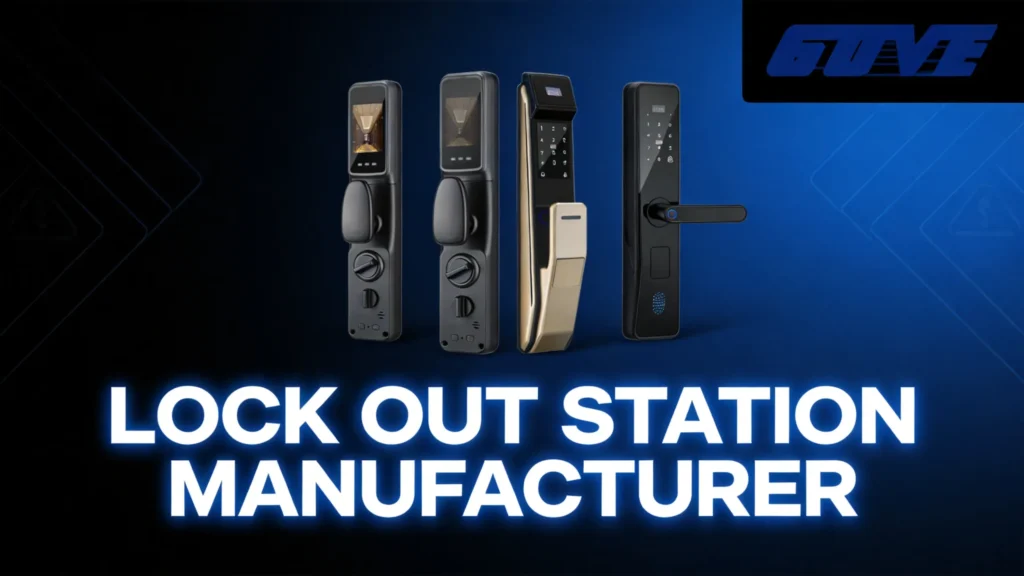
To support high-security commercial requirements that combine advanced multi-credential validation with physical deadbolt strength, specifiers often evaluate advanced units like the Gove D 7800 Smart Door Lock, which integrates RFID cards with password, mechanical key, and facial authentication capabilities for multi-layered facility protection.
System Specification & Quote Preparation
Before requesting a formal proposal or bill of materials from a physical security manufacturer or systems integrator, compiling accurate architectural and electrical data minimizes revision cycles. A complete pre-procurement specification should detail the variables below:
- Opening Geometry and Door Construction: Detail door frame materials (hollow metal, storefront aluminum, solid wood, glass), swing orientation (in-swing, out-swing), and existing latching hardware.
- Credential Ecosystem and Frequency: Define whether the new system must read existing legacy 125 kHz fobs, transition to high-security encrypted 13.56 MHz cards, or incorporate mobile NFC/Bluetooth credentials.
- Egress and Life Safety Compliance: Identify all doors located along primary emergency exit paths requiring dedicated FACP tie-in relays, push-to-exit buttons, or pneumatic delay timers.
- Power Supply and Cabling Infrastructure: Determine whether the deployment will leverage structured Category 6 cabling for PoE controllers, or dedicated 12V/24V DC linear power supplies with battery backup enclosures.
- Software and API Integrations: Specify necessary integration endpoints, including active directory synchronization, visitor management kiosks, and video management systems via comprehensive access control integration frameworks.
- Environmental and Durability Requirements: Document exposure to coastal salt spray, extreme temperature ranges, or high-vandalism risks that require specialized electronic access control locks with IP66/IK10 ratings.
To evaluate specific hardware configurations, calculate power draw requirements, or request a customized multi-door system proposal, prepare your facility’s door schedule and reach out to our technical integration team for an architectural review.
Frequently Asked Questions
How do RFID access systems handle power outages?
Commercial installations utilize dedicated power supply cabinets equipped with sealed lead-acid (SLA) or lithium iron phosphate (LiFePO4) backup batteries.
These power supplies continuously float-charge the batteries during normal operation and switch over seamlessly to provide 4 to 24 hours of operational power if mains electricity fails.
Furthermore, hardware locks default to their designed state: fail-safe locks unlock to preserve occupant egress, while fail-secure locks remain locked from the exterior while allowing manual mechanical exit from within.
Can commercial RFID key fobs be easily cloned?
Vulnerability to credential cloning depends entirely on the operational frequency and cryptographic protocols used. Legacy 125 kHz low-frequency fobs transmit an unencrypted serial number that can be duplicated using inexpensive, commercially available handheld cloners.
In contrast, modern 13.56 MHz high-frequency credentials-such as MIFARE DESFire EV3-utilize advanced mutual challenge-response authentication and AES-128 or AES-256 encryption, preventing unauthorized sniffing, duplication, or skimming.
Are standalone RFID controllers better than networked controllers?
Standalone controllers are cost-effective, straightforward options for single isolated doors, storage sheds, or perimeter equipment enclosures where data cabling cannot be routed.
However, networked controllers are standard for commercial and multi-door facilities. Networked systems centralize administrative tasks, enabling global user provisioning, instant credential revocation, time-based scheduling, centralized event auditing, and multi-system integration with fire alarms and video surveillance.