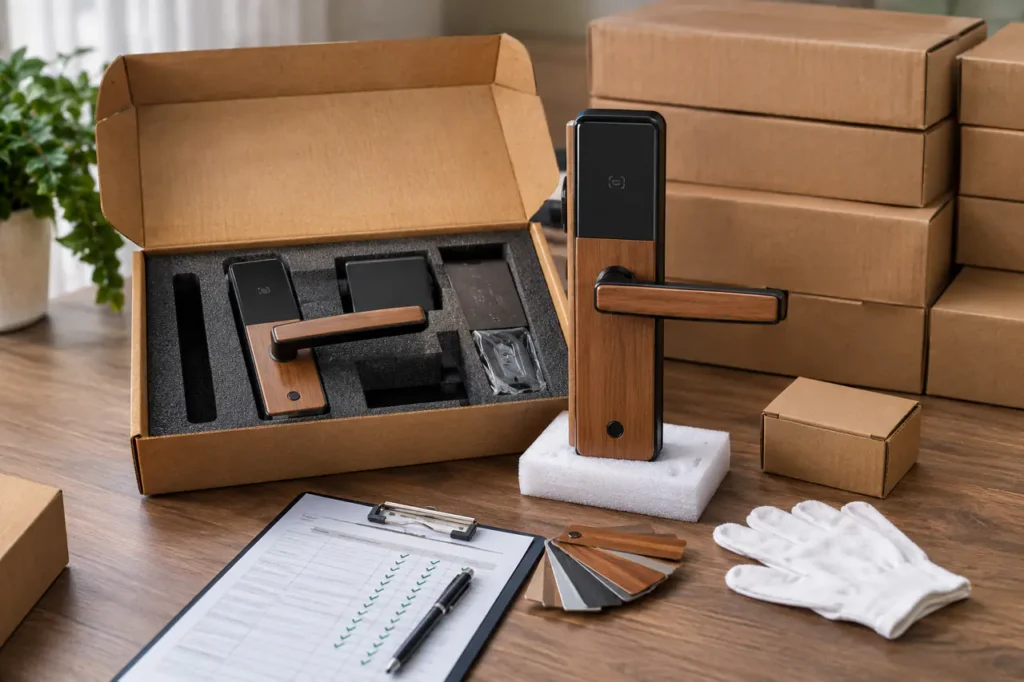
A hotel door lock OEM project can fail even when the lock itself looks impressive. Mechanical fit, firmware stability, PMS integration, certification evidence, and replacement support must work together.
The supplier that offers the lowest unit price may still create higher costs through new tooling, delayed approvals, incompatible mortises, or software changes discovered after installation begins.
Evaluating OEM/ODM Customization Capabilities
A capable OEM partner should customize both the physical lock and the digital system around it. That does not mean every supplier can redesign every component economically.
The first decision is whether your project needs a branded version of an existing platform or a genuinely bespoke lock architecture.
ODM white-labeling usually means selecting an existing lock body, reader, firmware platform, and mobile application, then adding your logo, finish, packaging, or selected software branding.
A custom OEM project may require new molds, a revised escutcheon, different mounting geometry, a new mortise footprint, or a dedicated API layer. Those changes affect tooling cost, testing, MOQ, and lead time.
ODM or bespoke OEM: decide before the RFQ
Use an ODM platform when the door schedule is conventional, the access functions are already proven, and the project can accept the supplier’s existing app or management software. This route normally reduces development risk and shortens the sample approval cycle.
A bespoke OEM route makes more sense when the hotel group has a strict visual identity, unusual door construction, an existing guest app, or a portfolio-wide hardware standard.
Ask the supplier to separate one-time engineering charges from recurring unit prices. Otherwise, tooling and software work can remain hidden inside an apparently attractive quote.
| Customization area | Typical ODM adjustment | Custom OEM requirement | What to verify |
|---|---|---|---|
| Finish and color | Standard finishes, logo plate, selected coating | Special color, coating process, or surface texture | Sample approval, coating durability, batch color tolerance |
| Materials | Existing zinc alloy or stainless steel parts | New material grade, thickness, or corrosion-resistant structure | Material declaration, salt-spray target, supplier process control |
| Mortise and lock body | Existing ANSI or EURO-compatible option | New footprint, backset, spindle, latch, or concealed fixing | Door drawings, sample door, fire and durability test scope |
| Branding and packaging | Logo, carton artwork, user manual, private label | Dedicated packaging architecture or multi-market documentation | Artwork approval, carton drop testing, spare-part labeling |
| Software | Supplier app with logo and selected settings | Custom app, API, SDK, firmware behavior, or PMS connector | API documentation, ownership terms, version support, test environment |
The matrix separates changes that look similar in a brochure but carry very different commercial consequences. A finish change may need a production sample. A mortise change can affect tooling, certification, installation, and the entire door schedule.
Physical hardware and mortise options
Material choice should follow the operating environment rather than the showroom appearance. A coastal resort, humid spa property, or poolside accommodation exposes hardware to salt, moisture, cleaning chemicals, and frequent handling.
- 304 stainless steel: Often preferred for exposed trim and higher-corrosion-risk locations, subject to the actual grade and finishing process.
- Zinc alloy: Can support complex shapes and controlled cost, but coating quality and substrate thickness require sample inspection.
- Mixed construction: May combine a stainless exterior with zinc alloy internal or decorative components. Request a material breakdown rather than relying on the product name.
- Coating system: Confirm preparation, plating or powder-coating steps, corrosion testing, and acceptable cosmetic variation between batches.
Mortise compatibility is equally important. ANSI and EURO lock bodies differ in dimensions, fixing positions, spindle arrangements, and door preparation. A supplier should review door drawings and, for a new project, inspect a representative sample door before confirming the production model.
For a hotel key-card deployment, compare the supplier’s RFID Hotel Door Lock platform with the actual door schedule, not only the reader design. A visually similar escutcheon may conceal a completely different mortise and installation requirement.
Software and system modifications
Software customization has two distinct levels. White-labeling a supplier’s mobile app may change colors, logos, language, and basic user permissions. It does not necessarily give the hotel control over user journeys, data, firmware updates, or third-party integrations.
SDK and API access matters when a hotel group wants mobile check-in, digital room keys, loyalty functions, staff access, or a single guest application.
Ask whether the API supports credential creation, revocation, battery status, audit events, user roles, and remote unlock commands. Also ask how authentication and permissions are handled.
- Is the API documented for external developers?
- Does the supplier provide a sandbox or test gateway?
- Can the hotel retain access to its integration if the supplier changes software?
- Are firmware updates backward-compatible with installed locks?
- Who owns custom code, connectors, and project-specific documentation?
If your team does not maintain an in-house application, a supplier’s existing app may be the more practical choice. The trade-off is lower development effort but greater dependence on the manufacturer’s roadmap and support policy.
Comparing Smart Access Technologies for Hospitality
Most modern hospitality deployments use RFID for dependable physical credentials and BLE for mobile keys. NFC and keypad access can add useful functions, but they should be selected for a defined operating case rather than added as generic feature upgrades.
The correct technology mix depends on guest demographics, phone connectivity, property layout, staff workflows, emergency procedures, and the hotel’s existing access-control ecosystem. A resort with weak mobile coverage may need a stronger card-first operating model than an urban hotel built around app-based check-in.
| Technology | Power profile | Security and control | Guest convenience | System cost factors |
|---|---|---|---|---|
| RFID or MIFARE card | Low reader-side demand; battery life depends on lock design and usage | Strong when encrypted credentials, key expiry, and audit controls are implemented | Simple for guests and front-desk teams | Cards, encoders, software, readers, and replacement credentials |
| BLE mobile key | Higher communication and user-device dependency than card-only access | Depends on credential encryption, app security, phone handling, and revocation controls | Supports mobile check-in and fewer physical cards | App, gateway, cloud service, SDK/API, support, and integration work |
| NFC | Generally low at the lock, but compatibility depends on the credential ecosystem | Varies with phone, card, wallet, and credential implementation | Convenient where supported by the chosen mobile workflow | Reader compatibility, credential platform, testing, and software integration |
| Keypad or PIN | Can increase battery use through frequent keypad activation | Requires expiry rules, anti-guessing controls, and careful staff permission design | Useful when guests should not carry cards or install an app | Keypad hardware, weather protection, service, and code-management software |
This comparison is a selection tool, not a ranking. RFID remains practical for large properties because front-desk issuance is easy to understand. BLE can improve the guest journey, but poor app onboarding or weak connectivity can turn a convenience feature into a support burden.
Where older access systems create project risk
Magstripe and basic low-frequency systems may be familiar, but they can limit credential security, mobile-key options, and future integration. Buyers moving to encrypted 13.56 MHz card systems should confirm the card standard, encoding method, reader compatibility, and migration plan.
Do not assume that a lock described as “card compatible” supports the same cards used by the hotel’s existing system. Request a written compatibility statement and test credentials from the proposed supplier.
The same check applies when combining room locks with elevators, parking, staff entrances, or amenity doors.
Emergency access is part of the specification
Electronic convenience cannot remove the need for controlled emergency access. Confirm how authorized mechanical override keys, emergency power, lost-card handling, dead batteries, and offline operation are managed. The override should be protected from casual access and included in the hotel’s key-control procedure.
For projects that need multiple entry modes, compare the RFID platform with broader products such as the Gove D 7800 Smart Door Lock, but verify whether its functions, enclosure, and software are intended for the specific hospitality deployment.
Software Ecosystems and PMS Integration
Your OEM lock system must communicate reliably with the hotel’s property management system so room assignment, credential issuing, cancellation, and access events follow the same operational record. A lock that works in a demonstration but cannot exchange production data is not an integration-ready product.
For Oracle Hospitality platforms such as Opera or Fidelio, ask which integration method the supplier supports.
Some systems use a certified connector, while others rely on middleware, a local gateway, or an API maintained by a technology partner. The commercial and technical responsibilities differ in each model.
Ask where the integration actually runs
An on-premise gateway can continue operating inside the property when the internet connection is interrupted, but it requires local hardware, network access, and maintenance. A cloud-based system may simplify multi-property administration, yet it introduces dependence on connectivity, account permissions, hosting, and recurring service terms.
- Which PMS versions and deployment models are supported?
- Does the system issue room keys automatically after check-in?
- How quickly are cancellations and room changes synchronized?
- Can staff credentials and time-limited contractor access be managed separately?
- What happens when the PMS, gateway, cloud service, or lock is offline?
- Are API calls, events, and integration errors recorded for troubleshooting?
Request a live integration demonstration using a representative workflow: assign a room, issue a credential, change the room, revoke access, and review the event log. This catches more problems than a presentation of isolated app screens.
Integration ownership changes the long-term cost
Confirm whether the OEM, a PMS partner, or your internal development team owns each part of the connection. Get version-support commitments in writing, including who handles firmware changes, API updates, security patches, and troubleshooting after the hotel opens.
If a supplier offers hotel API SDK availability, ask for documentation before approving the sample. A promise that an API “can be developed” is not equivalent to a tested interface with defined endpoints, authentication, rate limits, and error responses.
Hardware Certifications and Compliance Standards
Never procure commercial door hardware from a certificate list alone. Request the actual report, certificate number, tested model, test configuration, issuing laboratory, and validity status. A document for one lock body may not cover the customized escutcheon or mortise in your quotation.
- Fire and life-safety evidence: Confirm the required fire-door rating for the project and whether the complete lock assembly, mortise, door, and hardware combination has been tested for that application. A claimed 60- or 90-minute rating must be matched to recognized test evidence and local requirements.
- Electronic conformity: CE may be relevant for applicable European-market requirements, while FCC addresses applicable United States electromagnetic-emissions requirements. RoHS documentation concerns restricted substances and should identify the product scope.
- Mechanical standards: Ask whether the lock or hardware has been evaluated against the applicable ANSI/BHMA requirements and grade. Grade references must match the exact product and test configuration.
- Battery and radio documentation: Request evidence for the battery type, charger or gateway, BLE radio module, and any regional wireless approvals included in the finished product.
- Materials and supplier declarations: Obtain material declarations, finish specifications, and relevant chemical or environmental documents required for the destination market.
The mistake: treating a test report as a universal approval
Certification is model-specific and market-specific. A lock may carry CE documentation for electronics but still require separate evidence for fire doors, mechanical durability, radio equipment, or local building approval.
Ask the supplier to create a compliance matrix that maps each requirement to a document and product revision. This prevents a common late-stage problem: the certificate names the standard product, while the approved sample contains different metal parts, firmware, batteries, or mounting hardware.
Incoming and production QC should be visible
Factory capability is not proven by a showroom or a polished audit presentation. Ask how the supplier controls incoming metal parts, PCB assemblies, batteries, readers, mortises, and finished coatings. Then ask which checks are repeated during assembly and final inspection.
- Reader recognition and credential range under normal door conditions
- Latch, spindle, handle, and deadbolt operation across sample doors
- Battery installation, low-battery warning, and emergency power behavior
- Firmware version, configuration records, and access-event logging
- Finish defects, logo placement, carton labeling, and accessory completeness
- Random sampling rules, defect classification, and corrective-action records
The OEM Sourcing Workflow and Partnership Process
A structured sourcing process reduces manufacturing errors because each approval is tied to a physical sample, software version, document, or production milestone. Treat the OEM relationship as a controlled product-development project, not a one-time bulk purchase.
Start with a representative sample, not a catalog promise
Provide the supplier with door thickness, material, edge details, existing bore or mortise dimensions, handing, fire-door information, and finish expectations. If the project includes several door types, identify the exceptions early rather than forcing one lock across incompatible openings.
During sample approval, test the lock on a representative door and connect it to the planned software environment. Check mechanical fit, credential issuing, offline behavior, battery warnings, firmware updates, app permissions, and emergency procedures before approving mass production.
- Approve the physical lock and mortise against a signed drawing.
- Record the approved finish, logo position, packaging, and accessory list.
- Record the approved firmware, app version, API behavior, and configuration file.
- Define who may approve engineering changes after the sample stage.
- Keep retained samples for future incoming inspection and dispute resolution.
MOQs and tooling are commercial variables
Existing ODM products may support a lower MOQ than a lock requiring custom molds, special finishes, or dedicated electronics. The supplier should separate the MOQ for standard units, branded units, custom mechanical parts, and custom software work.
Ask whether tooling is exclusive, reusable for other customers, or owned by the factory. Confirm the cost of replacement molds, engineering samples, pilot production, and any minimum annual volume attached to a custom platform.
Where lead time usually moves
Production time is only one part of delivery planning. Approval delays, certification testing, special components, packaging artwork, firmware changes, and export documentation can add more time than assembly itself.
| Stage | Buyer approval or input | Risk if skipped |
|---|---|---|
| Technical review | Door schedule, access modes, PMS, region, finish | Wrong mortise, incompatible system, incomplete quotation |
| Engineering sample | Fit, function, software, emergency access | Production units require rework or cannot be installed |
| Compliance review | Reports, certificates, model numbers, market scope | Import, inspection, or project approval delays |
| Pilot production | QC records, packaging, firmware, accessory count | Batch variation reaches the installation site |
| Bulk shipment | Carton plan, labels, spare parts, shipping documents | Damage, missing parts, customs or site receiving problems |
Packaging deserves its own approval. Hotel locks are heavy, finish-sensitive assemblies with small parts that can be lost during site handling. Confirm individual protection, carton quantity, palletization, moisture protection, spare-part labeling, and the packing list used for receiving inspection.
After-sales support is part of the lock specification
Ask how the supplier supports a five-year property rollout after the first shipment. Confirm replacement mortises, batteries, readers, handles, escutcheons, keys, gateways, and control boards. Also clarify firmware support, remote troubleshooting, response times, and the process for warranty claims.
The cheapest lock can become the most expensive option if one failed component requires replacing the complete assembly or if the factory changes the electronics without preserving compatibility.
What to Prepare Before Requesting an OEM Consultation
Before requesting a quote or engineering consultation, compile the property’s technical, software, compliance, and aesthetic requirements. Complete information allows the supplier to recommend a realistic platform, identify exceptions, and price custom work separately.
- Door data: Door material, thickness, handing, edge detail, fire-door status, existing mortise, bore dimensions, and representative door drawings.
- Access requirements: RFID or MIFARE cards, BLE mobile keys, NFC, PIN access, staff credentials, mechanical override, elevator access, and offline operation.
- Software environment: PMS name and version, Opera or Fidelio deployment details, existing access-control systems, preferred cloud or on-premise architecture, and API or SDK requirements.
- Customization scope: Finish, material, escutcheon shape, mortise footprint, logo, packaging, mobile app branding, language, and user-interface requirements.
- Compliance target: Destination markets, required electronic approvals, fire-door evidence, ANSI/BHMA expectations, radio requirements, and environmental documentation.
- Commercial plan: Estimated room count, door-type breakdown, pilot quantity, annual volume, target delivery window, destination port, and spare-parts allowance.
- Approval process: Sample reviewers, test site, acceptance criteria, required documents, inspection method, and authority for engineering changes.
Use this supplier handoff checklist
- Request a line-item quotation separating lock units, mortises, cards, gateways, software, tooling, samples, packaging, and freight.
- Ask for the exact product revision covered by every certificate and test report.
- Request a sample test plan covering mechanical fit, access credentials, PMS workflows, battery behavior, and emergency entry.
- Confirm MOQ by configuration rather than accepting one general MOQ figure.
- Ask for standard lead time, sample lead time, pilot-production lead time, and the main delay conditions.
- Confirm spare-part availability, warranty process, firmware support, and escalation contacts.
- Define acceptance criteria for finish, function, packaging, software, and documentation before production begins.
Buyers comparing Hotel Door Lock System options or reviewing Hotel Door Lock Manufacturers should send this information with the initial inquiry. For a card-focused deployment, the Hotel Key Card Lock System requirements should be listed separately from mobile-key or PMS requirements.
With the project data assembled, contact the OEM engineering or sales team for a technical consultation, sample recommendation, and project quotation based on the actual door schedule rather than a generic catalog configuration.