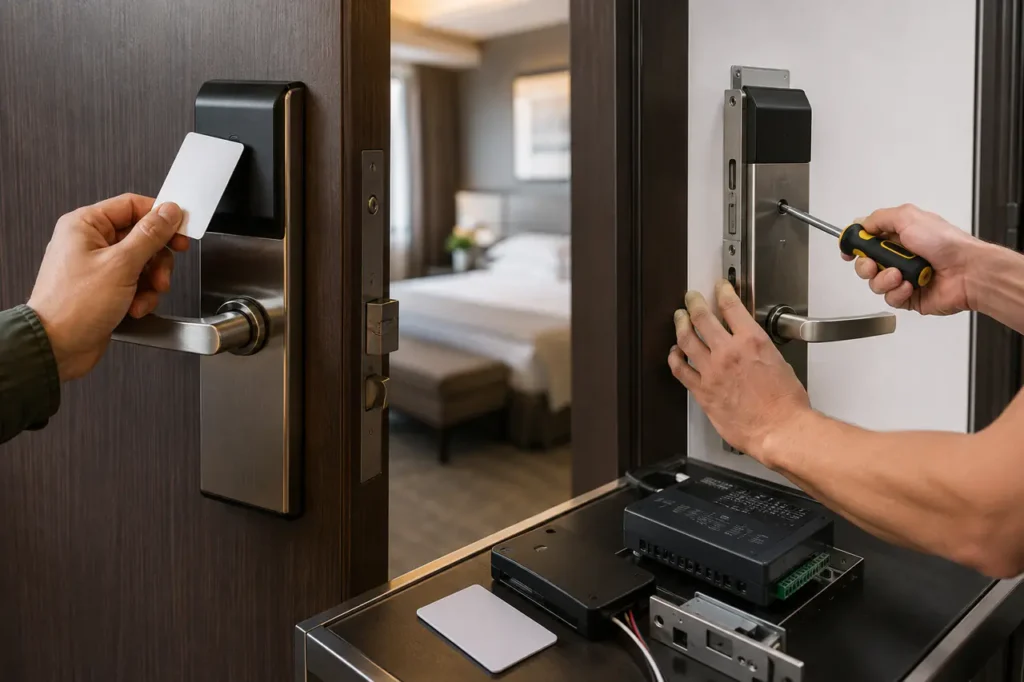
A hotel key card lock system upgrade rarely fails because the card reader cannot open a door.
It fails when the selected hardware does not match the existing mortise, the PMS cannot exchange credentials reliably, or the property lacks the network and maintenance capacity the proposal assumes.
For hoteliers, the decision is a balance between guest convenience, security, installation disruption, and lifecycle cost. The most practical approach is to compare credential technology first, then select the system architecture, hardware grade, integration depth, and supplier support required by the property.
Comparing Key Card Credential Technologies
Magnetic stripe cards remain inexpensive, but RFID is the current baseline for most new hospitality installations because contactless credentials tolerate heavier use and reduce reader wear. Mobile access is best treated as an additional access channel, not automatically as a replacement for physical cards.
The choice affects more than guest experience. It changes card-issuing equipment, reader compatibility, data security, replacement procedures, and the way the hotel handles upgrades.
Confirm that the proposed credentials match the door locks, elevator controls, staff areas, and any existing Key Card Door Access System.
Magnetic Stripe (Legacy Systems)
Magnetic stripe cards are familiar and inexpensive, which explains their long use in budget hotels and older properties. Guests swipe the card through a reader, while the lock validates the encoded access period and room assignment.
The weakness is physical and operational. The stripe can demagnetize, wear down, or become unreadable after contact with phones, wallets, or other magnetic sources. Swipe readers also require more direct contact than RFID readers, increasing failure points at busy front desks and room doors.
- Best fit: existing properties with a functioning magstripe estate and a strict replacement budget.
- Main risk: card damage, reader wear, and weaker resistance to credential copying.
- RFQ question: can the supplier support a phased migration without replacing every encoder and lock at once?
RFID and Proximity Cards (Industry Standard)
RFID hotel door locks use contactless cards or fobs, so the guest presents the credential near the reader rather than inserting or swiping it. This improves usability and usually provides better durability in high-turnover environments.
Security depends on the credential standard, encryption method, key management, and lock firmware. Do not accept “RFID” as a complete security description.
Ask which card technology is supported, how keys are managed, whether credentials can be revoked, and whether the lock stores an access event history.
RFID is generally the strongest default for a new hotel installation. It supports physical guest cards while leaving room for staff credentials, elevator access, parking areas, and future mobile-key upgrades.
Mobile Keys and NFC (Modern Smart Access)
Mobile key systems use Bluetooth Low Energy, NFC, or both to let an approved smartphone act as a room credential.
They can reduce front-desk queues and support remote check-in, but the guest journey depends on app installation, phone permissions, battery status, and reliable digital identity verification.
Mobile access works best as a layer over dependable door hardware. A hotel should still plan for physical RFID cards, staff credentials, and emergency procedures. If the lock requires a cloud connection for every opening, confirm the local fallback behavior before approving the design.
| Technology | Guest Convenience | Security Level | Data Capacity | Relative Hardware/Credential Cost |
|---|---|---|---|---|
| Magnetic stripe | Familiar, but requires a swipe | Lower; physical stripe wear and copying concerns | Limited | Lower initial cost; higher replacement risk |
| RFID/proximity | Contactless and quick | Moderate to high, depending on credential encryption and key management | Higher than magstripe | Moderate |
| Mobile key/NFC | Highly convenient for digitally prepared guests | High when identity, encryption, and revocation are well managed | Digital credential data handled through software | Higher system and integration cost |
The practical decision is usually not “cards or phones.” It is whether RFID will remain the dependable primary credential while mobile access serves guests who prefer digital entry. This dual-channel approach reduces adoption risk during rollout.
Evaluating System Architecture: Standalone vs. Networked
Networked locks provide real-time administration and remote event visibility, but they require dependable gateways, communication coverage, software support, and a maintenance process. Standalone hotel lock systems cost less to deploy and suit smaller or older properties with limited infrastructure.
Architecture should be decided before choosing a software feature. A platform may advertise remote unlocking, mobile keys, or live dashboards, but those functions are only useful when the door hardware, gateway placement, network design, and power strategy can support them.
Standalone (Offline) Lock Systems
Standalone locks store authorized credentials and access rules locally. Front-desk staff encode a card, and the lock validates it without requiring a live connection to the property network. Updates may be delivered through staff cards, portable programmers, or periodic synchronization.
This approach minimizes wiring and reduces dependence on Wi-Fi coverage. It is often suitable for independent hotels, limited-service properties, guesthouses, and retrofit projects where opening walls or installing communication cabling would create unacceptable disruption.
- Lower installation complexity and fewer network dependencies.
- Battery replacement remains a door-by-door maintenance task.
- Audit data may require collection from the lock rather than live viewing.
- Lost staff credentials need an update method that works while locks are offline.
Online (Networked) Lock Systems
Online locks communicate through gateways, wired networks, wireless links, or a property-specific access control infrastructure. Administrators can often update permissions, view events, and respond to incidents without visiting every room.
The additional capability comes with infrastructure requirements. Confirm gateway density, communication range through walls and corridors, network segmentation, software licensing, battery behavior, and who owns troubleshooting when a lock stops reporting.
Networked architecture is more valuable in large resorts, multi-building properties, high-security facilities, and hotels that need centralized oversight. It may be excessive for a small property where staff can manage offline credentials quickly.
Smart Lock Retrofit Kits
Retrofit hardware can add Bluetooth, mobile access, or online management to selected existing locks. This can reduce room downtime and preserve compatible exterior trim, but compatibility is not universal.
Ask the supplier to inspect the existing mortise, spindle, door thickness, strike position, escutcheon dimensions, handing, and battery compartment. A retrofit that fits one room type may fail on fire doors, connecting doors, balcony doors, or older frames.
| Architecture | Scalability | Wiring/Infrastructure Needs | Real-Time Audit Capability | Ideal Hotel Size |
|---|---|---|---|---|
| Standalone/offline | Good for controlled expansion | Low; local battery-powered hardware | Limited or periodic | Small hotels, older properties, budget retrofits |
| Online/networked | Strong across buildings and departments | Moderate to high; gateways, network, coverage, and software | Strong when communication is available | Large hotels, resorts, multi-building properties |
| Smart retrofit | Depends on existing lock compatibility | Low to moderate; may use BLE gateways or wireless links | Varies by module and platform | Phased upgrades and selected renovation projects |
Use the table as a starting point, not a final specification. A small hotel with multiple detached buildings may need networked capabilities, while a larger urban property with strong front-desk processes may deploy standalone locks in selected zones.
Essential Hardware Features and Security Certifications
A commercial hotel lock must withstand repeated daily use, support safe egress, and remain serviceable when batteries weaken or software is unavailable. For new specifications, prioritize ANSI/BHMA Grade 1 commercial hardware where the product and door application require that level.
Certification claims must be tied to the exact model, configuration, and market. Request current test documentation rather than relying on a catalog statement that applies to another lock family or mechanical configuration.
ANSI/BHMA Grade 1 Commercial Certification
ANSI Grade 1 door locks are intended for demanding commercial applications. Ask whether the certification covers the complete electronic lock assembly, including the latch, chassis, escutcheon, and relevant operating mode.
Also verify door and frame requirements. A certified lock does not make an unsuitable door assembly compliant. Fire-rated openings, emergency exits, panic hardware, and accessibility requirements may require separate listings or local review.
- Exact model number and certification scope.
- Applicable ANSI/BHMA test standard and current report.
- Fire-door compatibility and required installation configuration.
- Emergency egress behavior under power, battery, or communication failure.
- Material finish, corrosion resistance, and suitability for coastal or humid sites.
Audit Trails and Staff Accountability
Audit trails should record useful events such as valid entries, rejected credentials, mechanical override use, low-battery warnings, and administrative changes. Ask how many events each lock stores, how they are exported, and whether timestamps remain consistent across devices.
Staff accountability depends on individual credentials. Shared master cards weaken the value of an audit trail because an event cannot be tied to one employee. Specify separate staff permissions, role-based access, revocation procedures, and a documented emergency credential process.
Battery Life, Maintenance, and Emergency Overrides
Battery life depends on lock design, traffic, credential type, wireless communication, temperature, and battery quality. Require a stated test condition and a low-battery warning interval that gives maintenance staff enough time to respond.
Mechanical key overrides can preserve access during a technical failure, but they also require controlled key custody. Confirm whether override use appears in the audit log and whether the supplier provides replacement cylinders, batteries, escutcheons, latches, and programming tools after installation.
ROHS documentation may be required for the supply chain or destination market. It is not a substitute for fire, accessibility, electrical, or local building requirements. Ask the vendor to identify which documents apply to the complete project.
PMS Integration and Operational Efficiency
The true operational value of a modern lock system comes from its connection to the property management system. A reliable PMS integration can synchronize room assignments, reduce manual encoding, support digital check-in, and revoke credentials without repeated front-desk intervention.
Do not evaluate integration from a software brochure alone. Confirm the supported PMS version, API method, middleware responsibility, data fields, user permissions, error handling, and support process. The lock platform must exchange the right data at the right time.
Synchronizing Room Assignments
During check-in, the PMS should provide the room assignment, guest stay dates, and access conditions to the lock management platform or encoder. The system should prevent credentials from remaining active after checkout or room reassignment.
- Supported PMS products and exact versions.
- Cloud, on-premise, or middleware connection requirements.
- Room, floor, elevator, parking, and staff-area permission mapping.
- Handling of early check-in, late checkout, room moves, and cancellations.
- Visible error messages when a credential fails to encode or synchronize.
Automating Mobile Key Delivery
Mobile key delivery usually requires more than a BLE-enabled lock. The platform must connect identity verification, reservation status, payment or check-in rules, mobile credential creation, and revocation. Ask whether the mobile key is native to the lock platform or dependent on a third-party application.
Test the complete guest path using different phone models, operating systems, permission settings, and weak-connectivity conditions. A digital key that works in a demonstration but fails during arrival creates a front-desk workload rather than removing one.
Properties assessing broader Keyless Entry System options should compare mobile keys with physical RFID fallback, not evaluate app functionality in isolation.
Streamlining the Re-Keying Process
Electronic access reduces the need to physically replace cylinders when a guest loses a card or an employee leaves. Administrators can cancel a credential, issue a replacement, and update permissions according to the lock architecture.
- Instant remote blacklist updates for online locks.
- Staff updater cards or portable programming for offline locks.
- Separate guest, housekeeping, engineering, management, and emergency roles.
- Audit records for credential creation, cancellation, and override use.
- Documented fallback procedures during PMS or network downtime.
For a practical explanation of the guest credential workflow, see How Do Hotel Key Card Work. The operational question is simple: can staff resolve a lost credential in minutes without visiting multiple doors?
Hotel Lock Procurement Checklist & Next Steps
Before requesting pricing from access control vendors, compile the physical, software, and operating requirements that affect the bill of materials. Incomplete inputs produce quotes that look competitive but exclude gateways, door modifications, programming equipment, installation labor, or replacement parts.
Facility and Door Data
- Total guest-room doors, staff doors, service areas, elevators, and amenity spaces.
- Door count by type, floor, building, fire rating, and opening direction.
- Existing mortise types, lock brands, backset, door thickness, and strike condition.
- New construction, full replacement, or smart lock retrofitting requirement.
- High-traffic, exterior, humid, coastal, or pool-area openings requiring special finishes.
Software and Network Inputs
- Current PMS name, deployment model, and software version.
- Required connection to payment, guest-app, elevator, parking, or security systems.
- Available Wi-Fi, Ethernet, gateways, VLANs, power, and server or cloud access.
- Required audit retention, administrator roles, reporting, and export formats.
- Offline operating procedures for network, PMS, cloud, or power interruptions.
Sample Approval and Supplier Evidence
Approve one representative sample before releasing a full order. The sample should be installed on the most difficult common door condition, not only on a new, perfectly aligned test door.
- Test latch engagement, door alignment, closing force, reader range, and credential rejection.
- Check guest cards, staff cards, emergency credentials, and mobile keys if specified.
- Confirm battery access, low-battery alerts, mechanical override, and audit event capture.
- Request certification reports, installation drawings, wiring diagrams, manuals, and software documentation.
- Confirm MOQ, production lead time, sample charges, spare-part availability, warranty scope, and after-sales response.
Quote Variables That Commonly Move the Price
Compare suppliers on the same scope. A lower unit price may exclude card encoders, management software, gateways, custom finishes, door preparation, shipping, commissioning, training, or local installation support.
| Quote Area | What to Confirm |
|---|---|
| Hardware | Lock body, trim, reader, cylinder, batteries, strike, mounting parts, and finish |
| Software | Licensing, user accounts, PMS middleware, mobile-key modules, updates, and hosting |
| Installation | Door preparation, cabling, gateway placement, commissioning, testing, and training |
| Logistics | Packaging, labeling by room, spare units, shipping terms, customs documents, and delivery schedule |
| Support | Warranty, remote diagnosis, replacement parts, firmware support, and response times |
Bring this information to a system compatibility consultation or custom engineering quote. Gove can use the door schedule, PMS details, infrastructure notes, and sample requirements to define a more accurate hotel locking solution before procurement approval.
Frequently Asked Questions
What happens to a networked hotel lock during a power or Wi-Fi outage?
Commercial networked locks normally retain approved credentials and access rules in local memory, so temporary loss of Wi-Fi does not necessarily stop valid RFID cards from working. Remote monitoring and live updates may pause.
Confirm whether the selected model is fail secure or fail safe, how egress is protected, and how long cached permissions remain valid.
Can we upgrade to mobile keys without replacing our existing RFID locks?
Many compatible RFID locks can accept an internal Bluetooth Low Energy module or retrofit reader, allowing mobile access without replacing the complete door hardware assembly.
Compatibility depends on the lock family, firmware, battery capacity, mortise, and management platform. Test the retrofit on each major door type before approving a property-wide rollout.
How are lost master key cards handled in modern electronic systems?
Administrators can usually blacklist a lost master card and issue a replacement credential. Online locks receive the update through the network, while offline locks may use staff updater cards or portable programming devices.
Confirm how quickly revocation reaches every door, whether the event is logged, and what procedure applies during a network outage.