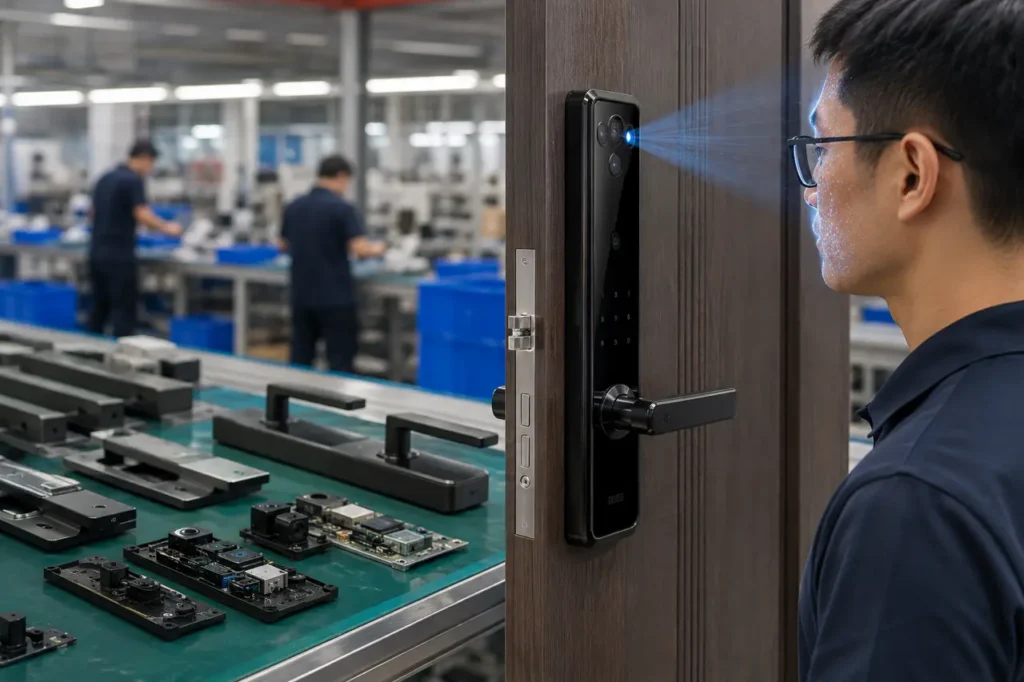
A supplier can label an RGB camera as facial recognition and still market the lock as 3D. That shortcut creates a costly security and warranty problem after rollout.
A credible 3D face recognition smart lock manufacturer should prove its depth-sensing method, anti-spoofing performance, lock compatibility, and production controls before unit price becomes part of the decision.
The Engineering Baseline: Identifying True 3D Biometric Technology
A reliable manufacturer uses a depth-sensing biometric module rather than a standard RGB camera. True 3D recognition measures facial geometry, helping the lock distinguish a live face from a printed photo, phone screen, or flat video replay.
Ask the supplier to identify the sensor architecture by name. “Face ID camera” or “AI recognition” is not enough. The specification should state whether the lock uses structured light, time-of-flight (ToF), stereo vision, or a defined 2D/3D hybrid method.
The photo-spoofing check that exposes weak modules
Premium biometric locks combine depth data with liveness detection. Depending on the module, liveness checks may analyze infrared response, depth contour, movement, reflected light, or multi-frame facial data. A factory that cannot describe its anti-spoofing biometric security approach is not ready for a security-led project.
- Request a demonstration using a printed face photo, a phone-displayed video, and a face image under low ambient light.
- Confirm whether recognition still relies on a visible-light RGB image after the depth sensor fails or becomes obstructed.
- Ask whether facial templates are stored locally, in a cloud service, or through the selected platform provider.
- Verify how the lock behaves after repeated failed recognition attempts, including lockout, alarm, and audit-log behavior.
FAR and FRR must be discussed together
False Acceptance Rate, or FAR, measures how often an unauthorized person could be accepted. False Rejection Rate, or FRR, measures how often an authorized user is rejected. A low FAR improves security, but an overly aggressive setting can raise FRR and create access complaints.
The expensive mistake is asking only for an advertised recognition speed.
A lock that unlocks quickly in a controlled showroom may perform poorly with backlighting, hats, glasses, changing facial appearance, or users approaching from different heights.
Require the manufacturer to explain test conditions, enrollment limits, recognition distance, and supported user profiles.
| Commercial deployment check | What to request from the supplier | Why it matters |
|---|---|---|
| Biometric method | Sensor type, module model, and recognition workflow | Prevents a 2D camera product from being quoted as a 3D lock |
| FAR and FRR evidence | Test method, operating conditions, and firmware version | Shows the security and usability trade-off behind the claim |
| Liveness testing | Photo, screen replay, video, and low-light test demonstration | Checks resistance to common spoofing attempts |
| Fallback access | Fingerprint, PIN, card, key, app, and emergency power options | Reduces lockout risk when face recognition is unavailable |
For a distributor or private-label brand, this evidence should be tied to the exact production firmware. A sample running one algorithm version and mass production running another is a preventable source of field failures.
Technical Comparison of 3D Biometric Hardware
The biometric module determines more than the headline feature. It affects component cost, enclosure design, power draw, recognition speed, low-light behavior, and the level of spoofing resistance the final product can credibly claim.
Structured light is often the premium choice for smart locks because it projects a known pattern and calculates facial depth from its distortion. Time-of-flight sensors measure reflected light travel time, while 2D/3D hybrid systems combine a conventional camera with limited depth information.
| Technology | Security level | Unlocking speed | Low-light performance | Relative unit cost |
|---|---|---|---|---|
| Structured light | High when paired with liveness detection and controlled firmware | Fast after stable enrollment and approach-angle tuning | Generally strong because the system projects its own pattern | Higher |
| Time-of-flight (ToF) sensors | Medium to high, depending on depth resolution and anti-spoofing logic | Fast, but performance depends on sensor range and ambient conditions | Often good, with module-specific limitations to verify | Medium |
| 2D/3D hybrid | Variable; quality depends heavily on the depth component and software | Can be fast in controlled conditions | Variable; visible-light dependence can reduce reliability | Lower to medium |
Structured light is usually the better fit for premium residential developments, executive apartments, and security-led access projects. It gives the manufacturer a stronger technical basis for anti-spoofing claims, though buyers should still test it on real doors and real users.
Where a lower-cost sensor changes the whole product
A cheaper module can trigger secondary compromises. It may need more visible-light support, have a narrower recognition distance, or require a different front-panel layout. That can affect industrial design, battery runtime, and the user experience at night.
- Specify the intended installation height and the expected user height range.
- State whether the lock will be used in corridors, covered entries, exterior gates, or bright glass-front doors.
- Ask for recognition tests with direct sunlight, side lighting, glasses, masks where applicable, and different approach angles.
- Confirm whether the sensor window has an anti-smudge or protective coating and how it performs after cleaning.
Do not treat “3D” as a complete specification. The module, algorithm, lens protection, mechanical housing, firmware, and enrollment process all influence the final result. A competent OEM smart door lock factory should help define these interfaces early.
Key Criteria for Selecting a 3D Face Recognition Smart Lock Manufacturer
Vetting a manufacturer means looking beyond a polished catalog. The supplier must show that it can build the selected biometric architecture consistently, adapt it to your market, and support the product after the first container has shipped.
Use a capability matrix to compare suppliers against the same requirements. A lower quote is not meaningful if it omits compliance files, software work, spare parts, export packaging, or the engineering support needed to resolve a field issue.
| Evaluated metric | Minimum acceptable standard | Premium supplier standard |
|---|---|---|
| Certifications and reports | Relevant CE, FCC, and RoHS documents available for the proposed model | Traceable reports, clear model mapping, and support for target-market variants |
| OEM capacity | Logo, packaging, finish, and stock firmware options | Mechanical, firmware, app, and accessory customization with documented change control |
| Lead-time visibility | Written sample and production estimates | Component status, production milestones, inspection window, and shipping readiness plan |
| R&D support | Named product contact and standard documentation | Embedded, mechanical, app, and quality engineers available for project review |
| Quality control | Functional inspection before packing | Incoming QC, in-process checks, final inspection records, and retention samples |
| After-sales support | Written warranty scope and replacement-part list | Failure analysis process, firmware support, spare-part planning, and service response path |
What this means in practice: choose the standard that matches your rollout risk. A small pilot may need a responsive sample team. A hotel, multifamily, or distribution program needs formal product control, revision tracking, and spare-part continuity.
OEM/ODM Customization Capabilities
White-label work usually starts with logo application, packaging, manuals, and a defined finish. ODM work goes further. It may include a new handle shape, lock body, sensor placement, firmware behavior, user interface, or a proprietary mobile app.
Custom work has limits. A supplier can often modify trim parts and firmware faster than it can redesign a mortise, motor transmission, or biometric sensor stack. Ask which components are proprietary, which are shared across models, and which changes require new tooling.
- Branding: logo method, color standard, carton artwork, manuals, and language files.
- Hardware: handle direction, door thickness range, mortise type, cylinder, finish, and emergency interface.
- Firmware: auto-lock behavior, access methods, audit logs, alarm rules, and regional configuration.
- Platform: white-label app, cloud account ownership, SDK/API availability, and update responsibility.
For product fit, review a proven model such as the Gove D 7800 Smart Door Lock Fingerprint Password Card Key 3d Face Recognition as a starting point, then separate standard features from items that need OEM or ODM development.
Production Capacity and Quality Control (QC)
Capacity is not just monthly output. It includes the supplier’s ability to reserve biometric modules, motors, PCBs, batteries, and packaging materials without changing approved parts mid-project. Ask for the bill of materials control process and notification rules for substitutions.
In-house or third-party testing should cover the risks that matter for the proposed installation. Salt spray testing can inform corrosion resistance for coastal projects. Motor lifecycle testing, handle endurance, keypad response, battery protection, and repeated recognition tests are equally important.
The inspection points worth putting in the purchase order
- Confirm the approved biometric module and firmware version against the production sample.
- Inspect mortise dimensions, handing, backset, door-thickness compatibility, and cylinder configuration.
- Test face, fingerprint, PIN, card, app, mechanical key, and emergency power access where supplied.
- Check finish consistency, sensor-window alignment, display response, handle return, and latch action.
- Require carton drop protection, accessory count verification, serial-label accuracy, and waterproofing where specified.
A third-party final inspection is useful, but it cannot repair weak incoming QC. The supplier should explain how it tests incoming electronics, verifies mechanical components, and isolates failed units during assembly.
Global Compliance and Export Certifications
CE, FCC, and RoHS are common requests, but the required documentation depends on the market, radio configuration, power system, and final product identity. Do not accept a certificate merely because the supplier has one for a similar lock.
- Ask for reports and declarations tied to the exact model, radio module, charger or battery configuration, and branding arrangement.
- Check whether Wi-Fi, Bluetooth, Zigbee, or other wireless functions change the documentation required for your destination market.
- Confirm whether labels, user manuals, warning statements, and packaging marks need localization.
- Request the supplier’s process for maintaining documents after a PCB, wireless module, or firmware revision.
A China Smart Lock Security Door Supplier should be able to map product documents to the target market rather than leaving the importer to discover a mismatch at customs or during a customer audit.
Software Integration: SDKs, APIs, and App Development
Hardware is only half the product. For a private-label brand, distributor, or property technology integrator, the supplier’s software options determine who controls user data, feature updates, credentials, support requests, and the long-term customer relationship.
Some projects work well with white-label Tuya or TTLock support because the platform shortens launch time. Others require custom app development, local deployment options, or smart lock SDK API integration with a property management system, hospitality platform, or access-control environment.
Where white-label platforms are enough
Use an established platform when speed, proven functions, and lower development cost matter more than owning every part of the digital experience. Confirm which screens, languages, notifications, and brand elements can actually be changed. “White label” sometimes means only a logo and app icon.
- Confirm account ownership, administrator roles, user-data handling, and cloud-region availability.
- Ask how remote unlock, temporary PINs, event logs, firmware updates, and failed-access alerts are exposed.
- Verify whether the platform charges recurring fees, limits API calls, or restricts migration to a future app.
- Request a test account before purchase-order approval, not after production begins.
Custom integration needs a defined support boundary
For proprietary software, request API documentation, SDK versions, supported mobile operating systems, authentication methods, error handling, and release notes. The integration agreement should state who maintains the API when the lock firmware changes.
This is where projects often go wrong: the lock works in the supplier’s app, but the buyer cannot reliably enroll users, receive audit events, or update credentials through its own system.
A capable Biometric Smart Lock Factory should support a controlled proof of concept before custom software is approved.
What to Prepare Before Requesting an OEM Quote
An accurate quote and prototype timeline require a usable technical and logistical brief. Sending a product photo and a target price usually produces a vague offer, followed by changes to specifications, tooling, certifications, or packaging after the project is already committed.
Build the RFQ around the installed door, not the catalog image
- Door type, thickness, handing, material, existing bore pattern, mortise requirements, and installation environment.
- Required access methods, including 3D face recognition, fingerprint, PIN, RFID card, mechanical key, app, and emergency power.
- Preferred biometric technology: structured light, ToF sensors, or another approved architecture, plus required anti-spoofing evidence.
- Target market, required certification documents, language needs, radio configuration, and labeling requirements.
- Expected annual volume, pilot quantity, planned minimum order quantity (MOQ), delivery destination, and target launch date.
- Finish, material preference such as aluminum alloy or zinc alloy, logo method, packaging, manuals, and spare-part requirements.
- White-label platform scope or custom SDK/API integration requirements, including the systems the lock must connect to.
Separate the sample approval from the first mass-production order. The approved sample should record the hardware revision, biometric module, firmware version, finish standard, packaging layout, and test results. Otherwise, the phrase “same as sample” has little contractual value.
Quote risks that should be resolved in writing
- Does the quoted price include the selected biometric module, radio module, battery pack, mortise, cylinder, and accessories?
- Which certifications are already covered, and which require new testing, labels, or product variants?
- What is the production lead time after deposit, artwork approval, sample approval, and component confirmation?
- How are replacement parts priced and stocked after the warranty period?
- Who pays for software adaptation, API maintenance, firmware bug fixes, and a component change caused by shortage?
- What packaging test, pre-shipment inspection, and shipping marks are included in the order?
Gove can review a structured RFQ, align a suitable standard model or OEM/ODM route, and identify the technical questions that need closure before sampling.
Send the door schedule, target market, access requirements, expected volume, and software scope to the engineering and sales team for a customized proposal, sample request, or factory discussion.
Frequently Asked Questions about Sourcing Biometric Locks
What is the standard minimum order quantity (MOQ) for custom OEM smart locks?
MOQ depends on the depth of customization and component availability. Stock white-label locks may be practical at roughly 50-100 units, while custom firmware, packaging runs, finishes, or dedicated parts often raise the requirement.
New tooling, proprietary electronics, or custom ODM work may require 500-1000 units or more.
How long does it take to develop a custom ODM 3D face recognition lock?
A straightforward prototype may take around 30-45 days after the specification is frozen. New tooling or molding can add roughly 60-90 days, followed by initial mass production.
A total of 3-5 months is a useful planning range, but sensor supply, certification work, app integration, and approval changes can extend it.