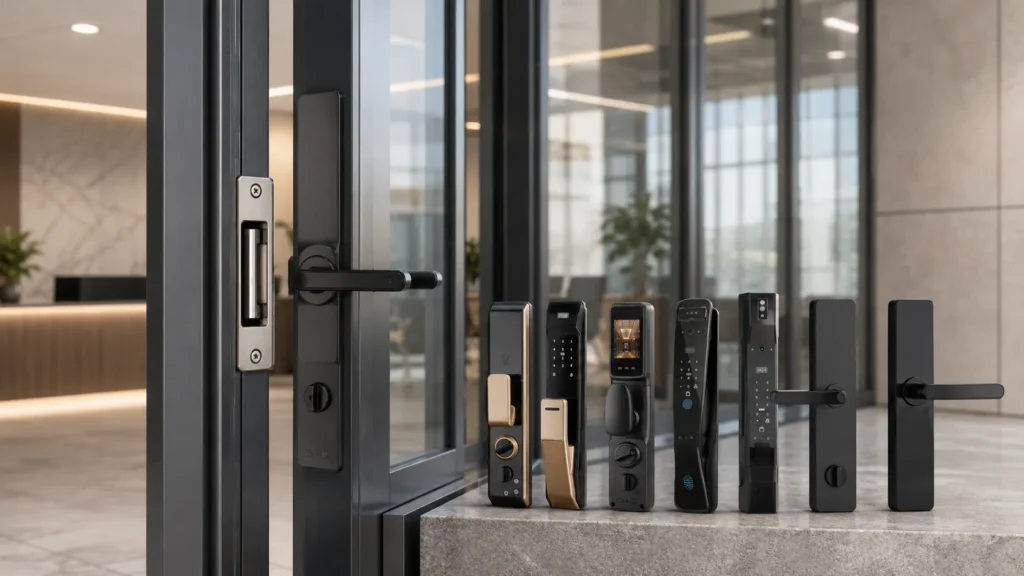
Most selection mistakes around electric door strike hardware happen before the installation even begins. A strike that fits the frame but ignores fire code, or one rated for the wrong voltage, can turn a secure entry into a liability the moment the power fails. This guide walks you through the four decisions that determine whether a strike will work safely, reliably, and without callbacks.
We’re writing this for security installers, facility managers and prosumers who need commercial-grade judgment—not just a datasheet. You’ll learn how to match mode, lock type, electrical load and holding force to the exact door you’re looking at, so you can order the right part first.
What is an Electric Door Strike and How Does It Work?
An electric door strike is an access control device that replaces a standard door frame strike plate, allowing the latch to be pulled away electronically while the mechanical lockset remains mechanically locked. It is the hardware that does the releasing, not the locking.
Inside the strike body, a movable keeper (also called the latchbolt interface) pivots or slides when energized. When the access controller sends a signal, the keeper releases the latch, and the door opens with a push or pull—no need to turn the handle. This is fundamentally different from a magnetic lock, which bonds the door to the frame with an electromagnet and requires the entire door to be pulled against that force. Strikes are hidden inside the frame, preserve the original lockset, and are nearly invisible from the secure side, making them the preferred choice for most commercial retrofits.
Because the strike works with the existing mechanical lock, it integrates neatly into any electronic access control system without changing user behavior at the door. The handle still works the same way for egress, and the deadbolt can stay in play for after-hours security.
Fail-Safe vs. Fail-Secure: The Most Critical Choice
Fail-safe strikes unlock when power is lost, ensuring free egress for life safety; fail-secure strikes remain locked when power is lost, preserving security in sensitive areas. This single selection often determines whether a fire marshal signs off on the installation.
| Mode | Power Status | Lock State (Power On) | Lock State (Power Off) | Best Use Case |
|---|---|---|---|---|
| Fail-Safe | Powered to lock | Secure (locked) | Unlocked | Fire exit doors, stairwell doors, any egress path where code forbids obstruction |
| Fail-Secure | Powered to unlock | Unlocked (released) | Locked | IT rooms, cash handling areas, perimeter doors where security must survive a power outage |
Note: Actual specifications depend on the model and should be verified with the manufacturer. Always confirm fire-rating requirements for your jurisdiction.
The fail-safe / fail-secure decision also governs the solenoid duty cycle. Fail-safe strikes typically use continuous duty solenoids because they stay energized while the door is locked. Fail-secure strikes often run on intermittent duty, energized only during the brief unlock pulse. A fail-secure strike mistakenly wired for continuous power will overheat and burn out, so matching the power supply and controller configuration to the strike’s duty rating is non-negotiable. If your facility has a fire alarm integration that drops power to all secured doors, every strike on that loop must be fail-safe. Mixing modes on the same circuit without careful planning creates a double jeopardy: some doors fail open, some stay locked, and the egress path breaks down exactly when it is needed most.
Hardware Compatibility: Cylindrical, Mortise, and Rim Exit
The physical architecture of the lockset on your door defines the electric strike body you need. Get this wrong, and the latch won’t align with the keeper, creating a jammed door or a security gap.
Cylindrical Lock Strikes
Cylindrical locksets have a latch that extends from the edge of the door into a simple rectangular cutout. Standard cylindrical lockset strikes use a 4-7/8″ ANSI strike plate footprint with a squared faceplate. The critical dimension is the location of the deadlatch—a small auxiliary plunger that prevents credit-card bypass. If the electric strike’s keeper doesn’t capture the deadlatch correctly, the door can be forced open. We check for full deadlatch engagement before finalizing a cylindrical strike selection.
Mortise Lock Strikes
Mortise locksets use a deep, one-piece case that houses both the latch and deadbolt. The strike opening for a mortise lock compatibility must accommodate both the main latchbolt and the auxiliary deadlatch in a much taller, narrower faceplate. Off-the-shelf cylindrical strikes won’t fit; mortise strikes typically require a cutout that spans nearly the full body height, and many use an extended lip to fill the frame profile of hollow metal doors. Without the correct mortise-profile cutout, the strike won’t seat flush and the keeper travel will be obstructed.
Rim Exit Device Strikes (Panic Bars)
Rim exit device hardware uses a surface-mounted panic bar with a latch that projects into a strike mounted on the frame surface, not recessed. These are the simplest to pair with an electric strike: a surface-mount strike with a corresponding open-back keeper. No frame cutting is required, and the strike body is bolted to the face of the frame. For old-style rim hardware with a wide paddle latch, verify the keeper throat width before ordering.
| Lock Type | Frame Material | Recommended Strike Type | Installation Difficulty |
|---|---|---|---|
| Cylindrical | Hollow metal or wood | ANSI 4-7/8″ recessed strike (optional faceplate options) | Moderate (frame cutting required) |
| Cylindrical | Aluminum storefront | Narrow style strike with center-line adjustment | High (tight frame profile) |
| Mortise | Hollow metal | Mortise-specific deep cutout strike | Moderate to High (precise mortise cut needed) |
| Rim exit device | Any | Surface-mount rim strike (no frame cutting) | Low |
Note: Specific fit varies by frame thickness and lock brand. Always verify throat depth and faceplate dimensions against the strike you purchase.
Electrical Requirements: Voltage and Current Type
Most 12V/24V DC electric strikes will work out of the box with modern access control system panels; AC strikes exist mainly for legacy buzzer installations and are increasingly rare in new commercial builds.
Dual-voltage strikes accept either 12V or 24V DC with a simple jumper or wire selection—these are the industry standard for installed flexibility. The voltage you pick determines the current draw and the wire gauge needed over distance. A typical 12V DC strike pulls around 300-500 mA, while the same model wired at 24V pulls about half that. Over a long cable run, voltage drop can cause erratic release or solenoid chatter, so 24V is usually preferred for distributed installations. The power supply must be regulated and filtered; an unregulated wall wart will introduce AC ripple that causes humming and premature wear on the solenoid coil.
We also stress the importance of a dedicated access control panel with timed dry-contact relays. Repeated dry-contact closures from a properly configured controller protect the strike from overcurrent and allow lock-out delays. For networked systems, PoE access control modules often supply 12V DC directly at the door edge, eliminating a separate power supply. Before connecting, always check the strike’s tolerance for voltage drop and whether it can accept continuous or intermittent signal output, matching the duty cycle established by your fail-safe/fail-secure configuration.
Selecting for the Environment: Holding Force and Material
Choose a strike with a holding force rating that matches the security level required; residential projects rarely exceed 1,000 lbs, while commercial storefronts and breezeways benefit from 1,500-2,500 lbs to resist forced entry attempts.
Holding force alone doesn’t tell the full story: the frame material determines how that force is transferred. A strong strike bolted into a soft aluminum storefront frame will pull out before the keeper yields. For aluminum frames, select a strike with an extended mounting tab or a reinforced backbox that distributes the load. For commercial storefront applications, look for strike models specifically rated for narrow stile profiles.
Weather resistance is another factor that often gets skipped during specification. Outdoor gates, loading docks, or pool-access doors need a strike rated for wet or damp locations. Stainless steel internals, sealed solenoid coils, and a faceplate with a drainage channel protect against corrosion and freeze-up. Even in covered but unconditioned spaces like parking garages, condensation will kill an indoor-only solenoid in a single season if the housing isn’t protected. We recommend verifying the strike’s NEMA or IP rating if the door faces the elements or high-humidity washdown areas.
Installation Overview: Surface Mount vs. Recessed
Recessed strikes require cutting the door frame to embed the strike body; surface-mount strikes bolt to the frame face and are used almost exclusively with rim exit devices, eliminating frame surgery.
On hollow metal frames, recessed installation is a job for a die grinder or a sharp metal-cutting jig, followed by filing to create a clean pocket. The cutout must match the strike’s faceplate precisely, allowing the lip to sit flush with the frame edge so the door closes without catching. For wood frames, a sharp chisel and a router template can produce a clean result, but splintering around the screw holes weakens the mount over time. The strike must be center-lined—meaning the keeper opening aligns exactly with the latchbolt path. In aluminum storefronts, an offset strike may be required because the door stile centerline doesn’t line up with the narrow frame profile, and the strike must compensate for that offset.
Basic installation tools include a drill, appropriate metal or wood bits, a template or layout punch, a Dremel or saw for cutting, a deburring file, and a multimeter to verify voltage before final connection. Surface mounting a rim strike is straightforward: mark the mounting holes, drill and tap for machine screws into a reinforced frame or use through-bolts with sleeves. In all cases, always run the wire through a protective grommet where it enters the frame and leave a service loop so the strike can be pulled out for inspection without cutting the cable.
Choosing the Right Electric Strike for Your Facility
Match your lock type, fail-safe or fail-secure requirement, and voltage to ensure a secure and compliant installation. The right strike integrates into your commercial access control locks architecture without compromising egress or adding callbacks.
If you’re deploying across multiple doors and need volume compatibility verification, we offer a full catalog of modular electric strikes with detailed dimensional drawings. For security managers retrofitting older buildings with varied hardware, our technical team can walk through a door-by-door audit to identify which strike models match each opening. Explore our electric strike lineup or reach out to discuss a bulk specification for your next project. For integrated system design, we also support commercial door operator combinations that coordinate strike release with automatic opening sequences.
Frequently Asked Questions
Can I install an electric strike on a residential door?
Yes, but it requires a DC power supply and a place to run low-voltage wiring; expect to cut the wood frame for recessed installation or use a surface housing if the design allows. Prosumer setups often pair a strike with a UniFi-style access reader and a small wall-mount PoE injector.
Do electric strikes work with smart locks?
The electric strike operates independently from the lock’s handle mechanism, so a smart lock can coexist with a strike. The latchbolt must mechanically fit the strike’s throat, and the smart lock’s bolt throw must align with the keeper depth.
Why is my electric strike buzzing?
A buzzing or humming noise almost always indicates that an AC-powered strike is receiving unrectified AC voltage, or a DC strike is being fed by an unregulated supply with excessive ripple. DC solenoids are inherently silent if the input power is clean; replace the power supply or switch to a DC-only strike if the buzzing persists.
Is an electric strike better than a magnetic lock?
It depends on the application. Electric strikes are fail-secure by default, invisible, and preserve the mechanical lockset, while magnetic locks are fail-safe only and require an external push-button or sensor for egress. For most access-controlled fire exits, a fail-safe electric strike or maglock may both be code-compliant depending on local regulations.