The decision between wired vs wireless access control starts with your building, not the hardware catalog. Before comparing reader specs or battery life, verify three facility realities that usually overrule everything else.
- Are you in a leased space, a historic structure, or a building you own outright?
- Do the security doors that matter most sit on the perimeter, or are they deep inside the floor plate?
- Can your facility tolerate a week of wall and ceiling disruption, or does every installation hour count against operating revenue?
Architectural Differences at the Door
The core difference isn’t how a credential is read – it’s how power and data reach the door. Wired wireless access control locks are often misunderstood at the infrastructure level, and that mistake leads to expensive change orders later.
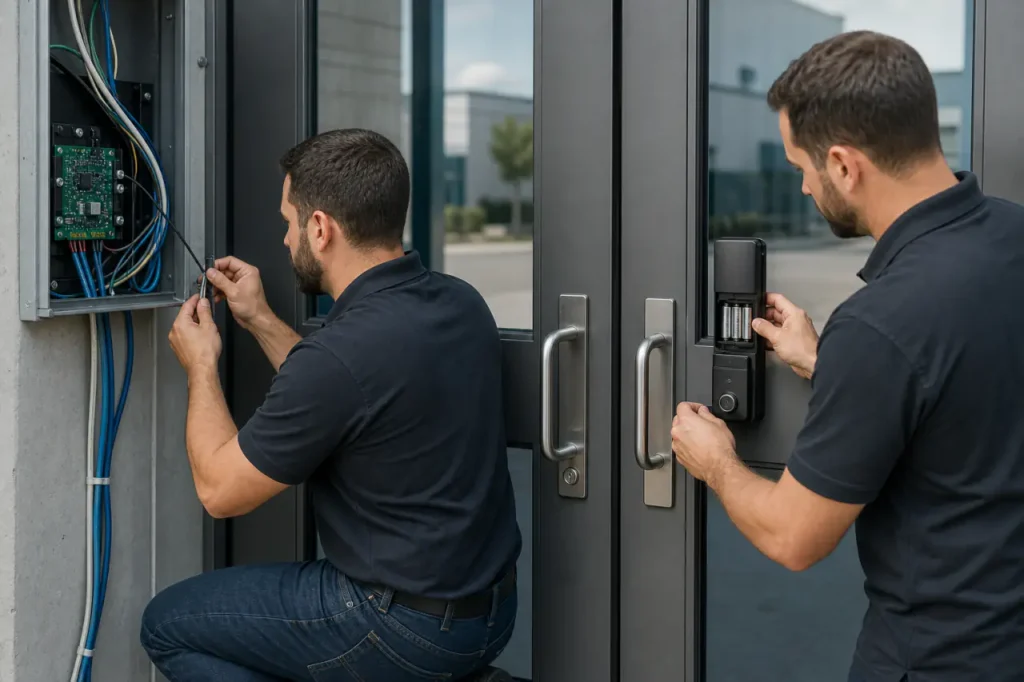
Wired access control depends on physical cabling. A dedicated low-voltage cable – typically Cat5e, Cat6, or a composite security cable – runs from a central controller or PoE switch to each door reader and lock. That cable delivers constant power plus an always-on data channel.
The lock mechanism (often an electric strike or magnetic lock) is energized directly from the building’s power infrastructure, with no battery to replace at the door.
Wireless access control removes the door-level cable. A battery-powered lockset or wall-mounted reader communicates over Wi-Fi, Bluetooth, or a proprietary 900 MHz / 2.4 GHz protocol to a nearby access point or gateway.
The gateway bridges back to the network – sometimes over Ethernet, sometimes wirelessly.
Power comes from on-board batteries, not a central feed. The reader’s data link is wireless, and its lock actuator runs off those same batteries.
This architectural split changes every downstream decision: installation disruption, total cost of ownership, security resilience, and what happens when the building loses power.
Core Comparison: Security, Installation, and Maintenance
Wired systems demand high upfront capital. Wireless systems shift cost toward ongoing operational maintenance. The choice isn’t cheap vs. expensive – it’s capital budget vs. facility staffing load.
| Metrik | Wired Access Control | Wireless Access Control |
|---|---|---|
| Biaya Awal | High – cable pulls, door coring, electrician labor, and often a dedicated access control panel | Moderate – lock hardware cost, plus gateway(s); no door cable |
| Installation Disruption | Significant – walls, ceilings, and door frames opened; may require after-hours work in occupied spaces | Minimal – surface-mounted locksets replace existing hardware; a few hours per door |
| Sumber Daya | Centralized – powered from building mains, typically with UPS/generator backup | Decentralized – lithium or alkaline batteries at each door; gateway may be PoE |
| Data Stability | Very high – dedicated copper path, no interference; constant connection to controller | Dependent on RF environment; susceptible to dead spots, congestion, and jamming |
| Beban Pemeliharaan | Low – once commissioned, physical connections rarely fail; lifecycle driven by hardware age | High – scheduled battery swaps across all doors; signal surveys; firmware and security patching |
The upfront gap is easy to see. The longer-term workforce demand is what catches facility directors off guard.
A 40-door wireless deployment can require 80-160 battery swaps per year, each requiring a technician visit and possibly a ladder. Compare that to a wired system where the only routine door-level maintenance might be a strike alignment adjustment every few years.
Installation Disruption and Upfront Costs
cURL Too many subrequests by single Worker invocation. To configure this limit, refer to https://developers.cloudflare.com/workers/wrangler/configuration/#limits Sistem kontrol akses PoE cURL Too many subrequests by single Worker invocation. To configure this limit, refer to https://developers.cloudflare.com/workers/wrangler/configuration/#limits.
cURL Too many subrequests by single Worker invocation. To configure this limit, refer to https://developers.cloudflare.com/workers/wrangler/configuration/#limits
- cURL Too many subrequests by single Worker invocation. To configure this limit, refer to https://developers.cloudflare.com/workers/wrangler/configuration/#limits
- cURL Too many subrequests by single Worker invocation. To configure this limit, refer to https://developers.cloudflare.com/workers/wrangler/configuration/#limits
- cURL Too many subrequests by single Worker invocation. To configure this limit, refer to https://developers.cloudflare.com/workers/wrangler/configuration/#limits
cURL Too many subrequests by single Worker invocation. To configure this limit, refer to https://developers.cloudflare.com/workers/wrangler/configuration/#limits.
cURL Too many subrequests by single Worker invocation. To configure this limit, refer to https://developers.cloudflare.com/workers/wrangler/configuration/#limits.
cURL Too many subrequests by single Worker invocation. To configure this limit, refer to https://developers.cloudflare.com/workers/wrangler/configuration/#limits
cURL Too many subrequests by single Worker invocation. To configure this limit, refer to https://developers.cloudflare.com/workers/wrangler/configuration/#limits.
cURL Too many subrequests by single Worker invocation. To configure this limit, refer to https://developers.cloudflare.com/workers/wrangler/configuration/#limits
- cURL Too many subrequests by single Worker invocation. To configure this limit, refer to https://developers.cloudflare.com/workers/wrangler/configuration/#limits
- cURL Too many subrequests by single Worker invocation. To configure this limit, refer to https://developers.cloudflare.com/workers/wrangler/configuration/#limits
- cURL Too many subrequests by single Worker invocation. To configure this limit, refer to https://developers.cloudflare.com/workers/wrangler/configuration/#limits
- cURL Too many subrequests by single Worker invocation. To configure this limit, refer to https://developers.cloudflare.com/workers/wrangler/configuration/#limits
cURL Too many subrequests by single Worker invocation. To configure this limit, refer to https://developers.cloudflare.com/workers/wrangler/configuration/#limits.
cURL Too many subrequests by single Worker invocation. To configure this limit, refer to https://developers.cloudflare.com/workers/wrangler/configuration/#limits.
cURL Too many subrequests by single Worker invocation. To configure this limit, refer to https://developers.cloudflare.com/workers/wrangler/configuration/#limits
- cURL Too many subrequests by single Worker invocation. To configure this limit, refer to https://developers.cloudflare.com/workers/wrangler/configuration/#limits
- cURL Too many subrequests by single Worker invocation. To configure this limit, refer to https://developers.cloudflare.com/workers/wrangler/configuration/#limits
- cURL Too many subrequests by single Worker invocation. To configure this limit, refer to https://developers.cloudflare.com/workers/wrangler/configuration/#limits
- cURL Too many subrequests by single Worker invocation. To configure this limit, refer to https://developers.cloudflare.com/workers/wrangler/configuration/#limits
cURL Too many subrequests by single Worker invocation. To configure this limit, refer to https://developers.cloudflare.com/workers/wrangler/configuration/#limits
cURL Too many subrequests by single Worker invocation. To configure this limit, refer to https://developers.cloudflare.com/workers/wrangler/configuration/#limits.
cURL Too many subrequests by single Worker invocation. To configure this limit, refer to https://developers.cloudflare.com/workers/wrangler/configuration/#limits
- cURL Too many subrequests by single Worker invocation. To configure this limit, refer to https://developers.cloudflare.com/workers/wrangler/configuration/#limits. cURL Too many subrequests by single Worker invocation. To configure this limit, refer to https://developers.cloudflare.com/workers/wrangler/configuration/#limits.
- cURL Too many subrequests by single Worker invocation. To configure this limit, refer to https://developers.cloudflare.com/workers/wrangler/configuration/#limits. cURL Too many subrequests by single Worker invocation. To configure this limit, refer to https://developers.cloudflare.com/workers/wrangler/configuration/#limits cURL Too many subrequests by single Worker invocation. To configure this limit, refer to https://developers.cloudflare.com/workers/wrangler/configuration/#limits, cURL Too many subrequests by single Worker invocation. To configure this limit, refer to https://developers.cloudflare.com/workers/wrangler/configuration/#limits.
- cURL Too many subrequests by single Worker invocation. To configure this limit, refer to https://developers.cloudflare.com/workers/wrangler/configuration/#limits cURL Too many subrequests by single Worker invocation. To configure this limit, refer to https://developers.cloudflare.com/workers/wrangler/configuration/#limits cURL Too many subrequests by single Worker invocation. To configure this limit, refer to https://developers.cloudflare.com/workers/wrangler/configuration/#limits cURL Too many subrequests by single Worker invocation. To configure this limit, refer to https://developers.cloudflare.com/workers/wrangler/configuration/#limits.
cURL Too many subrequests by single Worker invocation. To configure this limit, refer to https://developers.cloudflare.com/workers/wrangler/configuration/#limits.
cURL Too many subrequests by single Worker invocation. To configure this limit, refer to https://developers.cloudflare.com/workers/wrangler/configuration/#limits.
cURL Too many subrequests by single Worker invocation. To configure this limit, refer to https://developers.cloudflare.com/workers/wrangler/configuration/#limits
cURL Too many subrequests by single Worker invocation. To configure this limit, refer to https://developers.cloudflare.com/workers/wrangler/configuration/#limits.
cURL Too many subrequests by single Worker invocation. To configure this limit, refer to https://developers.cloudflare.com/workers/wrangler/configuration/#limits
- cURL Too many subrequests by single Worker invocation. To configure this limit, refer to https://developers.cloudflare.com/workers/wrangler/configuration/#limits
- cURL Too many subrequests by single Worker invocation. To configure this limit, refer to https://developers.cloudflare.com/workers/wrangler/configuration/#limits
- cURL Too many subrequests by single Worker invocation. To configure this limit, refer to https://developers.cloudflare.com/workers/wrangler/configuration/#limits
- cURL Too many subrequests by single Worker invocation. To configure this limit, refer to https://developers.cloudflare.com/workers/wrangler/configuration/#limits
| Skenario Fasilitas | Sistem yang Direkomendasikan | Alasan Utama |
|---|---|---|
| Konstruksi Baru, Gedung Milik Sendiri | Kabel (PoE) | Biaya kabel tambahan terendah selama pembangunan; stabilitas maksimum untuk pintu perimeter dan pintu keamanan tinggi |
| Bangunan Bersejarah atau Situs Landmark | Nirkabel | Menghindari pengeboran melalui batu bata, bingkai ornamen, dan kain yang terdaftar; pemasangan menjaga integritas arsitektur bangunan |
| Ruang Kantor Disewa (masa sewa 3-7 tahun) | Nirkabel | Menghindari perubahan struktural yang memerlukan persetujuan pemilik dan penghapusan saat akhir sewa; biaya modal rendah, perangkat keras portabel |
| Infrastruktur Kritis / Pusat Data | Kabel, dengan interior nirkabel terpilih | Pintu perimeter dan ruang server membutuhkan daya konstan dan risiko RF nol; pintu admin interior dapat nirkabel untuk fleksibilitas |
| Pintu Interior Berputar Tinggi (misalnya, coworking, ruang fleksibel) | Nirkabel | Rekonstruksi cepat tanpa pengkabelan ulang; perubahan kredensial ditangani dalam perangkat lunak; mendukung perubahan tata letak kantor yang sering |
Untuk bangunan bersejarah, nirkabel tidak hanya lebih mudah – seringkali ini satu-satunya opsi yang memenuhi persyaratan otoritas warisan setempat. Untuk ruang sewa, izin pemilik untuk penetrasi kabel dapat menunda proyek selama berbulan-bulan. Nirkabel menghilangkan ketergantungan itu.
Tapi jika Anda memiliki bangunan dan dindingnya belum disegel, melewatkan kabel mengorbankan keamanan jangka panjang. Penghematan jangka pendek mungkin terlihat kurang menarik lima tahun kemudian.
Pendekatan Hibrida: Kombinasi Terbaik dari Kedua Dunia
Sebagian besar fasilitas berskala besar menerapkan arsitektur hibrida untuk menyeimbangkan keamanan perimeter yang kokoh keamanan pintu perimeter dengan efisiensi anggaran.
Aturannya sederhana: pasang kabel keras pada pintu yang menghadap ke luar, melindungi aset bernilai tinggi, atau berfungsi sebagai titik keluar penting, dan gunakan nirkabel untuk semua yang ada di dalam yang tidak memenuhi kriteria tersebut.
Tata letak hibrida yang umum membagi pintu menjadi dua tingkat:
- Dihubungkan dengan kabel untuk: pintu eksterior, roll-up dock, ruang IT/server, ruang penanganan uang tunai, dan koridor keluar penting.
- Nirkabel untuk: kantor interior, ruang rapat, area istirahat, zona coworking, dan ruang fasilitas.
Pintu yang terhubung kabel mendapatkan daya konstan, integrasi alarm kebakaran pusat, dan jalur data yang tahan terhadap gangguan. Pintu interior nirkabel menerima pembaruan kredensial dan penjadwalan melalui udara, tanpa kabel baru.
Satu pengendalian akses berbasis cloud platform mengelola kedua jenis perangkat di bawah satu antarmuka, sehingga tim keamanan melihat log kejadian terpadu dari satu tampilan.
Model kontrol akses yang skalabel ini juga memungkinkan Anda melakukan fase dalam penerapan. Sebuah organisasi mungkin memulai dengan kunci interior nirkabel untuk akses hot-desking, kemudian menambahkan pintu perimeter berkabel nanti saat anggaran renovasi disetujui.
Perangkat lunak head-end harus mendukung armada campuran tanpa memerlukan basis data atau konsol operator yang berbeda.
Ajukan Permintaan Audit Akses Fasilitas Kustom
Arsitektur kontrol akses yang tepat sepenuhnya bergantung pada jejak bangunan Anda, pola lalu lintas harian, dan kebutuhan kepatuhan keamanan.
Perbandingan lembar spesifikasi dapat membantu Anda memulai, tetapi kunjungan ke lokasi yang memetakan jalur kabel, mengukur gangguan RF, dan mengidentifikasi titik integrasi alarm kebakaran akan menghasilkan rencana perangkat keras yang akurat dan perkiraan total biaya kepemilikan yang realistis.
Kami bekerja sama dengan integrator komersial dan direktur fasilitas untuk menilai kebutuhan pintu per pintu dan merekomendasikan konfigurasi perangkat keras yang menyeimbangkan keamanan, kenyamanan instalasi, dan biaya pemeliharaan jangka panjang.
Jika Anda membandingkan sistem kontrol akses terintegrasi untuk proyek baru atau retrofit, tim teknik kami dapat membantu Anda meninjau jadwal pintu, mengidentifikasi di mana kabel terhubung masuk akal, dan di mana kunci tanpa baterai atau kunci nirkabel hemat daya dapat mengurangi gangguan tanpa mengurangi keamanan.
Hubungi kami untuk mendiskusikan audit akses fasilitas yang disesuaikan dan rencana perangkat keras.