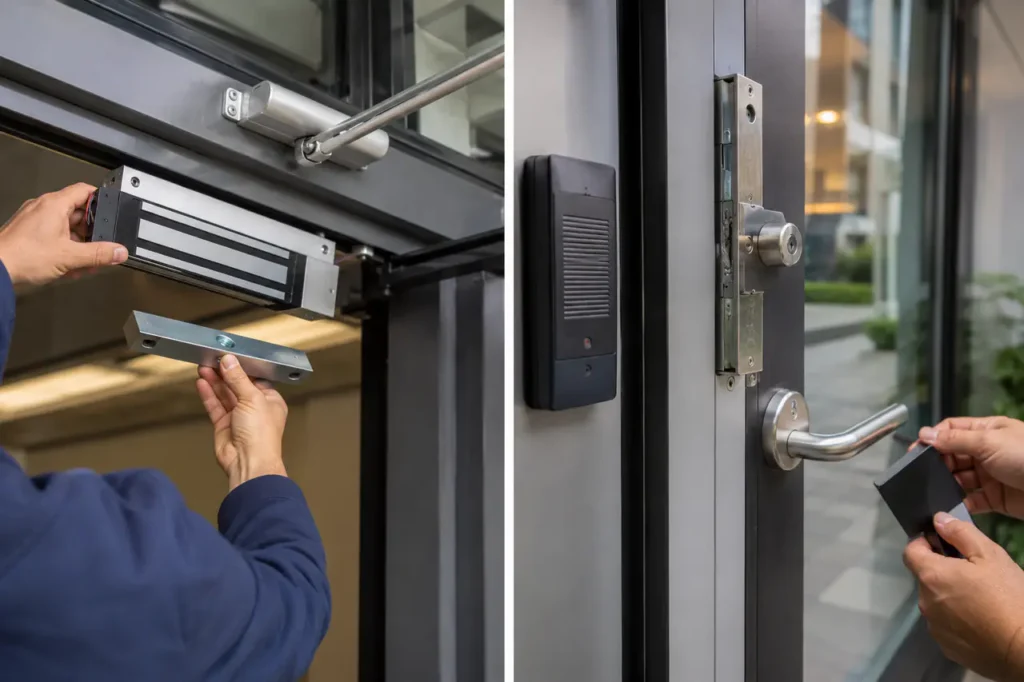
During a commercial power outage, door locking hardware immediately dictates whether building occupants can escape safely and whether secure zones remain protected. Selecting between a fail safe vs fail secure lock is an engineering decision driven by life safety codes, asset risk, and electrical behavior.
The Core Difference: Power-Loss Mechanics
A fail-safe lock requires continuous electrical current to remain locked, instantly unlocking when power is removed. A fail-secure lock requires electrical power to unlock, remaining locked when current is interrupted.
The mechanical difference lies in the internal solenoid or motor armature position when unpowered. Fail-safe devices rely on constant energization to hold a mechanical latch or magnetic field closed.
Fail-secure hardware relies on internal mechanical springs to hold the locking bolt in place until an electrical signal temporarily releases it.
| Operational Parameter | Fail-Safe Locks | Fail-Secure Locks |
|---|---|---|
| Default Unpowered State | Unlocked (Free entry and exit) | Locked (Restricted entry from exterior) |
| Power Application Rule | Power applied to lock | Power applied to unlock |
| Primary Goal | Occupant life safety and rapid evacuation | Property and physical asset protection |
| Power Draw Profile | Continuous current draw while locked | Pulsed current draw during credential release |
| Egress Path Suitability | Mandatory on specific emergency egress routes | Permissible when paired with mechanical free egress |
| Fire Alarm Integration | Required via direct FACP power interrupt | Optional depending on local AHJ requirements |
Table 1 compares the operational baseline of both configurations across electrical, mechanical, and code compliance axes.
Power draw and mechanical wear create different maintenance profiles.
- Continuous coil energization generates heat and requires clean voltage, higher-grade insulation, and thermal dissipation.
- Current is drawn only during unlock cycles, reducing electrical fatigue.
- Wear concentrates in mechanical springs and latches rather than thermal coil degradation.
Hardware Compatibility: Which Locks Support Which State?
Access hardware categories dictate whether a door can function as fail-safe, fail-secure, or offer field-selectable modes. Matching your security design with compatible physical hardware prevents costly field retrofits.
| Hardware Category | Supported Lock States | Common Facility Deployment | Mechanical Egress Behavior |
|---|---|---|---|
| Electromagnetic Locks | Fail-Safe Only | Glass lobbies, emergency exit stairwells | Immediate release when power drops |
| Electric Strikes | Fail-Safe or Fail-Secure | Interior office suites, commercial corridors | Interior door handle operates mechanically |
| Electromechanical Mortise | Field-Selectable (Most models) | High-security interior doors, perimeter entries | Mechanical latch retraction via interior lever |
| Electrified Panic Trim | Fail-Safe or Fail-Secure | Auditoriums, assembly spaces, fire exits | Push bar retracts latch regardless of power |
Table 2 outlines how core locking hardware types map to electrical loss behaviors and physical door operations.
Electromagnetic locks: Inherently fail-safe by design
Electromagnetic locks, or maglocks, have no moving mechanical latches. They rely entirely on magnetic flux between an electromagnet and an armature plate, making them inherently fail-safe devices.
When current stops, magnetic holding force drops to zero instantly. Evaluating electric strike vs magnetic lock options requires accounting for this limitation, as maglocks cannot function in a fail-secure configuration.
Electric strikes and mortise locks: Field-selectable flexibility
Electric strikes accommodate either mode depending on the solenoid orientation and mechanical locking cam position. Many commercial-grade strikes allow installers to toggle between configurations in the field using a simple locking screw adjustment.
Electromechanical mortise locks integrate solenoids directly inside the lock body. Specifying modular commercial access control locks with field-selectable modes simplifies stocking and allows keying adjustments as facility needs evolve.
Electrified panic hardware: Separating exterior trim from crash bars
Electrified panic hardware separates the mechanical egress function from the exterior access control trim. Pressing the crash bar mechanically retracts the latch bolt under all circumstances, even if the exterior trim remains locked in a fail-secure state.
This separation allows facility managers to enforce exterior perimeter security without violating building egress requirements or endangering occupants during emergency evacuations.
The Fundamental Conflict: Life Safety vs. Asset Protection
Building design forces an ongoing compromise between occupant safety and asset security. Life safety codes prioritize unimpeded exit during emergencies, while security protocols focus on preventing unauthorized entry during site disruptions.
Deploying fail-safe locking on high-security rooms creates significant asset risk during power outages. If utility power drops and generator backup fails, a server room using pure fail-safe hardware unlocks automatically, leaving sensitive data physically exposed.
Conversely, installing fail-secure hardware without mechanical free egress on emergency exit doors creates serious safety hazards. Occupants can become trapped inside during a facility emergency if power fails simultaneously with an evacuation event.
The Authority Having Jurisdiction (AHJ)-typically the local fire marshal or building inspector-holds final authority on door hardware approvals. AHJs enforce national codes such as NFPA 101 (Life Safety Code) and the International Building Code (IBC).
- Life Safety Priority: Clear egress paths, immediate power-drop release, and mechanical panic bar functionality.
- Asset Security Priority: Continuous latch engagement, physical barrier integrity, and restricted exterior entry during power outages.
- Regulatory Baseline: Life safety codes always legally override physical asset protection preferences on designated emergency egress routes.
Evaluating hardware specs requires confirming Are Smart Locks Safe under local municipal codes before completing your procurement schedule.
Facility Mapping: Where to Deploy Each Configuration
A compliant facility hardware specification categorizes doors by occupant traffic, egress classification, and asset density rather than applying a single lock type across the whole building.
High-Traffic Egress and Fire Doors (Fail-Safe)
Main lobby vestibules, high-occupancy assembly rooms, and primary stairwell exits require fail-safe configurations or panic hardware. High traffic volumes necessitate immediate unlocking during power interruptions or fire alarms to prevent dangerous bottlenecks.
Glass architectural entrance doors using electromagnetic locks must connect directly to emergency release circuits. Deploying enterprise-grade hardware ensures full alignment with local egress laws while keeping public entrances manageable.
IT Closets, Server Rooms, and Exterior Perimeters (Fail-Secure)
Data centers, server closets, research labs, and confidential document archives require fail-secure hardware. Maintaining physical security during power loss, hardware brownouts, or deliberate grid disruptions is essential for asset protection.
Integrating wireless access control lock setups configured as fail-secure keeps interior secure rooms latched mechanically while maintaining audited badge access during routine power fluctuations.
Stairwells (The Hybrid Approach)
Stairwells represent complex environments governed by strict re-entry requirements under NFPA 101. While occupants must always be able to enter the stairwell to escape, building codes often require stairwell doors to unlock remotely to allow re-entry on non-fire floors.
Fail-safe electrified mortise locks are commonly installed on the stairwell side of the door. Under normal conditions, the exterior lever remains locked to prevent unauthorized floor access, but unlocks automatically during a fire alarm signal.
To determine the correct state for every door across your floor plan, follow this systematic decision pathway:
- Is the door located along an official fire escape or emergency egress path? Specify fail-safe or mechanical panic hardware.
- Does the room contain high-value physical assets, critical server infrastructure, or hazardous materials? Specify fail-secure.
- Is the door part of a multi-story stairwell requiring selective re-entry during building evacuations? Specify fail-safe exterior trim with mechanical interior egress.
- Does the entrance use specialized enclosures or specialized access control hardware? Review special safety hardware compliance specs for unique enclosure needs.
Integration with Fire Alarm Control Panels (FACP)
Fail-safe locks deployed on designated emergency egress routes must integrate directly with the building’s Fire Alarm Control Panel (FACP). This connection ensures that power drops automatically whenever the fire alarm triggers.
Where mechanical integration overrides software control
Relying on software commands from an access control server to unlock emergency exit doors during a fire alarm introduces unnecessary risk. Network latency, software crashes, or damaged data cables can fail to unlock the doors in time.
- Life safety codes require a hardwired FACP relay to the power supply feeding fail-safe locks.
- Alarm activation opens an internal relay and physically cuts power at the source.
- Emergency interface modules interrupt 12-24 V DC output channels across tied doors.
Verifying request-to-exit (REX) and emergency power cutoffs
Doors using electromagnetic locks require multiple redundant release methods to comply with commercial building codes. Because maglocks do not have a mechanical latch override, dropping power is the only way to release the door.
- Primary Release: Passive infrared (PIR) request-to-exit (REX) sensor detecting approaching occupants.
- Secondary Release: Auxiliary manual push-to-exit button mounted near the door, equipped with an internal mechanical timer (minimum 30 seconds).
- Tertiary Cutoff: Direct fire alarm system relay connection that drops primary lock power during any alarm activation.
Common Misconceptions in Commercial Deployments
Misinterpreting locking terminology leads to specification errors, delayed building inspections, and unnecessary hardware change orders during construction.
Misconception: Fail-Safe Locks Guarantee Faster Exits
A common misconception is that fail-safe hardware is required on every door to permit rapid egress. In reality, mechanical egress functions independently from the electrical locking state on most standard lock bodies.
- Fail-secure electric strikes still release when the interior lever turns.
- The fail-secure state restricts exterior entry, not interior mechanical exit.
- Mechanical latch retraction works regardless of strike plate power.
Selecting robust commercial access control locks does not require compromising security on sensitive interior rooms.
Misconception: Fail-Secure Locks Trap Occupants During Outages
Fail-secure hardware restricts entry from the exterior side during a power failure, but it does not lock occupants inside a room.
- Interior door handles and lever trim retract the latch mechanically.
- Crash bars and panic hardware operate without electrical power.
- Exterior entry remains blocked unless a mechanical key override is used.
Final Selection Checklist & Security Consultation
Reviewing physical site parameters and local building codes before ordering access control hardware prevents project delays and installation rework.
- Verify AHJ fire code requirements for all doors designated along emergency egress routes.
- Map every door by asset protection priority versus occupant exit volume.
- Confirm that specified lock hardware matches the door construction (hollow metal, aluminum storefront, or frameless glass).
- Audit power supply locations, wire gauge runs, and emergency backup battery runtime capacities (24-48 hours baseline).
- Select field-selectable electric strikes and electromechanical locks to simplify field installation and spare parts inventory.
- Ensure all electromagnetic locks integrate hardwired FACP relay cutoffs and secondary manual exit devices.
- Evaluate advanced cloud management compatibility by reviewing cloud access control lock options for central monitoring.
Selecting the right hardware configuration requires balancing code compliance, electrical system design, and physical security. Contact our technical engineering team at Gove to review your door schedule, verify hardware specs, and ensure a code-compliant deployment.
Frequently Asked Questions
Do fail-secure locks require a battery backup?
Fail-secure locks require a battery backup (UPS) only if credentialed exterior entry must continue during power outages. Without backup power, the exterior trim stays mechanically locked when main power drops, requiring a physical key override to gain entry from the outside.
Can an electric strike be easily switched from fail-safe to fail-secure?
Many modern commercial electric strikes feature field-selectable operation. Installers can switch the mechanical operation between fail-safe and fail-secure modes by adjusting an internal locking screw or solenoid position prior to installation, reducing the need for separate hardware SKUs.