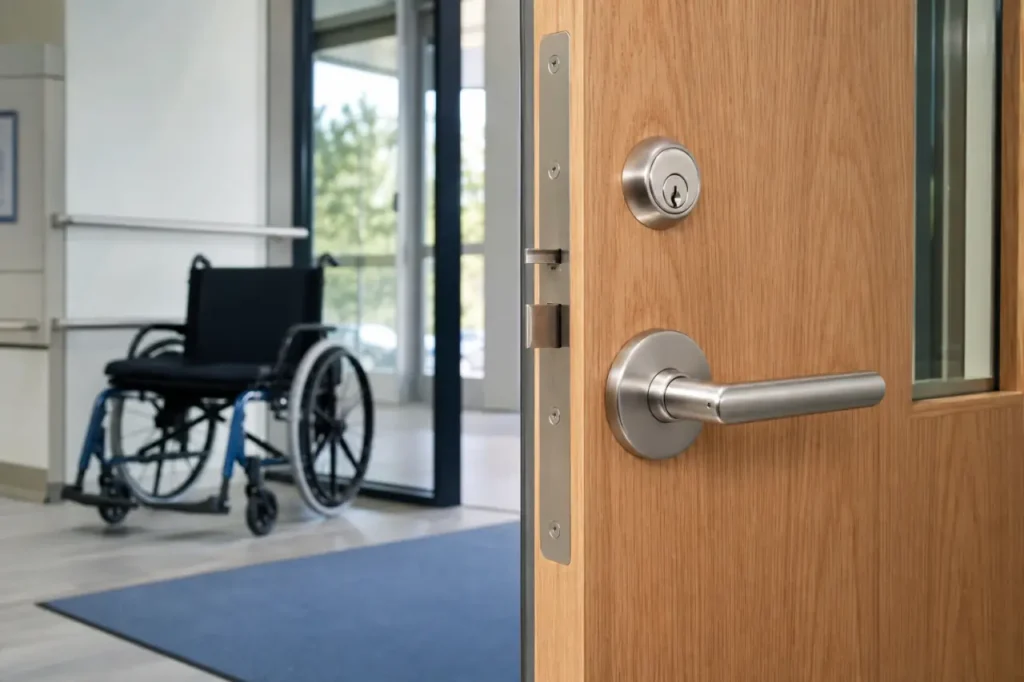
To specify an ADA compliant door lock correctly, the hardware must pass a simple functional test: it must be operable with one hand, without tight grasping, pinching, or twisting of the wrist.
If the lock requires more than 5 pounds of force or falls outside the 34-to-48-inch mounting range, it will not meet federal accessibility standards. This puts the facility at risk of non-compliance citations.
Federal Parameters for ADA Door Hardware Compatibility
ADA door hardware must allow single-motion egress with minimal effort. The three non-negotiable parameters below form the basis of every accessibility audit. A lock that fails any one of them is not compliant, regardless of its other features.
- Operating Force: Maximum 5 lbf to unlatch and fully open the door. Verify with a calibrated force gauge-not by feel.
- Mounting Height: The operable portion of the hardware must sit between 34″ and 48″ above the finished floor (AFF). Measure from the floor to the centerline of the grip.
- One-Hand Operation: The lock must unlatch without tight pinching, grasping, or wrist twisting. A closed fist or open palm should be enough to operate it.
These three rules are the minimum verification points on a door schedule. A lock that meets them is on the path to compliance; one that misses any single point must be substituted.
While meeting ADA standards is critical, fire code compliant locks often run parallel. Verify that any lock also satisfies fire-rated door requirements before ordering.
For facilities upgrading to electronic access without sacrificing compliance, a 7-in-1 smart door lock with a lever handle can satisfy all three parameters while adding audit trail capabilities.
Commercial Lock Types and ADA Compliance Status
Not all lock types meet the functional requirements equally. Lever handles and push-type mechanisms typically pass, while round knobs and small thumb-turns fail. The table below maps common lock styles to their compliance status and best-fit commercial applications.
| Lock Type | Compliance Status | Ease of Operation | Ideal Commercial Application |
|---|---|---|---|
| Lever Handles | Compliant | Operable with closed fist or elbow | Office entries, corridor doors |
| Mortise Locks (Lever) | Compliant | Smooth single motion | High-traffic commercial entries |
| Keypad Locks | Compliant if lever/push | One-hand code entry | Access-controlled offices |
| Exit Devices (Push Bar) | Compliant | Body force or palm push | Emergency egress doors |
| Round Knobs | Non-Compliant | Requires pinch and twist | Not for accessible routes |
The key factor is the absence of pinching and twisting. Even a mortise lock with a lever handle remains compliant; the lock mechanism itself is not the issue-the operating trim is.
A proper lever handle mortise lock meets ADA force and motion requirements without compromise.
Why Traditional Round Knobs Fail Compliance
Round knobs demand a tight pinch and wrist rotation to turn, which immediately violates the one-hand, no-grasp rule. Users with limited hand strength, arthritis, or prosthetics cannot operate them reliably.
In any accessible route, round knobs create a barrier that is both a code violation and a liability risk.
The Role of Handing (Left vs. Right-Handed Hardware)
A lever installed on the wrong handing forces the user to pull against the door’s swing or twist the handle awkwardly. Correct handing-left-hand or right-hand-ensures a natural downward or outward motion in a single continuous movement.
When specifying, always confirm the door swing direction and match the lock chassis accordingly.
Application Guide: Specifying Locks by Facility Type
Different commercial environments impose additional requirements beyond the baseline ADA parameters. The following facility types each demand a specific hardware focus to balance accessibility with privacy, security, and specialized safety codes.
Commercial Restrooms and Indicator Locks
For commercial restroom locks, the visual vacancy indicator is just as important as the lever. A large, color-coded window-green for vacant, red for occupied-lets users identify availability from across the room.
The lever must require less than 5 lbs of force and should not catch fingers or clothing.
- Single-motion lever with no pinch points
- Oversized indicator visible at distance
- Minimal operating force under 5 lbf
- Sturdy privacy function that latches without added resistance
Behavioral Healthcare and Anti-Ligature ADA Hardware
Behavioral health settings demand hardware that meets both ADA and anti-ligature standards. The lever must have a radiused tip and minimal protrusion to prevent tie-off points, while still allowing operation with a loose fist or palm.
Some designs incorporate a low-profile lock cylinder that doesn’t snag.
- Ligature-resistant shape with no sharp edges
- Lever returns to within 1/2″ of the door surface
- Visual indicator optional but preferred if risk-assessed
- Smooth, continuous motion without a separate twist lock
Office and Corporate Access Control
Corporate floors frequently pair mechanical levers with electronic credentials. A commercial door smart lock with a lever handle satisfies ADA while offering keycard, PIN, or mobile access.
Confirm that the keypad or reader height also falls within the 34-48″ range, and that backlit digits aid low-vision users. A simple commercial lever lock without electronics also meets all force and height standards for interior offices.
- Keypad or touchscreen mounted within the ADA height zone
- Backlit digits and audible feedback for users with visual or hearing impairments
- Lever handle for manual override if electronics fail
- Single-motion unlocking from the interior side
ADA Door Hardware Compliance Checklist
Use this checklist to audit existing doors or validate new hardware submittals before ordering. A five-minute check per opening prevents change orders and occupancy delays later.
| Parameter | ADA Requirement | Verification Method |
|---|---|---|
| Mounting Height | 34″ – 48″ AFF | Tape measure |
| Operating Force | Maximum 5 lbf | Force gauge |
| Handle Type | Lever, push bar, or push plate (no knobs) | Visual inspection |
| Handing | Left-hand or right-hand, matching door swing | Check door swing direction |
| Privacy Indicator | Large visual indicator (restrooms) | Visual check |
| Single-Motion Operation | Unlatches without additional twist or pinch | Operational test |
This audit, done before the final submittal, catches non-compliant specs that could delay an occupancy permit. If any line item fails, swap the hardware immediately instead of hoping for a field approval.
Hardware Procurement and Compliance Verification
Consolidate your door schedule data before requesting a quote. The supplier needs door thickness, handing, fire rating, and facility type to confirm that each lock meets ADA and local building codes. Missing even one data point can result in a non-compliant order.
- Door thickness: typically 1-3/4″ or 2-1/4″
- Handing: left-hand or right-hand, per door swing
- Fire rating: 20-minute, 45-minute, or 90-minute if required
- Facility use: restroom, office, patient room, corridor
- Quantity per type
To review your project hardware list, provide those details and our commercial team can verify compliance across your door openings before you commit to a purchase. We’ll cross-check the selections against the checklist above and flag any substitutions that might be needed.
Frequently Asked Questions
Are thumb-turn deadbolts ADA compliant?
Standard small thumb-turns require a pinch-and-twist motion, which fails the ADA operational test. Oversized, wing-style thumb-turns that can be operated with the side of the hand or a loose fist are compliant.
When retrofitting mortise locks, select an oversized thumb-turn or an integrated smart mortise lock option that maintains compliance.
Does the 5-pound force rule apply to exterior doors?
The ADA specifies a maximum 5 lbf for interior hinged doors.
Exterior doors often have higher allowable forces due to wind and building pressurization, but local fire and accessibility codes may still require the lowest practical operating force.
Always check with your local Authority Having Jurisdiction.
Can small businesses be exempt from ADA lock requirements?
Under Title III, most public accommodations and commercial facilities must comply. For older buildings, the “readily achievable” standard may allow some delay, but new construction and alterations must fully meet ADA requirements. Confirm with local code enforcement or an Architectural Hardware Consultant.