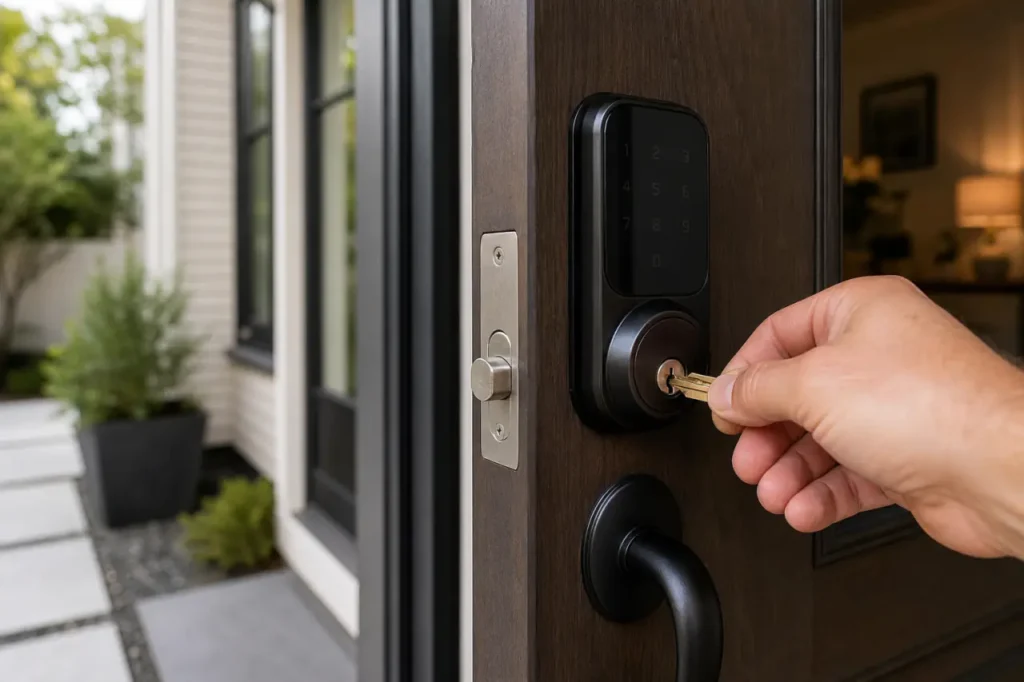
A dead smart lock battery at the wrong moment turns a convenient home into a frustrating lockout.
That’s why a smart lock with mechanical override is no longer an afterthought – it’s the single most reliable failsafe against electronic failure.
Whether you manage a rental property or just want to avoid calling a locksmith, a physical key backup ensures access when apps, fingerprint scanners, or keypads go dark.
Why You Need a Mechanical Override for Smart Access
A digital lock without a physical keyway leaves you fully dependent on batteries and wireless signals. When either fails, the only way in may involve a destructive entry. A mechanical override removes that single point of failure.
- Battery depletion. Cold weather drains batteries faster than most users expect. A key backup works immediately, with no wait for a temporary charge port.
- Motor or circuit board failure. Internal gears can jam, especially on older locks or after repeated slam-shut use. The key cylinder still turns the deadbolt mechanically.
- Network and app outages. A dead hub, lost Wi-Fi, or a phone that runs out of charge means app-based unlocking disappears. The physical key stays independent.
- Emergency access for others. First responders, property managers, or cleaning staff rarely have time to download an app. A key overcomes that access barrier instantly.
- Power outages on hardwired systems. Some smart locks use low-voltage building power. A blackout can disable the electronic latch, but a key cylinder keeps the bolt operable.
For light commercial settings – offices, clinics, vacation rentals – an keyless entry system with physical backup is often required by local fire codes. The override isn’t a convenience; it’s a compliance safeguard.
Keyway Styles: Hidden vs. Exposed Override Mechanisms
Not all key overrides look the same. The location and visibility of the cylinder change how the lock is used and perceived. The right choice depends on whether you prioritize aesthetics or frequent key access.
Exposed Keyways (Standard Cylinders)
Most traditional smart deadbolts place a standard keyway on the exterior face, just like a dumb lock. This design allows fast access for anyone with a physical key.
Maintenance staff, dog walkers, or family members without smartphones can operate the lock without learning a new interface.
Exposed cylinders are typically compatible with common keyways – Schlage SC1 or Kwikset KW1 – so a locksmith can rekey the smart lock to match your existing house keys.
This cuts the number of keys in circulation. The trade-off: an exposed keyhole is visible and may invite picking attempts, so cylinder quality matters more here.
Hidden and Concealed Keyways
Some manufacturers hide the mechanical backup behind a magnetic faceplate or tuck it under the lock body. The goal is a clean, minimalist facade that looks fully keyless.
Users who rarely touch a physical key – but want it available for emergencies – prefer this style.
Concealed keyways also add a mild tamper deterrent. A would-be intruder can’t easily identify the cylinder type without removing the cover. However, emergency access takes a few extra seconds. If you expect to use the key weekly, an exposed keyway is faster and less fiddly.
Top Smart Locks with Mechanical Override by Use Case
The override feature alone isn’t enough to pick a lock. The overall package – access methods, build quality, and door type – must match the property. Here’s how the key product families break down by application.
Yale Smart Mortice & Deadbolt Series (Best for Residential Security)
Yale’s smart deadbolts and mortice locks pair a rekeyable cylinder with PIN pads, RFID tags, and app control. The keyway sits on the exterior escutcheon, clearly accessible.
- Standard rekeyable cylinder (Schlage/Kwikset compatible)
- Multiple access methods: PIN, app, RFID tag
- Works on standard door preps for deadbolts
- Ideal for main entry doors where several family members prefer a physical key
For mixed-use buildings, the same lock can give tenants a key while the owner manages codes remotely.
Eufy Security Locks (Best for Biometric & Camera Integration)
Eufy bundles a fingerprint scanner, doorbell camera, and keypad into one unit. The mechanical key slot is a deep backup – tucked under a cover or at the bottom edge.
- Fingerprint, camera, keypad, and key access
- Override typically concealed for a clean look
- Ideal for homeowners who want to go mostly keyless but need a fallback
- Cylinder may not be rekeyable to an existing house key without an adapter
Verify compatibility before assuming a locksmith can match your keys.
Level Lock Series (Best for Invisible Design)
Level replaces only the internal deadbolt mechanism, leaving your existing exterior hardware and key cylinder untouched. Your old key still works.
- Invisible upgrade; no external keypad or scanner
- Keeps existing key cylinder and key
- Works with your door’s current look and key system
- Popular for period properties and high-end residential projects
The trade-off: you can’t add a fingerprint reader or camera to the lock body.
Codelocks & LockeyUSA (Best for Gates and Light Commercial)
These brands straddle mechanical and electronic access. Many models use a mechanical code lock with a key override that’s built into a weatherproof tubular or mortice latch.
- Exposed keyway with common cylinder (easy rekey)
- Weather-resistant for outdoor gates, pool enclosures, storage rooms
- Often rated for high-cycle use in light commercial settings
- Master key compatible for facilities teams managing multiple properties
If you need a lock that combines fingerprint, app, and a physical key in a single unit, the 7-in-1 smart lock with key override from Gove offers a similar profile for front doors and side entrances.
It’s built around a rekeyable cylinder, so it fits into an existing key system without extra parts.
Smart Lock Override Comparison Table
| Brand/Model | Primary Access Methods | Override Style | Cylinder Type / Rekeyable | Best Use Case |
|---|---|---|---|---|
| Yale Smart Deadbolt | PIN, App, RFID tag | Exposed | Standard (Schlage/Kwikset) / Yes | Residential front door, mixed-user building |
| Eufy Video Smart Lock | Fingerprint, Camera, Keypad | Concealed (bottom) | Proprietary / Limited rekey | Home entry with video monitoring, mostly keyless |
| Level Bolt | App only (uses existing key) | Standard (existing hardware) | Existing key cylinder / Yes | Invisible smart upgrade, historic doors |
| Codelocks CL550 | Mechanical code, Key | Exposed | Standard mortice / Yes | Gates, pool enclosures, light commercial |
| Gove A8010 | Fingerprint, PIN, App, Card, Key | Exposed | Standard / Yes | Front door, Airbnb, small office |
| Gove D-7800 | 3D Face Recognition, Fingerprint, PIN, Card, Key | Exposed | Standard / Yes | High-traffic entry, hands-free operation |
Use this table as a quick filter. If rekeying to an existing master key system is non-negotiable, drop models with proprietary or limited rekey options.
If the lock lives on a fully exposed gate, prioritize exposed keyways with weather-sealed cylinders over hidden covers that can trap moisture.
Buying Factors: How to Choose the Right Backup Key System
The mechanical override is only as useful as the cylinder inside it.
A poorly chosen key system can leave you locked out – or force you to carry a separate key just for that one door.
The factors below separate a reliable backup from a future frustration.
1. Rekeying Compatibility and Keyway Matching
- Ask whether the smart lock uses a standard keyway (Schlage SC1, Kwikset KW1) that a locksmith can rekey.
- Proprietary cylinders may not accept common key blanks, limiting your ability to consolidate keys.
- If your property already uses a master key system, verify the cylinder can be repinned to match without breaking the hierarchy.
- Some manufacturers offer a “rekeyable smart lock cylinder” upgrade; confirm availability before ordering.
2. Weatherproofing and IP Ratings for Outdoor Use
- For exterior gates and harsh climates, look for an IP55 or IP65 rating on the electronic housing.
- Even brass cylinders degrade if moisture reaches internal contacts; choose locks with sealed keyways.
- Salt air or extreme cold can accelerate wear – verify the lock’s operating temperature range.
- Exposed keyways need a simple drain path; concealed covers can trap moisture and freeze.
3. ANSI Grading and Physical Security
- For commercial or multi-family entries, specify ANSI Grade 1 smart locks for higher cycle and picking resistance.
- Grade 2 locks suit heavy residential use; Grade 3 is acceptable for interior or low-risk doors.
- A high-security cylinder with anti-bump and anti-pick pins adds protection regardless of the electronics.
- Match the cylinder grade to your insurance requirements; many underwriters demand at least Grade 2 on external doors.
4. Keyway Location and Real-World Accessibility
- A keyway behind a magnetic cover looks sleek but demands that the cover stays attached and recognizable.
- Property managers who use the key weekly will find an exposed cylinder faster and more reliable.
- In dark or wet conditions, a bottom-mounted override can be hard to locate; test before installing.
- If the cover gets lost or jammed, a hidden keyway becomes useless – plan for that scenario.
5. Code Compliance for Multi-Unit and Rental Properties
- Some fire codes require a physical key egress path or fire department access; check local regulations.
- Verify that the mechanical override works from both sides where needed, not just the exterior.
- In vacation rentals, the physical key must be accessible to the owner or manager without disassembling the lock.
- Smart locks with a key override can satisfy code while still enabling remote code changes between guests.
Final Selection & Installation Checks
Measure Your Door Before You Order
- Measure the backset – the distance from the door edge to the center of the bore hole. Common sizes are 2-3/8″ or 2-3/4″.
- Check door thickness: a cylinder that’s too short won’t engage the bolt properly.
- Confirm the bore hole diameter matches the lock’s spec (most require 2-1/8″).
- Take a photo of your existing door prep and edge bore; it helps suppliers verify fit.
When to Involve a Specialist
If the lock will integrate into a broader access control plan – for a vacation rental, office, or gate network – it’s worth consulting a hardware specialist.
They can confirm cylinder compatibility, match keys across properties, and ensure the smart lock’s override doesn’t break your master key hierarchy.
Start with a spec sheet and a photo of your existing door prep. A quick review can prevent a misordered lock.
Frequently Asked Questions
Does having a mechanical keyway make a smart lock easier to pick?
The lock is only as vulnerable as the cylinder inside it.
A high-grade cylinder with spool pins and anti-bump features resists picking just as effectively whether it’s part of a smart deadbolt or a traditional lock.
Look for models that use ANSI Grade 1 or 2 cylinders to maintain physical security.
Can I use my current house key with a new smart lock?
Yes, provided the smart lock’s cylinder uses the same keyway as your existing keys – usually Kwikset KW1 or Schlage SC1 – and the manufacturer allows rekeying.
A locksmith can repin the cylinder to match your current key in under 15 minutes. Always confirm cylinder type before purchase.