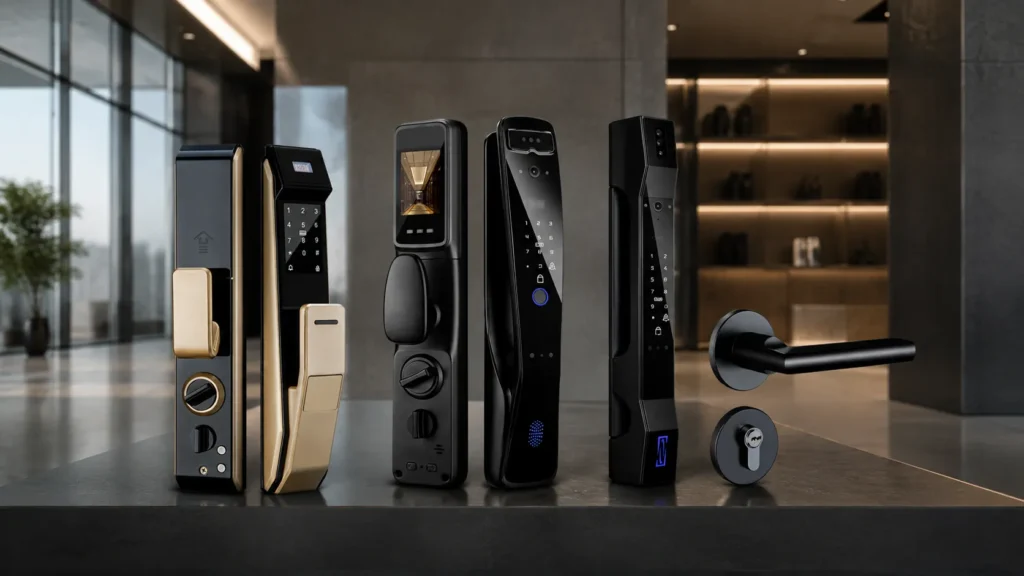
Biometric access control is moving beyond consumer gadgets into the core of commercial, multi-family, and institutional security planning. For procurement teams and property developers, sourcing wholesale biometric door locks means evaluating fingerprint sensors, facial recognition modules, and the factories that build them—not just comparing retail features.
This guide helps B2B buyers cut through the noise. We cover sensor technologies that affect false acceptance rates, sourcing channels that determine unit cost and customization depth, procurement logistics, and the application fit that separates a reliable commercial deployment from a maintenance headache.
Technical Comparison of Biometric Sensor Types
The sensor under the surface dictates security, cost, and how the lock performs in real-world conditions. Choosing the wrong type for the facility’s traffic level erodes the value of a bulk purchase fast.
| Sensor Type | Security Level | Unit Cost Impact | Best Use Case |
|---|---|---|---|
| Optical (fingerprint) | Moderate | Lowest | Interior office doors, staff rooms |
| Capacitive (fingerprint) | High | Moderate | Multi-family housing, high-traffic entrances |
| Facial Recognition (2D/3D) | Higher (3D), Moderate (2D) | Highest | Commercial lobbies, touchless-access projects |
Note: Security and cost values are directional examples based on typical factory offerings. Buyers should request specific sensor module datasheets and test sample units under actual lighting and humidity conditions before ordering.
Key Performance Metrics: FAR, FRR, and Durability
Reliability metrics matter more than feature lists when you’re deploying locks across hundreds of units. Two numbers tell you whether the biometric hardware will frustrate users or open security gaps.
- False Acceptance Rate (FAR): This measures how often an unauthorized fingerprint or face is incorrectly granted access. For commercial projects, target FAR benchmarks under 0.001%, and preferably as low as 0.0001% for controlled-access areas. A wholesale smart door lock with weak FAR will force expensive rekeying or replacement at scale.
- False Rejection Rate (FRR): In multi-family housing, FRR drives tenant complaints. A lock that rejects a valid fingerprint too often creates support calls. Acceptable commercial FRR typically sits around 1–3%, but verify with the biometric smart lock factory how this number was measured—lab conditions versus real-world dirty, wet fingers.
- Physical durability: Check IP ratings for dust and water resistance, especially for outdoor or semi-outdoor installations. ANSI/BHMA grades give an objective measure of cycle life and strength. Cheap sensors that fail in high-humidity coastal air or freezing winter temperatures will erase any initial bulk savings.
Buyer note: Ask for batch FAR/FRR test reports from production runs, not just prototype samples. A supplier who cannot provide this transparency is hiding sensor inconsistency you’ll pay for later.
Manufacturer vs. Trading Company: Choosing Your Sourcing Channel
Who you buy from shapes pricing, customization options, and after-sale support. A direct China smart door lock wholesale factory offers different advantages than a trading company that aggregates multiple lines.
| Factor | Direct Manufacturer | Trading Company | Specialized Distributor |
|---|---|---|---|
| Pricing | Lowest per-unit | Moderate, with margin | Higher, but includes local warehousing |
| MOQ (Minimum Order Quantity) | Higher, often 100–500 units | Lower, may split orders | Flexible, may offer smaller batches |
| Customization (OEM/ODM) | Deep: firmware, logo, finish, packaging | Limited; mostly branding only | Minimal, standard SKUs |
| Product Range | Narrow, focused on in-house models | Broad across multiple factories | Curated selection with warranty support |
Values are typical industry patterns. Actual MOQ, customization depth, and pricing tiers should be confirmed with the specific supplier. Request a sample order and verify lead times before committing to a channel.
For buyers prioritizing cost-effective wholesale smart locks, direct factory relationships usually win. But if you need mix-and-match product categories or lower initial volumes, a trading company or specialized distributor might match your procurement stage better.
Wholesale Procurement Logistics: MOQ and Customization
Beyond pricing, successful wholesale sourcing depends on matching order volumes to a supplier’s real production capacity and customization workflow. Missing the logistics details turns a good quote into a delayed project.
What to verify before you commit:
- Standard MOQ vs. private-label MOQ: Unbranded OEM locks may have a 50–100 unit minimum. Fully customized packaging, logo etching, or custom app development often pushes MOQ to 300–500 units. Confirm whether the factory counts per model or per color.
- OEM/ODM capabilities: Check if the smart lock manufacturer in China offers in-house firmware modification, hardware design changes, or SDK access. Simple logo print is not deep ODM. Ask for previous custom projects similar to yours.
- Lead time expectations: Sea freight from major ports typically adds 25–35 days to production time. Air freight cuts that to 5–10 days but increases per-unit logistics cost significantly. Clarify whether the quoted lead time starts from deposit receipt or from finished goods ready date—many delays hide in that difference.
- Certification verification: Insist on current CE, FCC, and RoHS certificates that match the exact model numbers on your order. Invalid or mismatched certifications can cause customs clearance failures. Request the test reports, not just the certificate images.
These checks apply whether you’re sourcing reducing lead times for wholesale locks for a new development or replacing legacy hardware across an existing portfolio.
Application-Specific Fit for Bulk Projects
Not every biometric lock works well in every building type. Aligning lock capability with the property’s daily use pattern prevents early wear, tenant complaints, and expensive retrofits.
- Multi-family housing: Prioritize cloud management, remote access granting, and audit trails. A fingerprint door lock wholesale order for apartments should include app integration that lets property managers add or revoke credentials without visiting the unit. High fingerprint capacity (100+ templates) per lock is a practical minimum.
- Commercial offices: Time-attendance integration and high user capacity matter most. Look for locks that store 200+ users and support scheduled access levels. Facial recognition models can add touchless entry, a factor many facility managers now demand.
- Hospitality/Hotels: Mobile key (BLE) compatibility and a hardwired emergency override are non-negotiable. These environments require fast enrollment and deletion cycles, often through a centralized PMS integration. Make sure your electronic door lock factory can provide an API or SDK for that integration.
Always request a field trial with at least 10 units installed across different door types, lighting conditions, and user demographics before placing a full order. What worked in a factory demo may fail on a west-facing door at sunset.
Requesting a Quote for Wholesale Biometric Locks
The quantity, timeline, and technical requirements you provide up front will determine how useful your quote is. Generic requests lead to generic pricing that hides hidden costs.
To receive an accurate bulk quote that covers your actual deployment, start by sending our team your estimated annual volume, door material and thickness, required sensor type, and any integration needs (app, PMS, BMS). A rough installation schedule helps us recommend the right shipping method and production slot.
We recommend ordering 3–5 pre-production samples after the initial quote to validate finish quality, biometric performance in your environment, and overall fit and feel. This is standard practice with any reliable smart door lock supplier—skipping it risks discovering a specification mismatch after 1,000 units are already packed.
Contact our sales team directly to discuss your project and get a spec-matched quotation that includes current lead times, customization options, and certification documentation.
Frequently Asked Questions
What is the typical lead time for a bulk order of 500+ units?
For standard branded orders without deep customization, production usually takes 3–5 weeks from deposit confirmation. Custom ODM projects with new tooling or app development may extend that to 6–8 weeks. Sea freight adds roughly 25–35 days to final delivery, while air freight can achieve delivery within 10 days after production but at a higher logistics cost. Always confirm whether the quoted lead time starts from deposit receipt or from final sample approval, since this distinction affects project scheduling directly.
Can these locks be integrated into existing building management systems (BMS)?
Integration depends on the lock’s communication protocol and whether the supplier provides an SDK or API. Many commercial-grade biometric locks support Wi-Fi, Z-Wave, or RS-485 communication and can be integrated into building management or access control systems when the manufacturer supplies the necessary interface documentation. Before ordering, request the integration protocol document and confirm compatibility with your BMS platform.
How are returns and warranties handled for international wholesale orders?
International wholesale returns are generally not practical for individual units due to shipping cost and customs complexity. Common B2B practice is for the supplier to include an extra 1–2% of units as complimentary spare parts with the bulk order, covering potential DOA (dead-on-arrival) or early-life failures. Warranty terms—typically 1–2 years for electronic components—are covered by replacement parts shipped with the next order. Confirm the exact spares policy and warranty process before finalizing the purchase agreement.