In lock picking vs. bumping, the defining difference is finesse versus kinetic force. Lock picking manipulates pins one by one, while bumping sends sudden impact through all pins at once.
Both bypass pin tumbler locks without the original key, making hardware choice a security decision.
Lock Picking vs. Bumping: Threat Profile Comparison
Both methods defeat standard locks without destructive tools, but they require different equipment, preparation, and skill levels.
Lock picking is an acquired craft that demands tactile sensitivity. Bumping is an opportunistic technique that relies on a specially cut key to exploit mechanical tolerances.
| Comparison Metric | Lock Picking | Lock Bumping |
|---|---|---|
| Primary Mechanic | Individual pin manipulation to locate the shear line under rotational tension. | Kinetic energy transfer (impact) that throws all driver pins above the shear line simultaneously. |
| Tool Used | Tension wrench combined with specialized picks (hook, rake, diamond). | Specially cut bump key (999 key) paired with a strike tool (mallet, screwdriver handle). |
| Skill Level Required | Moderate to high; requires extensive practice and spatial awareness inside the keyway. | Low; requires basic coordination and the correct key blank profile. |
| Time to Open | Varies from 30 seconds to several minutes depending on cylinder complexity and pin types. | Typically 2 to 10 seconds under standard conditions. |
| Primary Prevention Method | Security pins (spool, serrated), tight manufacturing tolerances, and sidebars. | Anti-bump pins, trap pins, secondary locking sidebars, or keyless lock designs. |
Security Planning Takeaway
- Lock bumping: A broader consumer threat because it requires minimal training and can be completed quickly.
- Lock picking: Less common in opportunistic burglaries because it requires more practice to overcome standard cylinder tolerances.
- Hardware decision: Use these threat profiles to evaluate how smart lock security compared to mechanical locks may affect the cylinder protection your doors need.
How Lock Picking Works (Precision and Skill)
Lock picking is a covert bypass technique that uses tension tools and fine picks to manipulate individual lock pins to the shear line one by one.
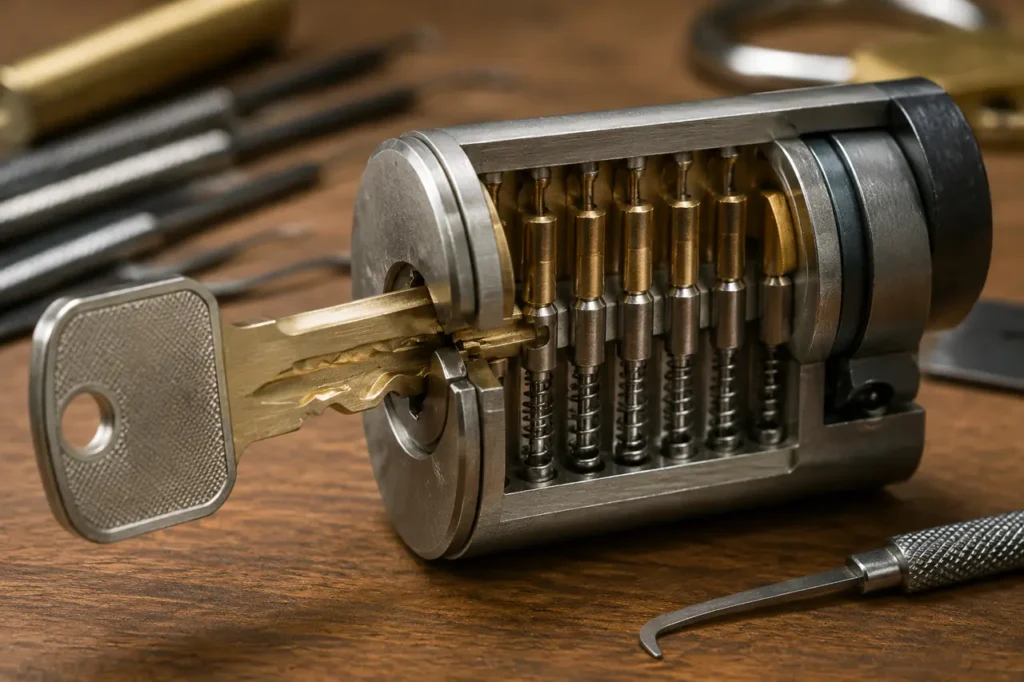
Inside a standard pin tumbler lock, a central plug sits inside an outer housing. Cylindrical chambers drilled vertically through the housing and plug hold two sets of pins: key pins at the bottom and driver pins at the top, kept under tension by small springs.
Under resting conditions, the driver pins straddle the boundary between the plug and the housing-known as the shear line-preventing the plug from turning.
Lock picking exploits the microscopic manufacturing imperfections in every mechanical cylinder. Because pin chambers are never drilled in a perfectly straight line, one pin will bind against the plug wall before the others when rotational torque is applied.
The picking process relies on this principle:
- Rotational Tension: A tension wrench applies slight rotational force to the plug, creating a tiny mechanical ledge at the shear line.
- Locating the Binding Pin: A metal pick (such as a hook or diamond) is inserted into the keyway to find the specific pin currently resisting movement.
- Setting Pins: As the pick lifts the binding pin, the driver pin crosses the shear line and rests on the ledge created by the turned plug. The spring tension holds the driver pin above the plug while the key pin falls back down.
- Repeating the Sequence: The lock picker repeats this tactile process for each remaining chamber until all driver pins sit above the shear line, freeing the cylinder to turn completely.
Because picking requires feeling subtle clicks and counter-rotations through thin metal picks, it requires steady hands, patience, and lock internal awareness. Well-made locks with tight machining tolerances significantly increase picking difficulty by minimizing the ledge that holds set pins.
How Lock Bumping Works (Kinetic Impact)
Lock bumping is a rapid mechanical bypass method that uses a specially crafted bump key and kinetic impact to momentarily throw all driver pins above the shear line.
The foundation of lock bumping is kinetic energy transfer-an elastic collision principle similar to the mechanics of a Newton’s cradle or a break shot in billiards.
The technique uses a “bump key,” a standard key blank matching the specific keyway profile, such as common residential keyways, with all pin positions cut to the lowest possible depth, often called a “999 key.”
The bypass sequence happens in a fraction of a second:
- The bump key is inserted into the keyway one notch short of full insertion, often cushioned by a small rubber O-ring or dampener.
- The user applies light, continuous rotational pressure to the key in the opening direction.
- The back of the key is struck cleanly with a light hammer, the handle of a heavy screwdriver, or a dedicated bumping tool.
- The impact drives the key inward, causing its cut ramps to strike the bottom key pins simultaneously.
- The key pins transfer their kinetic energy directly to the upper driver pins without moving upward significantly themselves. The driver pins launch upward into the lock housing chambers, compressing the top springs.
- For a fraction of a millisecond, a physical gap opens between the top driver pins and the bottom key pins directly at the shear line.
- The pre-applied rotational tension catches that momentary clearance, allowing the plug to turn and retract the locking mechanism.
Because the physical collision does the work of clearing the shear line across all chambers at once, lock bumping requires no internal picking skills. Anyone with the correct key blank profile and a few minutes of practice can open a standard unprotected pin tumbler lock.
The “Silent Threat”: Why Both Methods Leave Minimal Traces
A primary concern with both lock picking and lock bumping is that neither method relies on destructive physical force. Unlike drilling, cylinder snapping, or prying a door frame, covert bypass methods leave the lock mechanism intact and operational, creating distinct practical problems:
- Complications with Insurance Claims: Standard property insurance policies frequently demand physical evidence of forced entry (such as broken frames, shattered glass, or deformed deadbolt hardware) before approving residential theft claims. Because a picked or bumped door shows no external damage, documenting unauthorized entry for police reports and adjusters becomes difficult.
- Microscopic Internal Evidence: Physical evidence from picking or bumping is almost entirely microscopic. A bump key leaves slight brass indentations on the faces of the bottom pins and the front of the plug. Picks leave faint scrape marks inside the pin chambers. Detecting this requires full cylinder disassembly and forensic microscopic examination by a certified forensic locksmith.
- Delayed Discovery of Breaches: Because the lock functions normally with its standard key immediately after an attack, property owners may not realize an entry has occurred until missing inventory, cash, or valuables are discovered days or weeks later.
- Vulnerabilities in Hybrid Hardware: If an exterior entry utilizes smart locks with mechanical override keyways, the digital locking system remains vulnerable to physical covert bypass if the underlying mechanical cylinder lacks internal anti-bump protections.
How to Protect Your Doors Against Picking and Bumping
Defeating covert bypass techniques requires upgrading the internal pin geometry of your locks, restricting physical keyway access, or eliminating standard mechanical cylinders altogether.
Upgrade to High-Security Cylinders
Commercial-grade and high-security residential cylinders are designed to block both kinetic impact and precision picking. Many use secondary locking mechanisms, such as sidebars that interact with rotating pins or slider mechanisms.
Without the correct rotational angles on the key, the sidebar prevents the plug from turning even if the top pins clear the shear line.
When selecting hardware, verify compliance with established lock security standards, such as UL 437 listings or ANSI/BHMA Grade 1 certifications for bump and pick resistance.
Incorporate Security Pins
Standard locks use flat cylindrical driver pins. Replacing these with specialized security pins drastically increases picking and bumping resistance:
- Spool Pins: Shaped like an hourglass or thread spool, these pins tilt and catch on the edge of the plug when rotational tension is applied, creating a “false set” that prevents the plug from rotating without dropping other pins.
- Serrated Pins: Built with tiny horizontal grooves along their surface, serrated pins catch on the shear line ledge multiple times, confusing the tactile feedback required for picking and arresting kinetic jumps caused by bump keys.
- Mushroom Pins: Featuring an expanded head, these pins bind against the plug chamber lip during an attack, resisting rotational force.
Transition to Keyless Access Hardware
The most complete defense against lock picking and bumping is removing the traditional cylinder keyway. A fully integrated keyless entry system eliminates the physical aperture required for bump keys and lock picks.
For perimeter residential doors, commercial-quality smart deadbolt locks with encrypted keypad, biometric, or credential access make covert mechanical manipulation impossible.
For multi-unit properties, commercial buildings, or residential renovations requiring certified hardware, consult an established high-security smart lock supplier to specify pick-proof and bump-proof locking hardware suited to your entry requirements.
Frequently Asked Questions
Can a deadbolt be bumped?
Yes. If a deadbolt uses a standard pin tumbler cylinder without security pins or anti-bump mechanisms, it is vulnerable to bumping.
The strength of the deadbolt bolt does not protect the cylinder itself from kinetic energy bypass. Protection requires a deadbolt built with an anti-bump cylinder, spool pins, or a keyless design.
Are bump keys illegal to own?
In most jurisdictions, owning a bump key is legal provided there is no intent to use it unlawfully. However, local statutes vary.
Some regions classify unexplained possession of bump keys or lock picks outside a trade context as possession of burglary tools. Professional locksmiths and security technicians carry these tools routinely under trade licensing.
Does lock bumping work on all locks?
No. Bumping only works on standard pin tumbler cylinders. It has no effect on disc detainer locks, lever locks, warded locks, tubular locks, magnetic locks, or electronic smart locks that do not feature a standard keyed mechanical bypass.