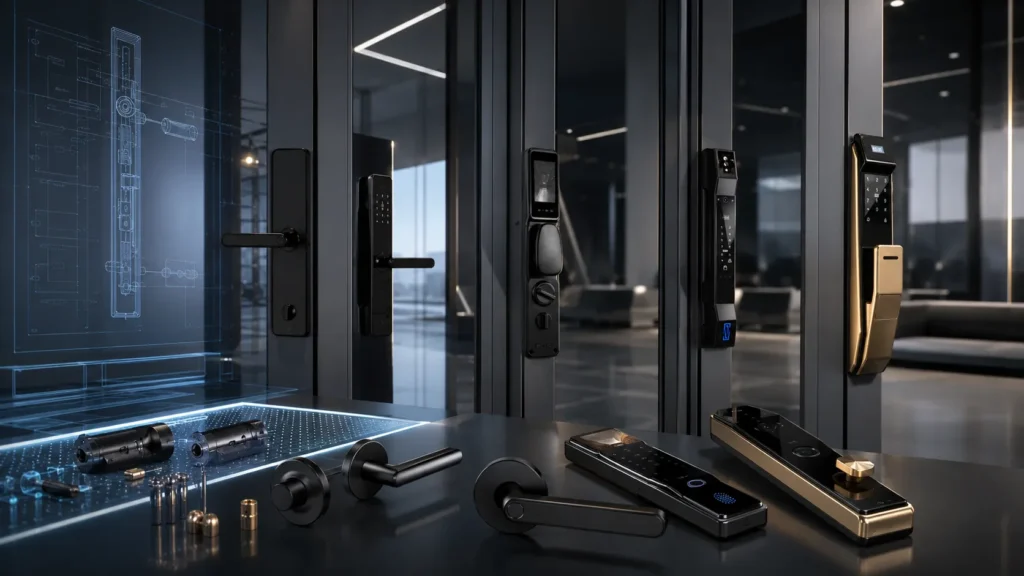
In keyless entry manufacturing, the shift from mechanical keys to electronic access isn’t just about convenience—it’s about integrating hardened hardware into enterprise security infrastructure. For security directors and facility managers, the investigation starts with manufacturing quality, not brand marketing.
This technical guide breaks down the core technologies, manufacturing standards, and encryption protocols that separate a durable, scalable commercial system from a disposable residential gadget. We focus on what procurement teams and integrators need to verify before selecting a keyless entry manufacturing partner.
Core Technologies in Keyless Access Manufacturing
A manufactured keyless entry system begins with a core access technology that dictates its range, security profile, and installation topology. The table below compares the primary architectures found in commercial-grade hardware, helping you align technology to threat model and facility layout.
| Technology Type | Typical Range | Security Level | Primary Commercial Use-Case |
|---|---|---|---|
| RFID (13.56 MHz / 125 kHz) | 1–10 cm (proximity) | Medium | Employee badge access, elevator control, parking garages |
| Bluetooth Low Energy (BLE) | 10–30 m (adjustable) | High | Mobile credentials, touchless entry, high-traffic office lobbies |
| Biometric (Fingerprint, Iris) | Contact / near-contact | High | Data centers, R&D labs, pharmaceutical storage |
| NFC | 1–4 cm | Medium-High | Smartphone-based access, multi-tenant offices, shared workspaces |
Note: Security levels and range depend on specific reader models, firmware configurations, and credential management architecture. Always request third-party penetration test reports from your keyless entry manufacturing partner before final selection.
Manufacturing Standards for Security and Durability
In industrial environments, a keyless entry device is as much a physical barrier as a traditional lock. Ingress protection, impact resistance, and electronic tamper ratings directly determine whether hardware survives installation or becomes a maintenance liability. Apply the standards below when evaluating any electronic door lock factory.
| Standard | What It Measures | Recommended Minimum for Industrial Use |
|---|---|---|
| IP Rating (IEC 60529) | Resistance to solid objects and liquids (e.g., IP65, IP67) | IP65 for outdoor gates and loading docks; IP66 for washdown areas |
| IK Rating (IEC 62262) | Mechanical impact resistance (e.g., IK08, IK10) | IK08 for high-traffic corridors; IK10 for public parking and exterior perimeters |
| UL 294 | Access control system endurance, tamper performance, and line security | Level 3 (Destructive Attack) for external doors; Level 1 minimum for interior doors |
| FCC Part 15 / CE RED | Radio frequency emission compliance | Required for any wireless keyless entry device in North America / EU markets |
Note: Ratings should be verified against the manufacturer’s latest test certificates. Many OEM lock manufacturing partners offer custom IP/IK testing for specific deployment environments—request batch test reports before accepting a shipment.
Encryption Protocols and Data Integrity
The chipset and firmware inside a keyless reader are the real attack surface. Physical durability means nothing if the credential exchange is vulnerable to relay or replay attacks.
Your manufacturing partner should demonstrate protocol-level security, not just mention “encryption” in a datasheet. Key technical markers to verify include:
- AES-128/256 hardware acceleration: Look for reader modules that perform encryption at the silicon level, not in application code. AES-256 is preferred for government-regulated installations.
- Rolling codes: Ensures each keyless entry transaction uses a unique code, making captured signals useless. Verify the code algorithm is seeded with sufficient entropy to prevent brute-force attacks.
- OSDP (Open Supervised Device Protocol) vs. Wiegand: OSDP provides bi-directional, encrypted communication between reader and controller, replacing the unencrypted, one-way Wiegand protocol that is trivial to sniff. Insist on native OSDP support from the factory, not via an add-on converter.
- Secure element storage: Credentials and encryption keys should reside in a dedicated tamper-resistant chip, not in general-purpose memory.
Buyer warning: Some “OSDP-ready” readers still ship with Wiegand as default. Confirm the default communication mode and encryption settings during sample testing, not from a brochure.
Scalability and Infrastructure Integration
A well-manufactured keyless entry system doesn’t require a forklift upgrade of your existing building management stack. Scalability is a function of the hardware’s protocol support and edge computing capabilities, not the cloud dashboard.
Key integration factors to verify with the manufacturer:
- API and SDK availability: Confirm the access controller provides a documented, versioned REST API for HR onboarding/offboarding automation and visitor management software integration.
- Power over Ethernet (PoE) 802.3af/at support: For large-scale deployments, PoE eliminates separate power supplies and simplifies fire alarm integration. Verify the lock controller’s power budget and cable length limits from the factory’s electrical design spec.
- Legacy credential compatibility: If migrating from 125 kHz Prox cards, request dual-frequency readers that support both low-frequency legacy and high-frequency secure credentials without hardware swaps.
- Cloud vs. on-premise architecture: For facilities with strict data residency requirements, confirm the manufacturer offers an on-premise controller option with local credential storage, not just a cloud-only hub. Ask about fail-over behavior if the WAN link drops.
For large-scale projects, understanding the difference between OEM vs ODM manufacturing is essential when you need custom firmware behavior or specific controller integrations baked into the hardware, not layered on later. Many facility teams underestimate the lead time for customized firmware until it’s too late, so engage your professional OEM lock manufacturing partner early for a technical scoping call.
Procurement Checklist: Evaluating a Manufacturing Partner
Use this checklist during the vendor evaluation and RFP stage. Each item targets a common point where a low-cost supplier cuts corners that reveal themselves only after installation.
- Certification documentation: Does the factory provide up-to-date UL 294, CE/RED, FCC, and IP test certificates from an accredited third-party lab? Request the actual test reports, not just a logo on a datasheet.
- Firmware update mechanism: How are firmware patches delivered? Is there a signed update process, or are devices left with a universal default password? Confirm the manufacturer’s vulnerability disclosure policy and historical patch cadence.
- Multi-factor authentication (MFA) support: Can the hardware natively enforce PIN + credential or biometric + card without relying on a software plugin? Check anti-tamper triggers that wipe local data after repeated attack attempts.
- Hardware backdoor testing: Has the PCB been audited for JTAG/SWD debug ports left accessible? Request an independent hardware security assessment for the specific batch you’re evaluating.
- Lead times and minimum order quantities: For 500+ lock deployments, reducing lead times in manufacturing can make or break a construction timeline. Confirm the factory’s worst-case lead time, not best-case, and ask about buffer stock agreements for ongoing projects.
- Customization capabilities: If you need specific card reader colors, dome styles, or custom silkscreening, verify whether the OEM lock manufacturing partner has in-house tooling or relies on subcontracted finishing, which can add variability.
Also, review top smart lock manufacturers for quality and security to benchmark how your shortlisted facilities compare on open disclosure of third-party certifications and hardware lifecycle management.
Request a Technical Specification Brief
Your final system selection shouldn’t depend on a single comparison chart. An accurate evaluation requires full hardware specification sheets, wiring diagrams, and detailed controller datasheets—documents that separate an engineered access solution from an off-the-shelf gadget.
For teams working on a campus-wide deployment, custom reader design, or multi-site rollout, we provide technical briefs covering materials, PCB design for keyless entry options, power management, and compliance test results. If biometric authentication is part of your scope, our biometric lock manufacturing team can supply sample units with anti-spoofing test data.
We also offer cost-effective wholesale options for qualified integrators and distributors. Contact our engineering team to schedule a technical consultation and receive architecture-specific hardware recommendations for your next project.
Frequently Asked Questions
What is the difference between active and passive keyless entry in a commercial context?
Active keyless entry requires the user to press a button on a fob or mobile credential to initiate the unlock, typically using BLE or RFID. Passive keyless entry detects an authorized credential as the user approaches and unlocks without physical interaction—common in hands-free hospital access and cold storage doors—but requires tighter proximity calibration and anti-relay-attack countermeasures in manufacturing.
How does OSDP improve upon the traditional Wiegand protocol?
Wiegand is a one-way, unencrypted protocol that sends raw credential data to the controller, easily intercepted. OSDP provides bi-directional, AES-128 encrypted communication, allowing the reader and controller to mutually authenticate. OSDP also enables remote reader firmware updates and tamper status monitoring, which Wiegand cannot support.
Can manufactured keyless systems be integrated with existing CCTV hardware?
Yes, through centralized access control software platforms that ingest event streams from the keyless entry controller and correlate them with CCTV video feeds. A well-manufactured controller will support standard ONVIF Profile integration or provide an API that allows VMS (Video Management System) platforms to pull access events and trigger camera recording based on door forced-open or unauthorized credential events.